 listicle
5 Energy Efficient Lighting Solutions for Warehouses
Table of Contents
- Why Warehouse Lighting Upgrades Pay for Themselves
- 5 Energy Efficient Warehouse Lighting Solutions Ranked
- Warehouse Lighting Design Standards You Must Meet
- How Warehouse Lighting Motion Sensors Reduce Energy Waste
- Commercial Lighting Energy Rebates: How to Claim Them
- ROI Calculation: Estimating Your Payback Period
- Maintenance Schedules That Protect Your Lighting Investment
- Frequently Asked Questions
Last Updated: August 25, 2026
Warehouse lighting is one of the largest controllable energy expenses a facility carries, yet most operations run outdated equipment that wastes significant portions of their utility budgets. This guide covers the 5 energy efficient lighting solutions for warehouses that deliver the strongest results, along with design standards, sensor strategies, and ROI math you need to justify the investment internally.
Quick Picks:
- Best Overall: LED high bay fixtures, highest lumen output, longest lifespan, widest compatibility
- Best for Existing Infrastructure: LED retrofit kits, upgrade without full fixture replacement
- Best for Immediate Waste Reduction: Occupancy and motion sensor controls, cut energy use in unoccupied zones automatically
- Best for Daylight-Heavy Facilities: Daylight harvesting and dimming systems, match artificial light to available natural light
- Best for Long-Term Facility Management: Smart IoT-integrated lighting systems, centralized control and data-driven scheduling
Why Warehouse Lighting Upgrades Pay for Themselves
Lighting accounts for a substantial share of a commercial facility's electricity bill. Warehouses are particularly exposed because of their operating hours, ceiling heights, and large floor areas. Lower wattage per fixture multiplied across hundreds of fixtures running 10-16 hours daily produces meaningful savings on every monthly utility statement.
Poor illumination also leads to picking errors, missed hazards, and slower movement through aisles. The Illuminating Engineering Society lighting recommendations establishes foot-candle requirements for different warehouse tasks because the connection between illumination levels and worker performance is well-documented.
Most warehouse lighting upgrades achieve payback in a timeframe that justifies the investment straightforwardly. Combine utility savings with available commercial lighting energy rebates, and net project cost drops further. Facilities that add occupancy sensors and dimming controls on top of LED fixtures see the strongest results because they attack energy consumption from two directions: reducing wattage and reducing runtime.
5 Energy Efficient Warehouse Lighting Solutions Ranked
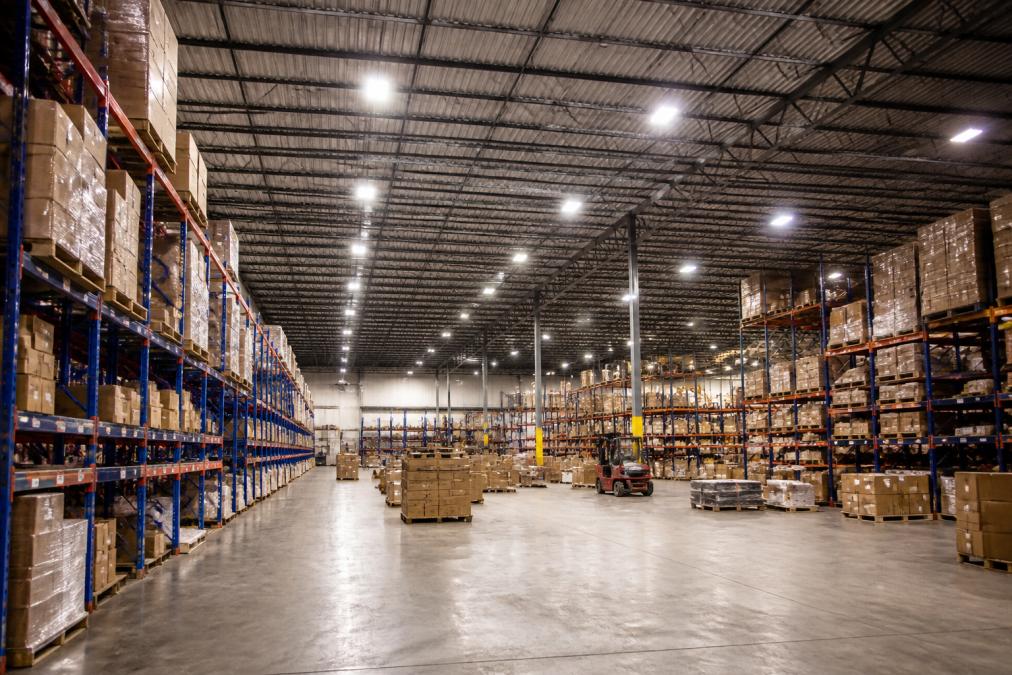
1. LED High Bay Fixtures
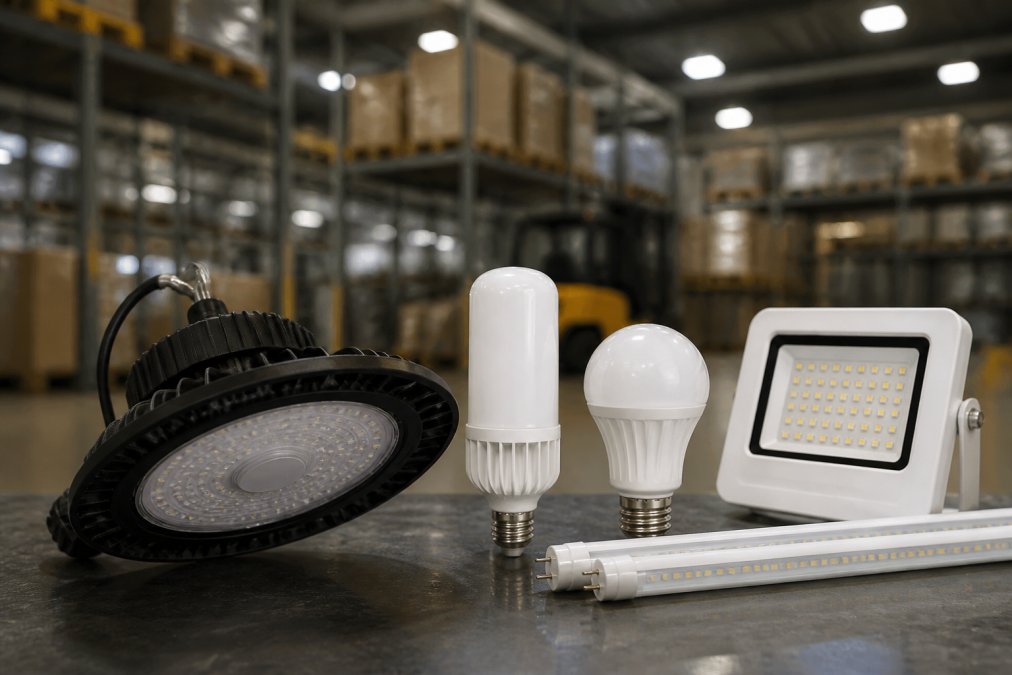
LED high bay fixtures are the foundation of any warehouse energy efficiency upgrade. They are engineered for ceiling heights above 20 feet, delivering high lumen output at a fraction of the wattage required by metal halide or high-pressure sodium alternatives. A 150-watt LED high bay typically replaces a 400-watt metal halide fixture while maintaining equivalent or better illumination.
What to evaluate when selecting LED high bay fixtures:
- Lumen output: Match to your ceiling height and required foot-candles for the task area
- Color temperature: 5000K is standard for warehouses, reading as daylight-neutral
- CRI (Color Rendering Index): 80 or above ensures accurate color rendering for inventory identification
- Beam angle: Narrow angles concentrate light in tall aisles; wide angles suit open floor areas
- Fixture efficacy: Look for fixtures rated above 130 lumens per watt
- Thermal management: Quality fixtures manage heat through aluminum housings; poor thermal management shortens lifespan
Pros: Longest lifespan (50,000+ hours), significant wattage reduction, minimal maintenance, compatible with dimming controls and occupancy sensors.
Cons: Higher upfront fixture cost; full installation requires licensed electrical work.
2. LED Retrofit Kits for Existing Fixtures
LED retrofit kits allow you to upgrade the light source inside an existing fixture housing, preserving mounting infrastructure while capturing most energy savings of a full replacement. This suits facilities where fixture housings are sound but lamps are outdated, common in buildings with fluorescent T8 or T5 systems from the 2000s.
Pros: Lower material cost than full fixture replacement, faster installation with less operational disruption, retains existing mounting points and wiring.
Cons: Fixture housing age limits the lifespan benefit of the new LED source; not suitable for high-bay applications.
3. Occupancy and Motion Sensor Controls
Occupancy sensors detect movement and switch or dim lights in unoccupied zones automatically, eliminating energy consumption in aisles, loading bays, and storage areas that sit empty for hours. For warehouses with variable foot traffic, occupancy sensors are standard.
Pros: Immediate runtime reduction with no behavior change required, compatible with both new LED installations and existing fixtures, scalable deployment.
Cons: Requires proper placement to avoid false-off events in slow-moving areas; timeout settings need calibration to your traffic patterns.
4. Daylight Harvesting and Dimming Systems
Daylight harvesting uses photosensors to measure available natural light and automatically dim artificial lighting to compensate. The result is consistent illumination levels regardless of time of day or cloud cover, with energy consumption that scales down whenever the sun does the work. LEDs dim efficiently without color shift or warm-up time.
Pros: Maintains consistent foot-candle levels automatically, reduces energy consumption during daylight hours, extends fixture lifespan by reducing operating hours at full output.
Cons: Requires careful photosensor placement; higher upfront cost than basic on/off sensor controls; most effective in facilities with meaningful skylight coverage.
5. Smart IoT-Integrated Lighting Systems
Smart IoT-integrated lighting systems connect individual fixtures to a central software interface, enabling scheduling, zone control, real-time energy monitoring, and integration with building management systems. According to the Department of Energy's Connected Lighting Systems guidance, networked lighting controls consistently deliver greater energy savings than standalone sensor or dimming solutions.
Pros: Centralized control across the entire facility, real-time data on energy consumption by zone, supports integration with occupancy data and HVAC systems, strongest platform for ongoing facility management.
Cons: Highest upfront cost, requires network infrastructure and ongoing software management, full value realized over years.
| Solution | Best For | Energy Impact | Upfront Cost | Complexity |
|---|---|---|---|---|
| LED High Bay Fixtures | Full facility upgrades | Very High | Moderate-High | Low-Moderate |
| LED Retrofit Kits | Existing fixture upgrades | High | Low-Moderate | Low |
| Occupancy/Motion Sensors | Runtime reduction | High | Low | Low |
| Daylight Harvesting/Dimming | Skylight-equipped facilities | Moderate-High | Moderate | Moderate |
| Smart IoT Systems | Facility-wide management | Very High | High | High |
Warehouse Lighting Design Standards You Must Meet
Warehouse lighting design standards define the minimum illumination levels required for safe operations. The Illuminating Engineering Society's RP-7 standard for industrial facilities specifies foot-candle requirements by task type. General warehouse storage areas typically require 10-30 foot-candles at the working plane, while inspection, assembly, and fine picking tasks require 50 foot-candles or more.
OSHA's General Industry standards reinforce these requirements from a safety compliance angle. Inadequate illumination is a citable hazard, and facilities that experience accidents in poorly lit areas face compounded liability exposure. The OSHA lighting requirements for general industry sets minimum standards your lighting design must satisfy.
Key design parameters to document before installation:
- Foot-candle targets by zone: Storage, picking, receiving, shipping, and office areas each carry different requirements
- Uniformity ratio: The ratio of average to minimum illumination across a zone; IES recommends no worse than 3:1 for most warehouse tasks
- Mounting height: Determines the fixture type, beam angle, and spacing needed to achieve target foot-candles at floor level
- Ambient lighting versus task lighting: High bay fixtures handle ambient illumination; task lighting supplements at workstations
A lighting design that meets IES and OSHA standards positions your facility for maximum rebate eligibility, since utility programs typically require documentation of pre- and post-installation illumination levels.
How Warehouse Lighting Motion Sensors Reduce Energy Waste
Warehouse lighting motion sensors reduce energy waste by ensuring fixtures operate only when occupancy justifies it. In a typical warehouse, a significant portion of the lit floor area is unoccupied at any given time, storage aisles between picks, loading docks between shipments, break rooms between shifts.
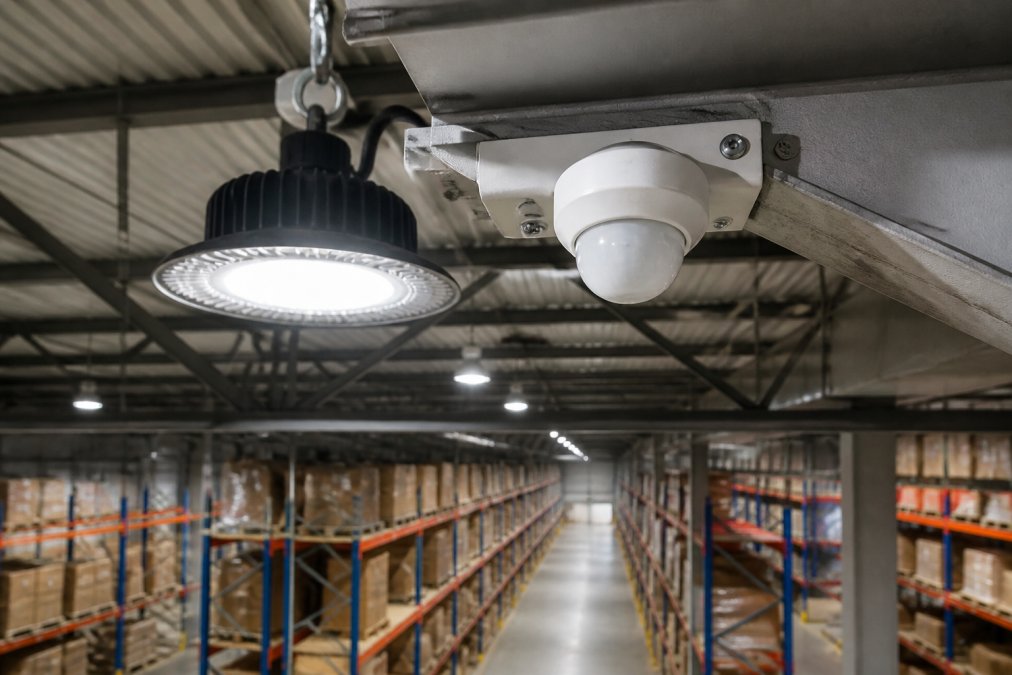
Sensors deployed in these zones capture that waste directly. The fixture dims or switches off after a configurable timeout, typically 5 to 15 minutes for warehouse aisles, and restores full output instantly when motion is detected.
Placement determines performance. Passive infrared sensors read lateral movement most reliably; ultrasonic sensors cover a wider detection pattern and are often preferred for complex aisle geometries.
Sensor configuration checklist:
- Set timeout periods based on actual traffic data, not default factory settings
- Test detection coverage at the extremes of each aisle before finalizing placement
- Configure dimming-to-low rather than full shutoff in high-traffic transition zones
- Integrate sensors with your smart lighting platform if IoT controls are installed
- Document sensor locations and settings for maintenance records
The combination of LED high bay fixtures and occupancy sensors is the most widely deployed pairing in warehouse energy upgrades, addressing both wattage and runtime reduction.
Commercial Lighting Energy Rebates: How to Claim Them
Commercial lighting energy rebates are incentive payments from utility companies or state energy programs that offset upfront upgrade costs. Most utilities offer prescriptive rebates, fixed amounts per fixture replaced or per watt reduced, that significantly strengthen the financial case for LED upgrades.
The rebate process:
- Conduct a pre-installation energy audit. Document existing fixture types, wattages, quantities, and operating hours.
- Verify product eligibility. Most programs require DLC (DesignLights Consortium) or ENERGY STAR certification.
- Submit a pre-approval application. Some programs require approval before installation begins.
- Complete installation with licensed electrical contractors. Utilities may require proof of licensed installation.
- Submit post-installation documentation. Invoices, product specifications, and sometimes post-installation illumination measurements are required.
- Receive rebate payment. Processing times typically range from 4 to 12 weeks.
State-level programs supplement utility rebates in many markets. The DSIRE database of state and utility energy efficiency programs identifies what's available in your jurisdiction.
ROI Calculation: Estimating Your Payback Period
ROI calculation for warehouse lighting upgrades follows a straightforward methodology. The payback period is the number of years it takes for cumulative energy savings to equal the net project cost after rebates.
Payback Period = Net Project Cost / Annual Energy Savings
Where:
- Net Project Cost = Total installation cost minus utility and state rebates
- Annual Energy Savings = (Watts reduced per fixture × Number of fixtures × Daily operating hours × Annual operating days) / 1,000 × Electricity rate per kWh
Example framework:
| Variable | Example Value | Your Value |
|---|---|---|
| Fixtures upgraded | 200 | ___ |
| Watts reduced per fixture | 250W | ___ |
| Daily operating hours | 14 hours | ___ |
| Annual operating days | 300 days | ___ |
| Electricity rate ($/kWh) | Check utility bill | ___ |
| Gross project cost | Get licensed quote | ___ |
| Utility rebate | Verify with utility | ___ |
| Net project cost | Gross minus rebate | ___ |
A complete ROI model includes energy savings, maintenance cost reduction (LED fixtures require significantly less frequent lamp replacement), and reduced lamp disposal costs. Most facility managers find that energy savings alone justify the project.
Maintenance Schedules That Protect Your Lighting Investment
LED fixtures don't fail dramatically; they degrade gradually. Lumen depreciation, the gradual reduction in light output over time, means a fixture that passes initial inspection may fall below IES foot-candle requirements years later without anyone noticing.
Recommended maintenance schedule for warehouse LED lighting:
| Task | Frequency | Notes |
|---|---|---|
| Visual inspection of all fixtures | Quarterly | Check for physical damage, discoloration, flickering |
| Lens and diffuser cleaning | Semi-annually | Dust accumulation reduces lumen output meaningfully |
| Photometric verification (foot-candle measurement) | Annually | Confirm illumination levels still meet IES and OSHA requirements |
| Sensor calibration check | Annually | Verify timeout settings, detection coverage, and dimming response |
| Smart system firmware updates | As released | IoT platforms require current firmware for security and performance |
| Full system energy audit | Every 3-5 years | Identify degraded fixtures, assess technology upgrades |
Lens cleaning deserves more attention than most maintenance plans give it. In a warehouse environment, airborne dust, forklift exhaust, and packaging particulates accumulate on fixture lenses faster than in clean commercial spaces.
Mister Volts provides licensed electrical services for commercial and industrial facilities, including lighting system installation, sensor integration, and compliance inspections. If your facility is planning an upgrade or needs a current system evaluated against IES and OSHA standards, our team handles the full scope from initial assessment through final documentation for rebate submission.
Frequently Asked Questions
What type of lighting is best for a warehouse?
LED high bay fixtures are the top choice for most warehouses. They deliver high lumen output at lower wattage than metal halide or fluorescent alternatives, produce minimal heat, and last 50,000 hours or more. For areas below 15 feet, LED low bay or LED tube lights work well. The right choice depends on ceiling height, aisle width, and the foot-candle levels required by your operation and IES standards.
What is the recommended foot-candle level for warehouse aisles?
The Illuminating Engineering Society (IES) recommends a minimum of 20 to 30 foot-candles for general warehouse storage aisles and 50 foot-candles for active picking and packing areas. Loading docks typically require 30 foot-candles. OSHA's general industry standards also reference adequate illumination for worker safety. An energy audit or photometric plan from a licensed electrician can confirm your facility meets these illumination levels before and after an upgrade.
How do motion sensors improve warehouse energy efficiency?
Occupancy sensors cut energy consumption by turning lights off or dimming them in unoccupied aisles, which can account for 30% or more of a warehouse's total lit space at any given time. Paired with LED high bay fixtures, motion sensor controls can reduce lighting energy use significantly compared to fixtures that run continuously. They also extend fixture lifespan because fewer operating hours mean less wear on the LED driver and thermal management components.
Are there rebates available for upgrading warehouse lighting?
Yes. Most major utilities offer commercial lighting energy rebates for switching to LED fixtures, adding dimming controls, or installing occupancy sensors. Rebate amounts vary by utility, fixture type, and wattage reduction. The federal government's 179D commercial energy efficiency tax deduction may also apply to qualifying lighting upgrades. Contact your utility's energy efficiency program or a licensed electrician familiar with facility management upgrades to identify which incentives apply to your project.
How can I reduce energy consumption in my warehouse lighting without a full replacement?
LED retrofit kits are the fastest path to lower energy consumption without replacing entire fixtures. A retrofit replaces the internal components of an existing high bay or fluorescent fixture with an LED module, cutting wattage while reusing the housing. Adding dimming controls and warehouse lighting motion sensors to existing LED or retrofitted fixtures can reduce consumption further. An energy audit identifies which zones offer the biggest savings before you commit to any equipment.