
 ultimate-guide
Industrial Warehouse Lighting Maintenance: Best Practices
Table of Contents
- Why Warehouse Lighting Maintenance Matters
- OSHA Warehouse Lighting Standards and Compliance
- Essential Warehouse Lighting Maintenance Checklist
- Energy Efficient Lighting Solutions for Warehouses
- Inspection and Testing Procedures for Fixture Failure
- Repair vs. Replace: Cost-Benefit Analysis
- Safety Protocols for High-Bay Lighting Work
- Frequently Asked Questions
Last Updated: September 30, 2026
Why Warehouse Lighting Maintenance Matters
Proper warehouse lighting maintenance directly impacts operational safety, inventory accuracy, and energy costs. When fixtures fail or performance degrades, picking errors increase, accident rates rise, and your facility consumes more electricity to maintain the same visibility. A single high-bay fixture that's dimmed by dust accumulation or a failing driver can reduce foot candles by 20-30%, forcing workers to move more slowly and making visual acuity tasks harder.
The challenge is deciding which maintenance tasks matter most. A distribution center running 24/7 with dense racking needs a different schedule than a lower-density storage facility. We've developed maintenance protocols that balance safety compliance, energy efficiency, and cost control.
Neglecting warehouse lighting maintenance creates cascading problems: fixtures fail suddenly instead of predictably, emergency replacements cost more, and downtime disrupts shipping schedules. A preventative approach catches issues early, extends fixture lifespan, and keeps your team safe.
OSHA Warehouse Lighting Standards and Compliance
OSHA references ANSI standards for adequate illumination. ANSI recommends 30 foot candles minimum for general storage, 50-100 for picking and inspection tasks, and 50+ for high-bay facilities depending on the task.
Lighting must be adequate for the work being performed. Regular inspection of fixture output, CRI, and color temperature ensures worker safety and prevents slips, trips, falls, and picking errors.
Fixtures must be properly grounded, wiring in good condition, and modifications must comply with the NEC. High-bay systems under extended load require regular electrical testing. Proper circuit breakers and service panels are essential to safe warehouse electrical infrastructure and should be inspected as part of your annual safety audit.
Essential Warehouse Lighting Maintenance Checklist
A structured maintenance schedule prevents reactive repairs and keeps your facility compliant. The checklist below divides tasks by frequency and scope.
Monthly Inspection Tasks
Inspect fixture shielding, lens clarity, and mounting hardware. Dust accumulation on lenses and reflectors is the primary cause of light output loss. Check for visible damage, flickering, discoloration, or unusual sounds from ballasts or drivers.
Test fixtures with a light meter and compare to baseline. A drop of more than 10% suggests cleaning or component replacement is needed.
Document observations to reveal patterns in fixture degradation and inform maintenance budgets.
Quarterly Deep-Cleaning Procedures
Dust accumulation reduces warehouse lighting performance. Quarterly cleaning restores output without replacing fixtures.
Turn off power and use a lift or scaffolding for high-bay fixtures.
Annual Electrical and Safety Audits
Conduct annual electrical inspections to catch wiring damage, loose connections, and driver failures.
Energy Efficient Lighting Solutions for Warehouses
LED technology and smart controls reduce energy costs and maintenance labor. Proper disposal of old fixtures and predictive maintenance technologies further optimize performance and extend asset life.
LED Retrofit Benefits and ROI
LED fixtures consume 40-60% less energy than metal halide or fluorescent systems. LED fixtures consume 40-60% less energy than metal halide or fluorescent systems.
Occupancy Sensors and Smart Controls
Occupancy and daylight harvesting sensors reduce energy waste by automatically dimming or turning off lighting in unoccupied zones and during daytime hours.
Predictive Maintenance Using IoT Sensors
Predictive maintenance uses sensors to monitor fixture health and alert you to problems before failure, shifting from reactive to proactive maintenance.
Sustainability: Proper Disposal and Recycling of Old Fixtures
Proper fixture disposal is a regulatory and financial responsibility.
Hazardous Materials in Old Fixtures
Metal halide and fluorescent lamps contain mercury; older ballasts contain PCBs. Improper disposal violates EPA regulations and can result in fines.
Recycling and Disposal Options
Financial Incentives for Recycling
Inspection and Testing Procedures for Fixture Failure
Knowing how to diagnose fixture problems helps you decide whether to repair or replace, and it prevents unnecessary downtime.
https://mistervoltsusa.com/contact →
Visual Assessment Techniques
Check if the fixture produces light. If not, verify power at the circuit breaker using a non-contact voltage tester.
Electrical Component Testing
Use a multimeter to test voltage and continuity. Fluctuating voltage suggests a wiring issue or failing driver.
Repair vs. Replace: Cost-Benefit Analysis
Repair versus replace decisions require structured financial analysis using total cost of ownership (TCO) rather than reactive, lowest-cost choices.
Total Cost of Ownership Framework
Repair Cost vs. Replacement Cost
For LED fixtures under 10 years old, component replacement is usually cost-effective versus new fixtures. However, address root causes like environmental stress before deciding.
Energy Consumption Over Remaining Life
Maintenance Labor Costs
Downtime and Operational Risk
TCO Calculation Example
Assume a 400-watt metal halide fixture, 8 years old, currently failing. You can repair the ballast or replace with a 150-watt LED.
Repair scenario (2-year remaining life assumption):
- Repair cost:
- Energy cost (2 years):
- Maintenance labor (1 additional repair likely):
- Downtime risk:
- Total:
Replace scenario (10-year LED lifespan):
- Replacement cost:
- Energy cost (10 years):
- Maintenance labor (minimal):
- Downtime risk:
- Total:
Decision Rules
Replace immediately if:
- The fixture is 15+ years old
- Repair cost exceeds 40% of replacement cost
- The fixture has failed more than twice in the past 3 years
- The fixture is in a critical zone where downtime is costly
- You're already planning a facility upgrade or zone renovation
Repair if:
- The fixture is under 10 years old
- Repair cost is less than 25% of replacement cost
- The fixture has not failed before
- The fixture is in a low-risk zone (storage, low traffic)
- You have a tight capital budget this year
Create a replacement schedule based on fixture age and performance data. Fixtures that dim fastest, fail most often, or are oldest should be prioritized. This spreads capital costs over time and prevents sudden, expensive replacement campaigns. Track which fixture types, brands, and mounting locations fail first, this data informs future procurement decisions and helps you avoid repeating expensive mistakes.
Safety Protocols for High-Bay Lighting Work
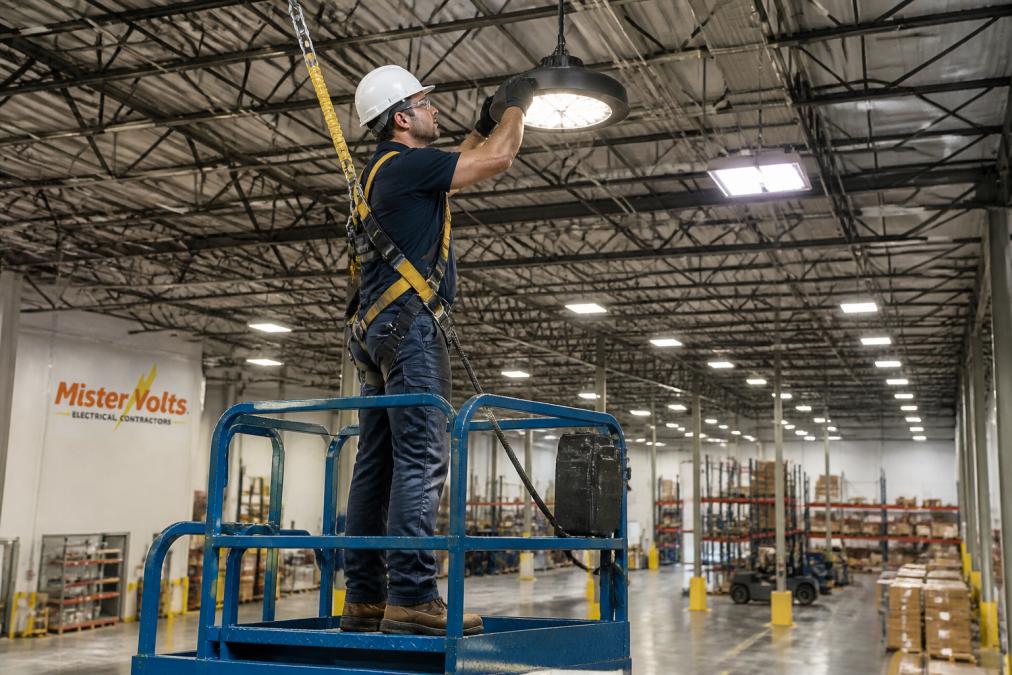
Working at heights to maintain or replace high-bay fixtures requires strict safety discipline. Falls are the leading cause of serious injuries in warehouse maintenance.
Frequently Asked Questions
What are the OSHA requirements for warehouse lighting?
OSHA does not mandate specific foot-candle levels for warehouses but requires adequate illumination for safe operations. The American National Standards Institute (ANSI) recommends 30 foot-candles for general warehouse areas and 50 foot-candles for detailed tasks like order picking. Your facility must provide enough light for workers to see hazards, read labels, and move safely. Consult with a licensed electrician to assess your warehouse lighting maintenance needs and ensure compliance with local electrical codes.
What is the recommended foot-candle level for warehouse aisles?
Warehouse aisles typically require 30 foot-candles of illumination for safe navigation and general material handling. Areas with detailed work, such as packing stations or inventory verification zones, should have 50 foot-candles or higher. High-bay lighting systems using LED fixtures can achieve these levels while reducing energy consumption compared to older halogen or sodium-vapor fixtures. Proper warehouse lighting maintenance ensures consistent foot-candle output and prevents dark spots that create safety risks.
How often should industrial warehouse lights be inspected?
Conduct visual inspections monthly to check for loose fixtures, visible damage, or flickering. Perform quarterly deep cleaning of fixtures and lenses to remove dust and debris that reduce light output due to lumen depreciation. Schedule annual electrical inspections by a licensed electrician to test ballasts, drivers, and wiring. High-traffic or high-temperature zones may require more frequent checks. A structured warehouse lighting maintenance checklist ensures no critical components are overlooked and helps identify fixture failure before it creates safety or operational issues.
What are the benefits of switching to LED for warehouse lighting?
LED retrofit projects deliver significant long-term savings through reduced energy consumption, lower maintenance costs, and extended fixture lifespan. LEDs consume less energy than traditional high-intensity discharge (HID) fixtures and last longer than older bulbs. They produce less heat, improving thermal management in your facility and reducing cooling costs. LEDs also provide better color rendering index (CRI) and eliminate flicker, improving worker visibility and reducing eye strain. Energy efficient lighting solutions for warehouses can pay for themselves through utility savings alone.
How does proper lighting maintenance impact workplace safety?
Inadequate or failing warehouse lighting increases trip-and-fall accidents, forklift collisions, and inventory errors. Proper warehouse lighting maintenance ensures consistent illumination across aisles, storage zones, and work areas, helping workers identify hazards and navigate safely. Well-maintained fixtures with correct color temperature and CRI improve visual acuity, reducing errors in order picking and quality inspection. Regular electrical safety inspections catch potential fire hazards from faulty wiring or driver failure. A comprehensive maintenance program directly reduces accident rates, workers' compensation claims, and operational downtime.
What should I look for in a warehouse lighting maintenance contractor?
Choose a licensed electrician with experience in commercial and industrial facilities who understands NEC compliance and OSHA standards. They should provide a detailed warehouse lighting maintenance checklist, schedule regular inspections, and offer both preventative maintenance contracts and emergency repair services. Ask about their experience with LED retrofit projects and energy efficient lighting solutions for warehouses. Verify they can perform electrical safety audits, load testing, and circuit inspections. A reliable contractor will provide upfront quotes, respect your operational schedule, and offer warranties on their work to minimize future downtime.
How do you troubleshoot flickering high-bay warehouse lights?
Flickering typically indicates driver failure, loose connections, or ballast issues in older fixtures. Start by checking that all wiring connections at the fixture and breaker panel are tight. If flickering persists, the driver or ballast may be failing and require replacement. In LED systems, flicker reduction features should be verified during electrical inspection. Loose mounting hardware can also cause intermittent contact. If multiple fixtures flicker simultaneously, the issue may be a failing circuit breaker or main panel connection. A licensed electrician can diagnose the cause quickly using specialized testing equipment and prevent further damage.