
 ultimate-guide
LED Warehouse Lighting Retrofits: Benefits & ROI Guide
Table of Contents
- Why LED Warehouse Lighting Retrofits Matter for Operations
- Energy Consumption Reduction and Cost Savings
- Improved Lighting Quality, Visibility, and Workplace Safety
- LED Retrofit vs Full Fixture Replacement: Which Approach Fits Your Facility
- OSHA Lighting Requirements for Warehouses and Compliance
- Commercial Lighting Rebate Programs and Financial Incentives
- Total Cost of Ownership and Return on Investment Timeline
- Frequently Asked Questions
Last Updated: September 18, 2026
Why LED Warehouse Lighting Retrofits Matter for Operations
LED warehouse lighting retrofits replace older fluorescent or incandescent fixtures with modern LED technology, cutting operational costs while improving safety and productivity by reducing energy consumption, maintenance, and equipment replacement cycles.
Older lighting systems waste energy, require frequent maintenance, and create dark corners that compromise safety. LED warehouse lighting retrofits eliminate these inefficiencies while delivering measurable financial returns.
Energy Consumption Reduction and Cost Savings
LED fixtures consume significantly less power than fluorescent or incandescent alternatives. Where a traditional 400-watt metal halide fixture might illuminate a warehouse section, an LED equivalent delivers the same or better illumination at 150-200 watts. That difference compounds across dozens or hundreds of fixtures operating 24/7.
Energy savings translate directly to lower utility bills. A facility with 100 fixtures running 16 hours daily will notice the difference within the first billing cycle after retrofit completion.
Beyond the monthly savings, LED fixtures have longer rated life hours, which reduces the frequency of replacements. Fluorescent tubes typically last 10,000-15,000 hours; quality LED fixtures rated for 50,000+ hours mean fewer relamping cycles, lower labor costs for maintenance, and less operational disruption from equipment changes.
Improved Lighting Quality, Visibility, and Workplace Safety
Poor lighting creates operational blind spots, literally. Dark corners in warehouse aisles increase accident risk, slow inventory location, and reduce picking accuracy. LED warehouse lighting retrofits eliminate these visibility problems by delivering consistent, high-quality illumination across the entire facility.
Color temperature (measured in Kelvin) and Color Rendering Index (CRI) directly impact how workers perceive colors, read labels, and identify defects. Matching these specifications to your specific warehouse tasks optimizes both safety and productivity.
Color Temperature and Task-Specific Lighting Design
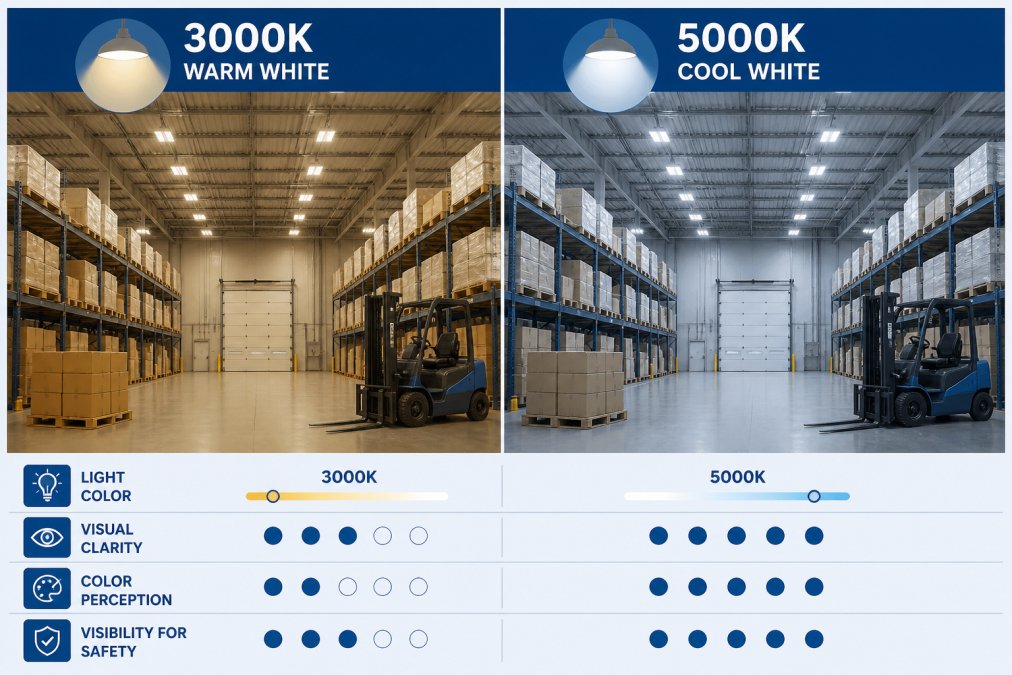
Color temperature describes whether light appears warm (yellowish) or cool (bluish). Warehouse tasks benefit from different color temperatures:
- 4000K (Neutral White): Standard for general warehouse areas, picking zones, and inventory management. Balances visibility with worker comfort during extended shifts.
- 5000K (Cool White): Used in quality inspection areas, loading docks, and high-precision picking zones. Enhances detail visibility and reduces eye strain during detailed visual tasks.
Selecting the wrong color temperature creates operational friction: 3000K appears dim in picking areas, slowing productivity; 5000K throughout may cause eye strain and fatigue.
Color Rendering Index (CRI) for Accurate Product Assessment
CRI measures how accurately colors appear under a light source, on a scale of 0-100. Standard incandescent bulbs score 100 (the reference standard), while older fluorescent fixtures often score 70-80. Quality LED retrofit fixtures typically offer CRI ratings of 80-95.
For warehouses handling colored products, textiles, cosmetics, or paints, CRI 90+ is essential to prevent picking errors and customer returns from misidentified colors or missed defects.
General storage and handling areas can function adequately with CRI 80-85, but picking and inspection zones should specify CRI 90+. This specification adds minimal cost to the retrofit but prevents costly operational errors.
Instant-On Capability and Operational Responsiveness
LEDs reach full illumination instantly, unlike fluorescent fixtures that require 30-60 seconds. This eliminates lag-time dark zones in motion-sensor areas and improves responsiveness as workers move between sections.
OSHA Compliance Through Proper Specification
OSHA requires adequate foot-candles but doesn't specify color temperature or CRI. A retrofit meeting foot-candle minimums but using poor color rendering still creates visibility problems.
Specify both foot-candle output (OSHA compliance) and color temperature/CRI (task optimization) in your retrofit plan.
LED Retrofit vs Full Fixture Replacement: Which Approach Fits Your Facility
When planning a LED warehouse lighting retrofits project, facility managers face a key decision: retrofit existing fixtures or replace them entirely. Each approach has distinct advantages and constraints.
https://mistervoltsusa.com/contact →
LED Retrofit Approach: Retrofit kits replace internal components (ballasts, tubes, bulbs) with LED equivalents while keeping existing housing and connections. This minimizes downtime and costs less upfront, but older fixture designs may not optimize LED performance or match the efficiency of modern purpose-built fixtures.
Full Fixture Replacement Approach: Replacing entire fixtures allows selection of fixtures optimized for your layout, ceiling height, and tasks. Modern LED fixtures are engineered for superior heat dissipation and light distribution. Installation takes longer and creates more downtime, but results in a cohesive system where every fixture performs at design specification.
| Approach | Upfront Cost | Installation Time | Light Distribution | Long-term Maintenance |
|---|---|---|---|---|
| LED Retrofit | Lower | Faster | Adequate | Moderate |
| Full Replacement | Higher | Longer | Optimized | Minimal |
OSHA Lighting Requirements for Warehouses and Compliance
OSHA establishes minimum illumination standards that vary by task type and facility area. Understanding these requirements ensures your retrofit delivers adequate lighting while avoiding over-specification that wastes energy.
OSHA specifies foot-candles for different zones: general areas 20-50, small-item handling 100+, and aisles 10-20 minimum.
Measure current illumination levels and compare against OSHA standards for your specific tasks to identify over-lit areas (wasting energy) and under-lit areas (safety gaps).
According to OSHA's general lighting requirements for industrial facilities, adequate illumination is non-negotiable for worker safety and productivity.
Commercial Lighting Rebate Programs and Financial Incentives
Many utility companies and government programs offer rebates for commercial LED lighting upgrades. These incentives can reduce the net cost of retrofit projects by 20-40%, significantly improving your return on investment timeline. However, rebate programs are complex, have strict eligibility requirements, and often operate on first-come, first-served funding. Understanding how to navigate them is critical to capturing available savings.
How Utility Rebate Programs Work
Eligibility Requirements and Documentation
Utility rebate programs typically require:
- Pre-Retrofit Energy Audit: You must document baseline lighting conditions before retrofit installation. This includes fixture types, wattage, quantity, and hours of operation. Some utilities require a professional energy audit; others accept facility manager estimates.
- Fixture Specifications: The LED fixtures you install must meet minimum efficiency standards. Most programs require fixtures rated for 50,000+ hours and CRI 80+. Some programs specify minimum lumen output or require fixtures from an approved manufacturer list.
- Licensed Contractor Installation: Many programs require that a licensed electrician perform the installation and sign off on completion. DIY or unlicensed contractor work typically disqualifies the project from rebate eligibility.
- Proof of Purchase: You must submit invoices showing the fixtures purchased and their specifications. Some programs require that you purchase fixtures before applying for rebates; others allow application before purchase but require documentation of planned specifications.
- Completion Documentation: After installation, you submit photos, completion certificates from the contractor, and sometimes a post-retrofit energy audit to verify the retrofit was completed as specified.
Timing and Application Strategy
Federal and State Incentive Programs
- Federal Energy Tax Credits: The Energy Policy Act and subsequent legislation have provided tax credits for commercial energy efficiency improvements. However, lighting-specific credits have been limited in recent years. Consult a tax professional to determine current eligibility.
- State Energy Office Programs: Some states offer grants or low-interest financing for commercial energy efficiency upgrades. The Database of State Incentives for Renewables & Efficiency (DSIRE) maintains current information on state-level programs. Programs vary significantly by state; some offer substantial rebates while others offer minimal incentives.
- Local Utility District Programs: Municipal utilities and rural electric cooperatives sometimes offer more generous rebates than large investor-owned utilities. If your facility is served by a smaller utility, inquire about their specific programs.
Maximizing Rebate Value
Common Rebate Program Pitfalls
Total Cost of Ownership and Return on Investment Timeline
A complete financial analysis of LED warehouse lighting retrofits requires looking beyond the upfront installation cost. Total cost of ownership (TCO) includes initial retrofit investment, ongoing energy consumption, maintenance labor, and equipment replacement cycles over the facility's operational lifespan.
Frequently Asked Questions
What are the primary financial benefits of LED warehouse lighting retrofits?
LED warehouse lighting retrofits reduce energy consumption by 50-75% compared to fluorescent fixtures, directly lowering your energy bills. Beyond immediate savings, retrofits extend fixture lifespan to 50,000+ hours, cutting relamping costs and service calls. Many facilities recover their retrofit investment within 2-4 years through combined energy and maintenance savings, then enjoy years of lower operating costs. Additional rebate programs can further accelerate payback.
How does LED retrofit vs full fixture replacement affect my decision?
An LED retrofit kit upgrades existing fixtures with LED components, preserving your current infrastructure and reducing installation downtime. Full fixture replacement removes old units and installs new LED fixtures, offering cleaner aesthetics and optimal light distribution but requiring longer installation. Retrofits cost less upfront and cause minimal disruption; replacements provide better long-term performance and design flexibility. Your choice depends on fixture age, facility downtime tolerance, and budget.
Are there specific OSHA lighting requirements for warehouses I need to meet?
OSHA requires minimum illumination levels based on warehouse task type: general areas need 30 foot-candles, detailed work areas require 100+ foot-candles, and aisle pathways need adequate visibility for safe movement. LED retrofits improve light distribution and color rendering, helping you meet these standards while reducing dark corners. Proper lighting also supports workplace safety by reducing accidents and improving employee visibility during material handling and inventory operations.
What commercial lighting rebate programs can help offset retrofit costs?
Many utilities offer rebates for LED warehouse lighting upgrades, with incentives ranging from $0.50 to $2.00 per fixture depending on your location and utility provider. Federal tax credits and state energy efficiency programs may also apply. Contact your local utility or visit the Database of State Incentives for Renewables & Efficiency (DSIRE) to identify available programs. Professional electricians familiar with rebate requirements can help you capture these incentives during installation.