 How-to
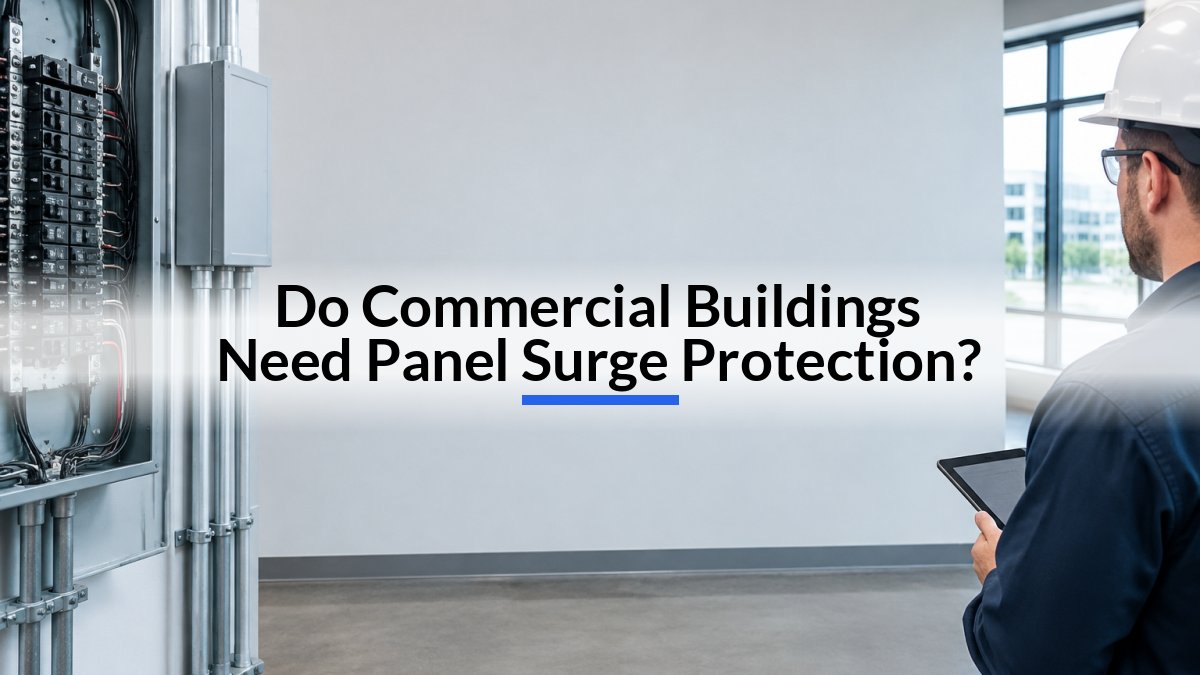
Do Commercial Buildings Need Panel Surge Protection?
Last Updated: November 20, 2026
Quick Summary
Yes, commercial buildings benefit from surge protection at the electrical panel, since a single spike can reach every circuit in the facility. Surge protective devices limit voltage spikes and divert excess energy to ground. Because they wear down as they absorb surges, they need regular inspection and maintenance.
- Surge protective devices reduce peak voltage to a level sensitive equipment can tolerate; they do not stop surges entirely.
- Surges come from external sources like lightning and utility switching, and internal sources like motors and HVAC compressors.
- Type 1 devices go at the service entrance, Type 2 at distribution and branch panels, and Type 3 near sensitive equipment.
- Check the system voltage match, surge current capacity, voltage protection rating, and short-circuit current rating before selecting a device.
- Keep lead lengths short and use the manufacturer's specified overcurrent protection, because long leads raise the clamping voltage.
Table of Contents
- What Surge Protective Devices Do in a Commercial Electrical System
- Commercial and Industrial Surge Risks: External Versus Internal Sources
- Type 1, Type 2, and Type 3 Commercial Surge Protective Devices Compared
- Type 2 Commercial Surge Protective Devices: Where They Fit and Why
- Commercial Building Surge Protection: NEC Requirements and Panel Placement
- Surge Protection and Power Conditioning: Choosing the Right Combination
- Booking a Commercial Panel Surge Assessment with Mister Volts
- Frequently Asked Questions
What Surge Protective Devices Do in a Commercial Electrical System
A surge protective device, or SPD, limits the voltage that reaches equipment during a transient spike. It diverts the excess energy to ground and returns the system to normal voltage. In a commercial building, that protection matters most at the electrical panel, where a single spike can reach every circuit in the facility.
SPDs do not stop power surges entirely. They reduce the peak voltage to a level that sensitive equipment can tolerate, and they wear down over time as they absorb surges. That is why a surge protective device is a component to inspect and maintain, not a one-time purchase.
Commercial and Industrial Surge Risks: External Versus Internal Sources
Surges come from two broad sources. External surges arrive from outside the building, most often through utility lines during lightning strikes or grid switching. Internal surges start inside the facility, from large motors, HVAC compressors, elevators and other heavy equipment cycling on and off.
Internal surges are easy to overlook. They happen every day, and their cumulative effect can degrade sensitive loads over years. External surges are less frequent but can carry far more energy.
A complete approach addresses both. Schneider Electric guidance on 2023 National Electric Code changes for surge protection describes how code requirements now shape where surge protection belongs in the electrical system.
Type 1, Type 2, and Type 3 Commercial Surge Protective Devices Compared
SPDs are classified by where they install and what they are built to handle.
| Type | Typical Location | Primary Role | Best For |
|---|---|---|---|
| Type 1 | Service entrance, line side of the main disconnect | Handles high-energy surges from outside the building | Facilities exposed to lightning or long utility lines |
| Type 2 | Distribution and branch panels | Handles residual surges that pass the service-entrance device | Most commercial panel installations |
| Type 3 | Near sensitive equipment | Provides final, fine-level protection | Electronics, controls and point-of-use protection |
Each type has tradeoffs. Type 1 devices offer the strongest first line of defense but require careful coordination with the service. Type 3 devices protect individual loads well but do little for the rest of the building on their own.
Type 2 Commercial Surge Protective Devices: Where They Fit and Why
Type 2 SPDs are typically mounted in distribution or branch panels. They catch surges that get past a Type 1 device and provide protection for the circuits fed from that panel. For many commercial buildings, Type 2 protection at the panel is the core of the strategy.
What separates a good Type 2 installation from a bad one is specification and placement, not the label on the box. A practical selection checklist for a commercial panel device should confirm:
- Voltage system match. The device must be rated for the actual system configuration, for example, 120/208V three-phase wye, 277/480V three-phase wye, or a 240V delta, and for the correct number of poles and phases. A mismatch here is the most common reason a device underperforms.
- Surge current capacity. Look for the per-mode surge current rating (often expressed in kA per phase) and confirm it is adequate for the exposure. Service-entrance and main-distribution locations generally warrant higher capacity than a small branch panel.
- Voltage protection rating (VPR). Lower VPR means the device clamps the transient at a lower voltage, which matters for sensitive loads. Compare VPR at the modes that actually protect the equipment.
- Short-circuit current rating (SCCR). The device must be rated for the available fault current at its point of connection, or it must be installed behind an overcurrent device with an adequate rating. Confirm this against the panel's available fault current.
- Monitoring and status. Status indicators, dry contacts for building management systems, and replaceable modules make maintenance practical. A device with no status indication is a device nobody checks.
- Listing and standards. Confirm the device is listed to the applicable UL 1449 edition and that the manufacturer's instructions match the installation.
Placement matters as much as the device. Keep lead length short and route conductors tightly to minimize impedance, because long, looping leads raise the clamping voltage the equipment actually sees. Use a dedicated breaker or the manufacturer's specified overcurrent protection, and bond the device to the panel grounding system per the manufacturer's instructions.
Watch out: a Type 2 device mounted without a proper overcurrent device, with the wrong voltage rating, or with long looping leads can fail to protect the equipment it was installed to shield, and the failure may not show up until a surge event.
A coordinated layout, Type 1 at the service, Type 2 at distribution and branch panels, Type 3 near sensitive loads, lets each device handle the energy level it is built for.
Commercial Building Surge Protection: NEC Requirements and Panel Placement
The 2023 National Electrical Code added and expanded surge protection requirements, but the rules are not uniform across occupancies. Section 230.67 requires a Type 1 or Type 2 surge protective device for services supplying dwelling units. That requirement is written for dwelling-unit services, so commercial designs should confirm how the rules apply to their occupancy rather than assuming the dwelling-unit language carries over.
Other articles matter for commercial work. Section 409.70 addresses surge protection for industrial control panels, placing an SPD internal to or immediately adjacent to the control panel. Article 285 governs surge protective devices generally, including installation, conductor routing, and grounding and bonding. Article 700 and Article 708 address emergency and critical power systems, where surge protection decisions carry additional reliability expectations. DITEK's summary of the 2023 NEC surge protection rules outlines the 2023 changes, including Section 409.70.
Edition and adoption are the practical variables. The National Electrical Code is updated on a three-year cycle, and jurisdictions adopt editions on their own schedules, some are on the 2023 edition, some remain on earlier editions, and amendments vary. A design that cites a section number without confirming the locally adopted edition can be wrong on paper even when the installation is sound.
A workable code-review sequence for a commercial panel project:
- Confirm the locally adopted code edition and any local amendments with the authority having jurisdiction.
- Identify the occupancy and the specific articles that apply, service equipment, feeders, control panels, emergency systems, and any special occupancies.
- Verify the SPD is listed to the applicable UL 1449 edition and installed per its listing and the manufacturer's instructions.
- Check grounding and bonding, conductor routing, and overcurrent protection against Article 285 and the device instructions.
- Document the code basis, the device ratings, and the inspection sign-off in the project record.
Coordinating Service, Distribution, and Branch Panels
Coordination means the service, distribution and branch panels work together rather than as separate islands. A Type 1 device at the service, Type 2 devices at distribution panels, and Type 3 devices near sensitive loads form a layered system. Placement should follow the one-line diagram, and each device needs the right voltage rating and a dedicated breaker.
Panel age and condition affect what can be added. An older panel may need evaluation before a surge device goes in. If you are unsure whether your panels can support additional protection, Mister Volts guide to warning signs that a panel needs replacing covers the signs that point to a panel needing prompt attention or a planned upgrade.
Commissioning closes the loop. A surge device that is never inspected is a device that quietly stops protecting the panel.
Surge Protection and Power Conditioning: Choosing the Right Combination
Surge protection and power conditioning solve different problems. An SPD limits spikes. Power conditioning, which can include voltage regulation and harmonic filtering, smooths the ongoing supply. Many facilities with sensitive equipment benefit from both.
Choose based on what you need to protect. Equipment that is vulnerable to brief spikes may need SPDs first. Equipment sensitive to sustained voltage swings or harmonic distortion may need conditioning added. A specification checklist that lists clamping voltage, short-circuit current rating, status indicators and dry contacts helps compare options fairly.
Booking a Commercial Panel Surge Assessment with Mister Volts
If your facility has sensitive equipment, shared panels or a history of unexplained equipment failures, a professional assessment is the practical next step. Mister Volts delivers professional, code-compliant electrical services for commercial clients in Macon, Perry and Warner Robins, with licensed electricians. book a commercial electrical consultation to review your panels and discuss protection options, or call Mister Volts to discuss your facility's needs.
Surge protection at the electrical panel is one of the most cost-effective ways to protect a commercial building's equipment. Mister Volts is ready to assess your system and recommend a practical, code-compliant plan.
Frequently Asked Questions
What type of surge protective device is used in a commercial building?
Commercial buildings commonly use Type 1 and Type 2 surge protective devices at the service entrance and distribution panels, with Type 3 devices closer to sensitive equipment. Type 2 devices are the most common choice for panel-level protection because they handle surges that originate both outside and inside the building. The right selection depends on the panel location, the available short-circuit current rating, and the code edition adopted where the facility sits. A licensed electrician can assess the existing system and recommend the correct device type.
Where should surge protection be installed in a commercial electrical system?
Surge protection is typically installed at the main service panel, at major distribution panels, and close to sensitive loads such as servers, controls, and medical or process equipment. Layering devices at several points gives coordinated protection rather than relying on a single device. The 2023 NEC requires an SPD for services supplying dwelling units and adds placement requirements for control panels, so the exact location should be confirmed against the edition your jurisdiction has adopted.
Does a commercial building need commercial surge protective devices at every electrical panel?
Not every panel needs its own device, but critical panels usually do. Service and major distribution panels are the highest-priority locations because they carry the most current and feed downstream equipment. Branch panels supplying sensitive electronics often benefit from additional protection. A facility manager should map which loads would cause the most downtime or damage if a surge occurred, then prioritize protection for those panels first.
How do you choose a surge protective device for a commercial panel?
Start with the panel's voltage, the system configuration, and the available fault current, then confirm the device's maximum continuous operating voltage and surge current rating. Check whether the device includes a status indicator, audible alarm, or dry contacts for remote monitoring. Power conditioning features may also matter for facilities with sensitive electronics. Compare these specifications against the requirements of your installation and the applicable NEC edition before purchasing.