 How-to
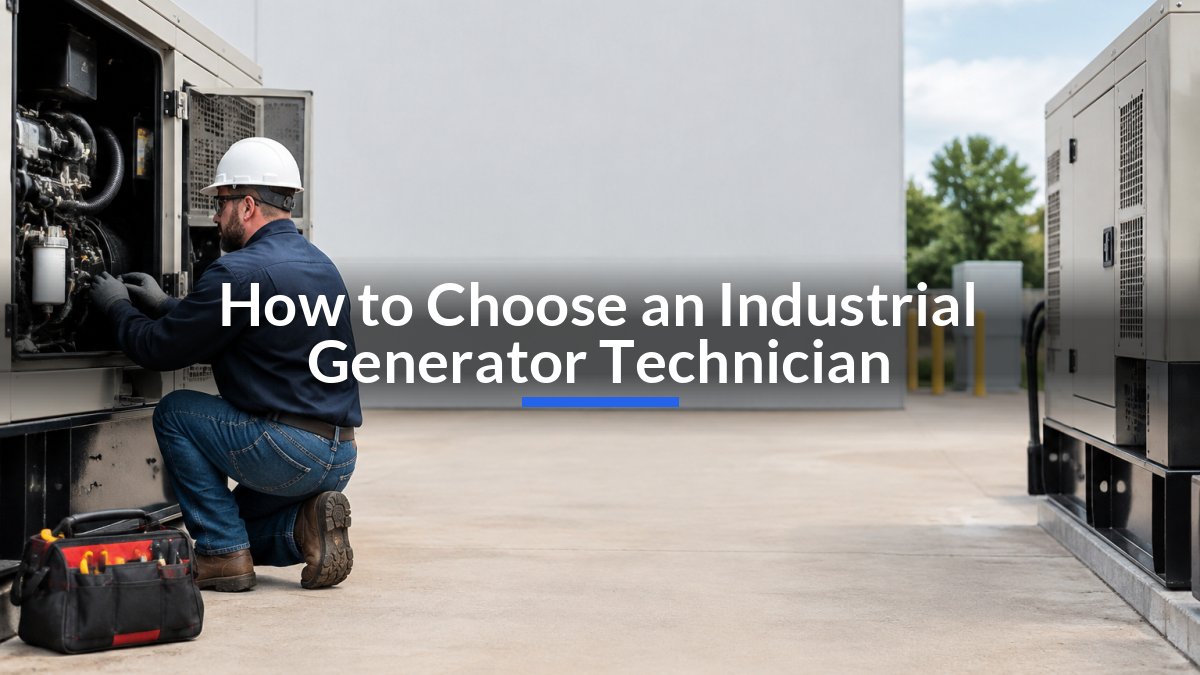
How to Choose an Industrial Generator Technician
Quick Summary
To choose a generator technician, verify factory training on your specific brand and model, then confirm hands-on experience with industrial units of comparable size. Request documented safety credentials, check references from similar facilities, and confirm written emergency response commitments before hiring.
- Ask whether the technician holds current factory training on your generator brand and model.
- Require documented experience with paralleled or high-capacity industrial units comparable to yours.
- Verify current lockout/tagout, arc-flash and confined-space training records before hiring.
- Call at least two references from facilities with equipment similar to yours.
- Get emergency response times and the escalation path in writing.
Table of Contents
- What an Industrial Generator Technician Does
- Generator Technician Qualifications to Look For
- Generator Technician Certification: What Counts
- Employee vs. Independent vs. Manufacturer-Authorized Technicians
- Generator Maintenance Checklist for Vetting Providers
- Evaluating a Generator Service Agreement
- Booking Your Industrial Generator Technician With Mister Volts
- Frequently Asked Questions
How to Choose an Industrial Generator Technician
Last Updated: November 18, 2026
What an Industrial Generator Technician Does
A generator technician installs, services, diagnoses and repairs standby and prime power generators. At industrial sites, that work often means keeping diesel units ready to carry a facility when the grid fails.
Many facilities also rely on the technician for scheduled preventive maintenance. That routine usually covers oil and filter changes, load testing, coolant checks and a review of the fault logs.
Good technicians also communicate clearly. They explain what failed, what it will cost to fix and how long the repair will take. Ask any prospective technician to describe a recent diagnosis in plain terms. If they cannot, expect the same confusion when something goes wrong on your site.
Generator Technician Qualifications to Look For
Start with the basics. Ask whether the technician has completed formal training on the generator brand and model you own. Many manufacturers run factory courses, and those credentials matter because controls and service procedures differ from one brand to another.
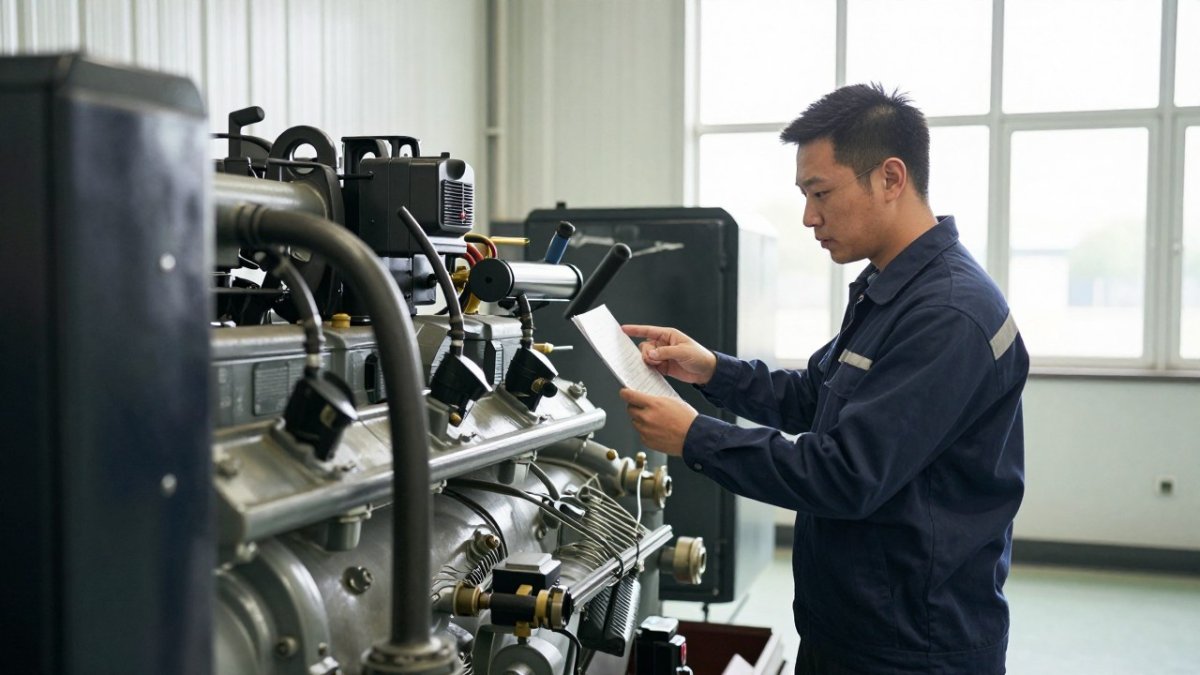
Next, look at hands-on experience with industrial units. A technician who has only serviced small residential standby generators may not be ready for a multi-megawatt diesel set with paralleling switchgear. Ask directly whether the technician has worked on paralleled units, load-sharing controls, and high-capacity equipment, and request specific examples.
!A licensed technician in work gear inspecting a large industrial diesel generator in a clean facility generator room
Education, Training and Hands-On Experience
A high school diploma or GED is the usual minimum. Beyond that, technical school programs in diesel technology, electrical systems or industrial maintenance give a technician a useful foundation. Apprenticeships add supervised field time, which many employers value more than classroom hours alone.
Ask how many years the technician has worked on generators and what types of equipment they have handled. Request examples of similar jobs, such as a fuel system rebuild or a transfer switch replacement. A common pattern is to weight documented industrial experience more heavily than total years in the trade, because residential standby work does not build the same skills.
Mechanical and Electrical Aptitude
Generator work sits where engine repair and electrical controls meet. A capable technician reads wiring diagrams, tests circuits with a multimeter and understands how the engine governor and voltage regulator respond to load changes. They should also be comfortable with fuel systems, cooling loops and exhaust components.
A simple test helps here. Ask the candidate to explain how they would troubleshoot a generator that cranks but will not start. A strong answer moves through fuel supply, starting batteries, control power and the engine's safety shutdowns in a logical order.
Safety Credentials and Compliance Verification
Industrial generator work carries real electrical, mechanical and confined-space hazards, so verify safety training rather than assume it. Ask for documentation of lockout/tagout training, arc-flash and electrical safety training, confined-space entry training, and first aid or CPR where the site requires it. Ask whether the technician's employer carries current liability and workers' compensation coverage, and request a certificate of insurance naming your facility where appropriate.
Requirements vary by jurisdiction and worksite, so match the credentials to your actual site rules rather than a generic list. A technician who cannot produce current safety training records is a risk on any industrial site.
A Practical Hiring Scorecard
Use a simple scoring rubric so you compare candidates on the same basis instead of on impressions. Score each candidate from 1 (weak) to 5 (strong) on the criteria below, then total the scores.
| Criterion | What a 5 Looks Like |
|---|---|
| Industrial equipment experience | Has serviced paralleled or high-capacity units comparable to yours |
| Brand and model training | Holds current factory training on your equipment |
| Troubleshooting method | Explains diagnosis in a logical, step-by-step order |
| Safety credentials | Produces current lockout/tagout, arc-flash and confined-space records |
| Documentation habits | Shows clear service reports and fault logs from past work |
| Communication | Describes a past repair in plain terms a facility manager can follow |
Pair the scorecard with a few consistent interview questions: describe a generator that failed to start during an outage and how you diagnosed it; walk through how you would perform a load bank test; explain how you verify a transfer switch operates correctly; and describe a time you found a problem during routine maintenance before it caused a failure. Score the answers the same way for every candidate.
Watch out: a candidate who scores well on years of experience but cannot explain a diagnostic sequence in order may be repeating tasks rather than solving problems.
Generator Technician Certification: What Counts
Certifications help you compare candidates, but they should not be the only test. The table below summarizes common credentials and what each one tells you.
| Credential | Issuing Body or Type | What It Indicates | Best For |
|---|---|---|---|
| Manufacturer training certificate | Equipment manufacturer | Trained on specific brand and model | Brand-specific service work |
| ASE certification (diesel or medium-heavy truck) | National Institute for Automotive Service Excellence | Tested knowledge of diesel engine systems | Engine and fuel system work |
| NFPA 110 familiarity | National Fire Protection Association standard | Understands emergency and standby power code requirements | Life safety and code-driven facilities |
| Electrical licensing | State licensing board | Authorized to perform certain electrical work | Transfer switch and wiring tasks |
| Manufacturer-authorized service status | Equipment manufacturer | Recognized for warranty and factory-backed service | Warranty-covered equipment |
Confirm any credential directly with the issuing body. Ask to see the certificate and its expiration date.
Employee vs. Independent vs. Manufacturer-Authorized Technicians
Each type of technician fits different needs, and each has trade-offs.
Employee technicians work in-house for your facility or a large operator. They know your equipment and site well, and they respond quickly during an outage. The cost is higher, since you carry salary, benefits and training expenses.
Independent technicians work for themselves or a small contractor. They often offer competitive rates and flexible scheduling. Their availability may vary, and their depth of experience with your brand of equipment can differ widely.
Manufacturer-authorized technicians have factory training and access to proprietary diagnostic tools and parts. They are usually the right choice for warranty work. Their rates can be higher, and their schedules may fill up during peak season.
Pros and cons at a glance:
- Employee: Strong site knowledge and fast response; higher ongoing cost.
- Independent: Flexible and often cost-effective; availability and brand expertise vary.
- Manufacturer-authorized: Warranty support and proprietary tools; premium pricing and possible scheduling delays.
Generator Maintenance Checklist for Vetting Providers
Use this checklist when you interview a provider or review a proposal. For each item, note whether the provider supplied documentation or only a verbal claim, because the difference matters when something fails.
- Documented training on your generator brand and model
- Experience with units of your size and fuel type
- Written preventive maintenance schedule
- Load bank testing capability or a documented testing process
- Access to parts and a stated parts sourcing plan
- Emergency response contact and expected response time
- Proof of insurance and any required licensing
- Service records from comparable industrial clients, available on request
- Clear explanation of how faults and repairs are documented
Verifying References, Service Records and Proof of Performance
Ask for references from at least two facilities with equipment comparable to yours, and call them. Ask what failed, how quickly the provider responded, and whether the repair held. Request redacted service reports from past visits and check whether they record the fault found, the corrective action taken, parts used and test results after the repair. A provider who cannot show records from similar sites may lack the experience your facility needs.
Service Coverage and Emergency Response
Response time is often the deciding factor during an outage, so get it in writing. Ask how many hours the provider commits to for emergency call-out, whether after-hours and weekend coverage is staffed or on-call, how far the coverage area extends, and what the escalation path is if the first technician cannot resolve the issue. Clarify whether the response commitment applies to your site specifically or only to a general service area.
Employment Versus Contractor Selection
The criteria shift depending on who you are choosing. When hiring an employee, weight trainability, safety habits and long-term fit alongside current skills. When choosing a service provider, weight response commitments, coverage, parts access and documented performance. When engaging an independent technician, verify insurance, licensing and references more carefully, because there is no larger organization backing the work.
Watch out: a provider who quotes a fast response time but cannot name the on-call technician or the escalation contact may not be able to honor it during a real outage.
Evaluating a Generator Service Agreement
A service agreement should spell out what is included, how often visits occur and how emergencies are handled. Look for a defined response time, a list of covered tasks and a process for approving repairs above a set dollar amount.
Read the terms on exclusions. Some agreements leave out fuel, batteries, filters or after-hours call-outs. Those gaps can add up quickly. Ask for a sample report from a past visit so you can judge how detailed the documentation will be.
Compare two or three written proposals side by side. Focus on the scope of work, the response commitment and the reporting format rather than only the headline price. Pricing depends on generator size, site access and service frequency, so request a quote for your specific equipment through https://mistervoltsusa.com/contact.
Booking Your Industrial Generator Technician With Mister Volts
Mister Volts provides electrical service, upgrades and maintenance for residential and commercial clients in Macon, Perry, Warner Robins and surrounding Georgia communities. Our licensed electricians can review your transfer switch and related electrical systems as part of a broader facility maintenance plan. book a generator maintenance consultation
If you are weighing a technician's electrical skills, see how our team approaches service capacity and modern equipment demands in our guide to electrical upgrades. Facilities that need electrical design, maintenance and lighting support across a whole site can review our commercial electrical services. To discuss your generator needs, contact Mister Volts directly and describe your equipment and site.
Mister Volts is ready to help your facility with electrical needs. Contact our team today through https://mistervoltsusa.com/contact to discuss your project and request a quote.
Frequently Asked Questions
What qualifications should an industrial generator technician have?
Look for a high school diploma or GED, formal technical training in diesel or power systems, and documented hands-on experience with industrial generators of your size and fuel type. Mechanical and electrical aptitude matter because technicians diagnose fuel, cooling, controls and electrical faults. Ask for proof of training and references from similar facilities. Manufacturer training is useful when your unit is a specific brand, since it covers service procedures and warranty requirements that general training may not.
Should I choose a generator technician based on certification or experience?
Use both. Certification shows that a technician has completed structured training and passed a recognized test, which gives you a baseline. Experience shows how the technician handles real faults on equipment like yours. A technician with strong field experience but no current credentials may be fine for routine work, while a certified technician with little industrial exposure may struggle with complex failures. Ask for specific examples of past generator jobs before deciding.
What questions should I ask before hiring a generator technician?
Ask how many industrial generators the technician has serviced, which makes and sizes they know best, and whether they carry the training required for your equipment. Ask about response times for emergency calls, how service records are documented, and whether they can provide references from comparable facilities. Confirm insurance coverage and the safety practices they follow on site. Clear answers to these questions help you compare providers on the same terms.
How often should an industrial generator be inspected and serviced?
Follow the maintenance schedule in the manufacturer's manual, which typically sets intervals for oil, filters, coolant, belts and load testing. Facilities with standby generators often schedule periodic inspections and load tests to confirm the unit will start and carry load when needed. Your technician should document each visit, record run hours and flag any wear trends. Ask any provider to show a sample service report before you sign an agreement.