
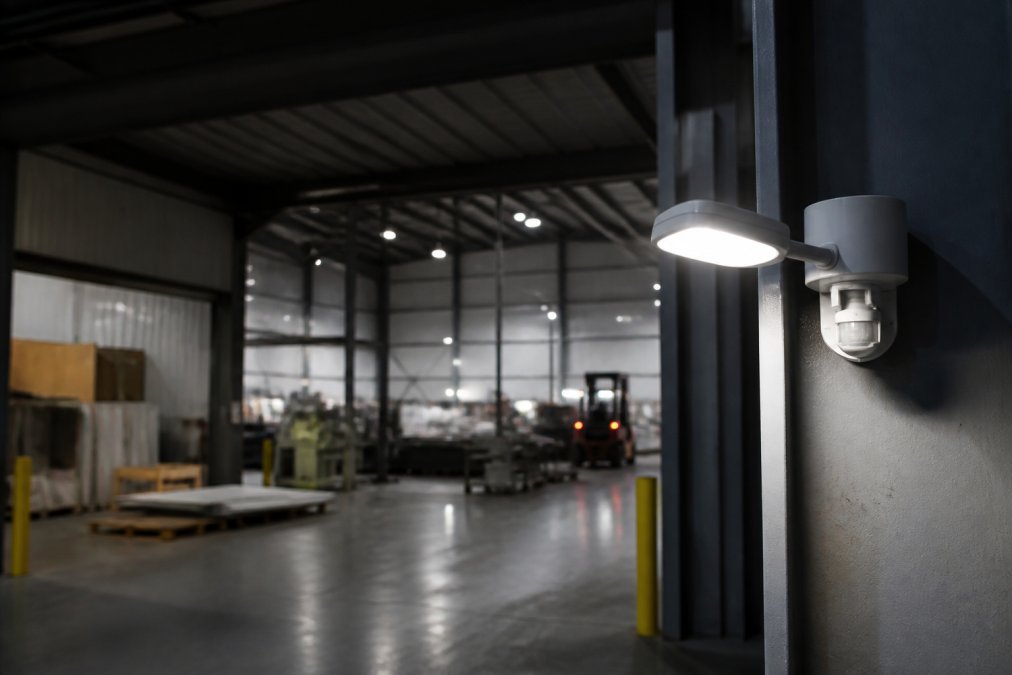
 listicle
Benefits of Motion Sensor Lighting for Industrial Safety
Table of Contents
- How Motion Sensor Lighting Reduces Accidents in Industrial Facilities
- Energy Savings and Operational Efficiency with Motion-Activated Lighting
- OSHA Lighting Requirements for Warehouses: Compliance and Standards
- Types of Occupancy Sensors for Industrial Use: PIR, Ultrasonic, and Microwave
- Energy Efficient Lighting Solutions for Warehouses: LED and Smart Controls
- Integrating Motion Sensor Lighting with Building Management Systems
- Maintenance and Calibration Best Practices for Industrial Motion Sensors
- Frequently Asked Questions
Last Updated: September 14, 2026
Motion sensor lighting has become essential for industrial facilities seeking to improve safety while reducing operational costs. Motion-activated lighting systems are transforming how warehouses, loading docks, and manufacturing plants approach workplace safety and energy management. The benefits of motion sensor lighting extend beyond convenience, they directly address accident prevention, security, compliance, and long-term cost savings.
How Motion Sensor Lighting Reduces Accidents in Industrial Facilities
Motion sensor lighting illuminates pathways and work areas only when occupants are present, eliminating dark zones where slips, trips, and falls commonly occur. Motion-activated systems keep critical areas lit during active work periods while preventing the energy waste of permanently illuminated empty spaces.
Illuminating Pathways and Loading Docks
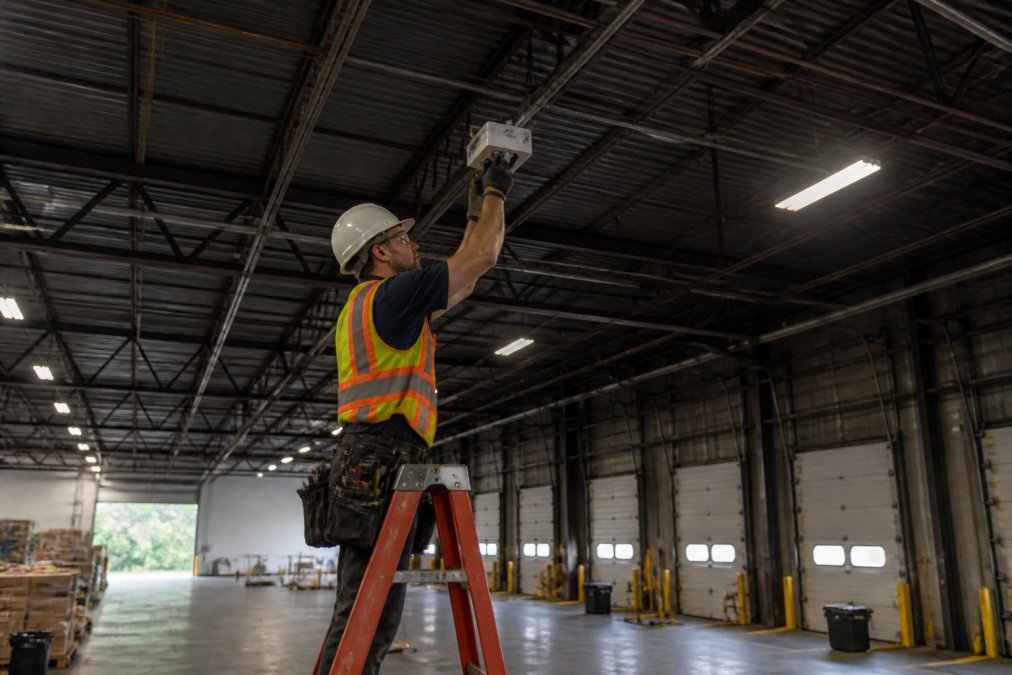
Loading docks present particular hazard challenges, workers navigate between vehicles, pallets, and equipment in areas that shift between full activity and complete inactivity. Motion sensor lighting activates automatically when movement is detected, ensuring workers never enter a dark zone. The sensors detect occupancy within seconds, providing visibility to identify obstacles, equipment, and other personnel before incidents occur.
Deterring Theft and Unauthorized Access
Beyond workplace safety, motion-activated lighting strengthens security. When lights activate only during detected motion, unauthorized access becomes immediately visible to security systems and personnel. This dual function makes motion sensor lighting a cost-effective security investment for facilities storing valuable inventory or equipment.
Energy Savings and Operational Efficiency with Motion-Activated Lighting
Motion sensor lighting eliminates the primary inefficiency of traditional industrial lighting: continuous operation regardless of occupancy. In warehouses and manufacturing plants where certain areas see sporadic use, motion-activated systems reduce electricity consumption dramatically. Many facilities report significant reductions in their overall energy footprint simply by installing occupancy sensors in low-traffic zones.
Reducing Electricity Bills and Carbon Footprint
The operational efficiency gains translate directly to measurable cost reductions. Lights operate only during actual occupancy, so idle periods, nights, weekends, or between shifts consume no energy. Across hundreds of fixtures, this selective activation compounds into substantial monthly savings and a smaller carbon footprint.
OSHA Lighting Requirements for Warehouses: Compliance and Standards
Most articles on motion sensor lighting stop at 'it improves safety.' For industrial facility managers, the more useful question is which regulations the system actually helps you satisfy, and where motion activation can create compliance risk if designed poorly.
The Standards That Actually Apply
Several distinct authorities shape industrial lighting requirements, and they do different jobs:
- OSHA 29 CFR 1910.303(b)(1), the general electrical safety requirement that equipment be free from recognized hazards. Poorly lit egress and work zones are commonly cited under this clause after an incident.
- OSHA 29 CFR 1910.37(b), requires exit routes to be adequately lit and marked. This is the standard most often triggered when a motion sensor leaves a path dark for too long.
- OSHA 29 CFR 1910.305(a)(2)(iii), temporary wiring and lighting rules that apply during construction or maintenance phases inside an active plant.
- OSHA 29 CFR 1926.56, the construction-industry illumination table, which specifies minimum foot-candles for areas like general construction, warehouses, and loading zones. Many industrial facilities reference this table as a practical benchmark even when 1910 governs their operations.
- NFPA 101 (Life Safety Code), sets means-of-egress illumination requirements, including a minimum duration that emergency lighting must remain on after a power loss.
- NFPA 70 (National Electrical Code), governs how sensor circuits, relays, and emergency bypass wiring must be installed so that life-safety lighting is never dependent on occupancy detection.
- IES recommended practices (e.g., IES RP-1 for industrial spaces), not law, but the de facto engineering reference for foot-candle targets by task and area.
What 'Adequate' Actually Means in Foot-Candles
OSHA does not publish a single lux number for every industrial task, but the 1926.56 table and IES RP-1 give usable targets inspectors reference in practice:
- General warehouse aisles and storage areas: roughly 10-20 foot-candles
- Active loading docks and truck aprons: roughly 20-30 foot-candles
- Precision assembly, inspection, and packaging stations: 50-100 foot-candles depending on task detail
- Emergency egress paths: minimum 1 foot-candle along the path of egress, with higher levels at stairs and changes in elevation
Motion sensors do not change the target, they change when it is met. The design question is whether the sensor's detection pattern, time-delay setting, and fixture warm-up cover the entire zone before a worker enters it.
Where Motion Sensors Create Compliance Risk
The failure modes that show up in audits and incident reports are predictable:
- Detection dead zones. A sensor mounted at 30 feet in a high-bay aisle may not see a worker who steps out from behind a rack. The light stays off, and the worker walks into an unlit zone.
- Short time-delay settings. A 30-second delay is fine in an office corridor but can leave a worker in the dark mid-task in a long aisle. Industrial settings typically call for 5-15 minute delays in active work zones.
- Warm-up lag with legacy fixtures. Metal halide and some fluorescent fixtures take 1-5 minutes to reach full output. If the sensor triggers on entry, the worker is still walking through a dim space. LED fixtures reach full output in under a second, which is one reason LED retrofits pair so naturally with occupancy control.
- Sensor override on emergency circuits. Covered above, this is the single most common code issue found during inspection.
How to Document Compliance
For facilities that undergo OSHA inspections, insurance audits, or ISO 45001 reviews, the practical deliverable is a lighting control narrative: a document mapping each zone to its target foot-candle level, sensor type and coverage pattern, time-delay setting, and emergency bypass arrangement. A licensed electrician should produce this alongside the as-built drawings, it turns 'we installed motion sensors' into 'we can demonstrate the system meets the applicable standards.'
OSHA 29 CFR 1910 Subpart S, Electrical NFPA 101 Life Safety Code overview
Types of Occupancy Sensors for Industrial Use: PIR, Ultrasonic, and Microwave
Sensor selection is where most industrial lighting projects succeed or fail. The three dominant technologies, passive infrared, ultrasonic, and microwave, behave very differently in a warehouse, a cold storage room, and a fabrication bay. The wrong choice produces nuisance triggering or, worse, missed detection.
Passive Infrared (PIR)
How it works: A pyroelectric sensor detects changes in infrared radiation across its field of view, it sees body heat moving across zones.
Strengths: Lowest cost per fixture, lowest standby power draw, and fewest false triggers in stable environments. Well suited to enclosed rooms, offices, restrooms, and warehouse aisles with clear sightlines.
Weaknesses in industrial settings: PIR needs line of sight, so racking, stacked pallets, and forklifts block detection. High ambient temperatures (foundries, boiler rooms, summer loading docks) shrink effective range. In cold storage, sensor lenses can fog or frost.
Typical mounting: 8-15 feet for standard coverage; high-bay PIR models reach 20-40 feet but with narrower detection cones.
Ultrasonic
How it works: Emits high-frequency sound waves (typically 25-40 kHz) and detects motion via Doppler shift in the returning signal.
Strengths: Detects around corners and through partial obstructions because sound reflects off surfaces. Works well in restrooms, stairwells, and partitioned areas. Not affected by ambient temperature the way PIR is.
https://mistervoltsusa.com/contact →
Weaknesses in industrial settings: Sensitive to air movement from HVAC ducts, compressed-air blowoffs, and open dock doors. Hard surfaces (concrete, metal racking) create echoes that cause false triggers, and high ceilings reduce effectiveness as sound energy dissipates.
Typical mounting: 8-12 feet; performance drops noticeably above 15 feet.
Microwave (Radar)
How it works: Emits low-power radio waves and detects motion via Doppler shift, similar in principle to ultrasonic but using RF energy.
Strengths: Penetrates non-metallic obstructions, pallets, cardboard, drywall, thin wood, making it the best choice for high-bay racking where workers move behind stored goods. Long detection range (up to 50+ feet) suits tall ceilings, and it is unaffected by temperature, humidity, or airborne dust.
Weaknesses in industrial settings: Most prone to false triggering because RF passes through walls and detects activity in adjacent spaces. Requires careful sensitivity tuning and sometimes shielding, with higher standby power draw than PIR.
Typical mounting: 15-40 feet, often ceiling-mounted in high-bay applications.
Dual-Technology Sensors
Many industrial fixtures combine PIR and ultrasonic (or PIR and microwave) and require both to confirm occupancy before turning lights on. This dramatically reduces false triggers, a forklift passing outside a doorway won't trip the lights, but a worker walking in will. The trade-off is higher unit cost and more complex commissioning.
Selection Matrix by Industrial Environment
| Environment | Recommended technology | Why |
|---|---|---|
| Standard warehouse aisle, 12-20 ft ceiling | PIR | Clear sightlines, stable temperature, lowest cost |
| High-bay racking, 25-40 ft ceiling | Microwave or dual-tech | Penetrates racking; long range |
| Cold storage / freezer | Microwave or dual-tech | PIR lenses frost; ultrasonic is unreliable in dense cold air |
| Foundry, boiler room, hot process area | Ultrasonic or microwave | PIR loses sensitivity as ambient temp approaches body temp |
| Loading dock with open doors | Dual-tech (PIR + microwave) | Rejects outdoor air movement and passing traffic |
| Partitioned assembly cells | Ultrasonic | Detects around partitions |
| Hazardous-location areas (Class I/II) | Spec-rated sensors only | Standard sensors are not listed for these environments |
Practical Selection Rules
- Match range to ceiling height, not to floor area. A sensor rated for 2,000 sq ft at 10 feet may cover only 400 sq ft at 30 feet.
- Overlap coverage. Adjacent sensors should overlap by 20-30% so a worker is never in a gap between zones.
- Tune time-delay to the task. Short delays save energy; long delays prevent lights from cycling off mid-task. In active work zones, 10-15 minutes is a common starting point.
- Commission with a walk test. Every sensor should be verified on-site with a walk test at the actual mounting height and with the actual racking in place. Manufacturer coverage diagrams assume an empty room.
- Plan for dust and lens fouling. In dusty environments, PIR and ultrasonic sensors need more frequent cleaning; microwave sensors are less affected but still require periodic inspection.
IES recommended practice for industrial lighting
Energy Efficient Lighting Solutions for Warehouses: LED and Smart Controls
LED technology paired with motion sensors creates the most efficient industrial lighting solution available. LEDs consume 75% less energy than traditional incandescent or fluorescent fixtures and last significantly longer, reducing maintenance frequency and costs.
Smart building management systems (BMS) integrate motion sensor lighting with HVAC, security, and access control to optimize overall energy performance. Automated scheduling, daylight harvesting sensors, and time-delay settings fine-tune when and how long lights remain active after motion ceases, transforming lighting from a static utility into a responsive, adaptive system.
Integrating Motion Sensor Lighting with Building Management Systems
Modern industrial facilities benefit from centralized control of motion sensor lighting through building management systems. Integration lets facility managers monitor lighting performance, adjust sensor sensitivity remotely, and coordinate lighting with other building operations. Occupancy data informs energy audits, revealing which areas receive heavy use and which could benefit from additional efficiency measures.
Smart BMS integration also supports predictive maintenance, sensors can flag when fixtures require cleaning or bulb replacement before performance degradation affects safety or efficiency.
Maintenance and Calibration Best Practices for Industrial Motion Sensors
Motion sensor lighting systems require periodic maintenance. Dust on sensor lenses reduces detection sensitivity, potentially leaving lights off when workers are present, so clean sensor faces quarterly. Verify calibration annually, adjusting range and time-delay settings as layouts or usage patterns change.
Temperature fluctuations can affect sensor performance, and PIR sensors in particular may need recalibration seasonally or after significant temperature changes. Professional technicians should handle these adjustments to ensure functionality and safety compliance.
Motion sensor lighting represents a practical investment in both safety and operational efficiency for industrial facilities. The combination of accident reduction, energy savings, enhanced security, and regulatory compliance makes a compelling case for upgrading. Mister Volts provides comprehensive design, installation, and maintenance services for motion sensor lighting systems throughout Macon, Perry, Warner Robins, and surrounding Georgia communities. Our licensed electricians ensure your system meets NEC standards, integrates with your existing infrastructure, and delivers the safety and efficiency benefits your operation requires. Contact Mister Volts today for a professional assessment of your facility's lighting needs and a customized motion sensor solution.
Frequently Asked Questions
What are the benefits of using motion sensor lights?
Motion sensor lighting improves industrial safety by automatically illuminating pathways, loading docks, and hazardous areas when movement is detected, reducing accidents. It cuts energy consumption by up to 60% compared to always-on lighting, lowers electricity bills, and extends bulb lifespan. Motion-activated lighting also deters theft and unauthorized access, supports OSHA compliance, and integrates with smart building management systems for centralized control.
What are the downsides of using motion sensor lights?
Motion sensor lighting can have false triggers from environmental factors like heat or moving machinery, causing unnecessary activation. Sensor range and coverage may be limited in large warehouses, requiring multiple units. Improper placement can leave dark spots, and some sensors need regular calibration to maintain performance. Initial installation costs are higher than standard switches, but energy savings typically offset them over time.
Do motion sensor lights help with OSHA compliance?
Yes, motion sensor lighting supports OSHA compliance by ensuring adequate illumination in walkways, loading docks, and hazardous areas as required by 29 CFR 1910. Motion-activated lighting maintains minimum foot-candle levels when workers are present, reducing slip, trip, and fall risks. It also helps meet emergency lighting requirements by automatically activating during power outages or emergencies, keeping facilities within safety standards.
How much energy can industrial facilities save with motion-activated lighting?
Industrial facilities can achieve significant savings on lighting energy with motion-activated lighting, depending on occupancy patterns and sensor settings. Warehouses with low-traffic areas see the highest savings because lights only turn on when needed. Pairing occupancy sensors with LED technology and time-delay settings maximizes efficiency, reducing electricity bills and carbon footprint while maintaining safety and visibility.