
 ultimate-guide
Improving Warehouse Safety With Better Lighting
Table of Contents
- Why Warehouse Lighting Directly Affects Accident Rates
- OSHA Warehouse Lighting Requirements: What You Must Meet
- LED High Bay Lighting Benefits for Warehouse Operations
- Strategic Fixture Placement for Aisles, Docks, and Hazard Zones
- Smart Lighting Controls and Automation for Safer Facilities
- Warehouse Lighting Maintenance Checklist
- Retrofitting vs. New Installation: Weighing the ROI
- Frequently Asked Questions
Last Updated: September 21, 2026
Why Warehouse Lighting Directly Affects Accident Rates
Improving warehouse safety with better lighting starts with a simple fact: workers cannot avoid what they cannot see. Poor illumination hides pallet corners, spilled liquids, and uneven dock edges until someone trips, clips a rack upright, or drives a forklift into a pedestrian. This guide from Mister Volts covers the practical fixes, from compliance minimums to fixture placement and controls.
OSHA Warehouse Lighting Requirements: What You Must Meet
OSHA does not publish a single warehouse foot-candle table. Enforcement runs through the General Duty Clause (Section 5(a)(1) of the OSH Act), which requires employers to furnish a workplace free from recognized hazards, and through 29 CFR 1910.303 for electrical safety and 29 CFR 1910.37 for exit route illumination. In practice, inspectors and safety managers anchor to the Illuminating Engineering Society recommended practice for industrial lighting, which sets task-level targets rather than a blanket number.
Minimum Illumination Standards by Zone
The table below reflects commonly adopted planning targets. Treat them as design minimums, not legal citations, and confirm current values against the applicable IES recommended practice and your local authority having jurisdiction before specifying fixtures.
| Area | Target Range (foot-candles) | Target Range (lux) | Why It Matters |
|---|---|---|---|
| General storage aisles | 10-20 fc | 100-200 lux | Basic navigation, rack identification |
| Order picking zones | 20-30 fc | 200-300 lux | Label and barcode reading accuracy |
| Loading docks and trailer edges | 20-30 fc | 200-300 lux | Trailer edge and forklift visibility |
| Packing and inspection | 30-50 fc | 300-500 lux | Fine detail, error reduction |
| Hazard zones and exits | 20+ fc | 200+ lux | Emergency egress, spill detection |
| Stairways and mezzanines | 20-30 fc | 200-300 lux | Consistent level top to bottom to prevent missteps |
How to Document Compliance for Inspections
Documentation is where most facilities fall short. An inspector who sees a hazard complaint will ask for three things: a lighting plan, current measurements, and a maintenance record. Build the file before you need it.
- Lighting plan: fixture locations, types, lumen output, mounting height, and the zone each fixture serves. Keep it current when fixtures are added or moved.
- Measurement log: floor-level readings taken with a calibrated light meter at fixed points in each zone, dated and initialed. Photograph the meter display with a timestamp.
- Maintenance record: cleaning, lamp or driver replacement, sensor recalibration, and any corrective action tied to a reported hazard.
- Incident cross-reference: if a near-miss or injury occurred in a zone, note the light level measured at that time and any change made afterward.
A Practical Compliance Checklist
Run this before any internal audit or scheduled inspection:
- Confirm each zone has a defined target foot-candle range and a documented measurement point
- Verify exit routes meet the continuous illumination requirement under 29 CFR 1910.37
- Check that emergency and exit lighting operates on battery backup for the required duration
- Confirm no fixture creates disability glare in a forklift travel path
- Verify uniformity in active aisles is within your stated ratio
- Confirm the maintenance log has entries within the last quarter
- Confirm any hazard report mentioning visibility has a documented lighting response
If you cannot check every box, the gap is your work order list, not a reason to delay the audit.
LED High Bay Lighting Benefits for Warehouse Operations
LED high bay lighting benefits go beyond the utility bill, though that is where the math gets attention. LED fixtures deliver consistent output across their service life, hold color temperature steady, and tolerate the vibration and temperature swings typical of warehouse ceilings.
Energy Savings and Reduced Maintenance Costs
The savings case rests on two mechanics. First, LEDs convert a higher share of electricity into light rather than heat, so energy consumption drops for the same delivered illumination. Second, the long rated life means far fewer lamp replacements, which matters when each change requires a scissor lift and a two-person crew.
Strategic Fixture Placement for Aisles, Docks, and Hazard Zones
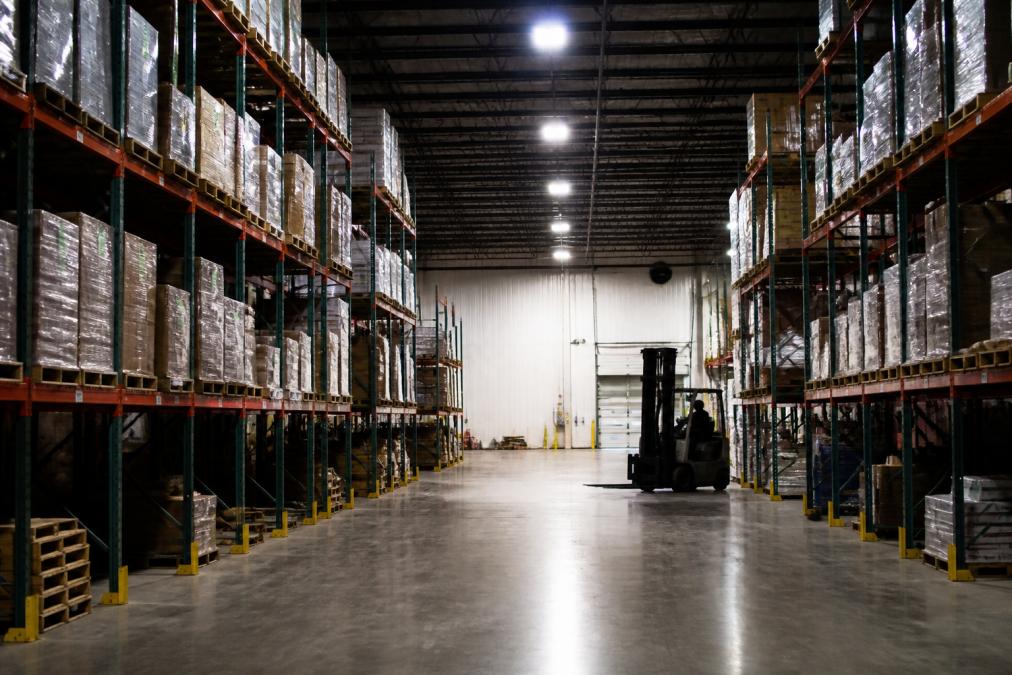
Placement decides whether good fixtures actually deliver. The goal is uniform illumination across the working plane with no shadow pockets between rack rows, no glare into a forklift operator's eyes, and no dark transition at doorways where eyes must adjust.
Lighting Specific High-Risk Areas
- Dock levelers and trailer edges: dedicated fixtures to remove the transition shadow
- Rack end caps and intersections: extra output where forklift and pedestrian paths cross
- Battery charging stations: well-lit and ventilated, with clear sight lines to exits
- Stairways and mezzanine edges: consistent light level top to bottom to prevent missteps
- Spill-prone zones: bright enough to reveal wet floors before someone walks through
Glare reduction deserves equal attention. A fixture that is bright but aimed poorly creates disability glare that makes hazards harder to see, not easier.
Smart Lighting Controls and Automation for Safer Facilities
Smart controls turn a static lighting system into an active safety layer. Motion sensors keep aisles at a safe baseline and raise output when a forklift or picker enters a zone. Daylight harvesting dims fixtures near skylights and dock doors when natural light is sufficient, which also cuts energy consumption.
https://mistervoltsusa.com/contact →
Warehouse Lighting Maintenance Checklist
A warehouse lighting maintenance checklist converts good intentions into a schedule. Assign an owner, log every reading, and treat out-of-range measurements as work orders rather than observations.
- Walk each zone monthly and note any dark or flickering fixtures
- Take floor-level light meter readings in every defined zone
- Clean lenses and fixture housings to remove dust buildup
- Check motion sensors and daylight harvesting settings
- Inspect wiring, connections, and mounting hardware for damage
- Verify emergency and exit lighting operates on battery backup
- Confirm dock and hazard zone fixtures are aimed correctly
- Review the log against previous readings for downward trends
Monthly and Quarterly Inspection Steps
Monthly checks focus on the obvious: outages, flicker, and visible dust. Quarterly inspections go deeper, with calibrated meter readings, sensor testing, and a review of any incident reports that mention visibility. If a near-miss occurred in a zone, measure that zone first.
Retrofitting vs. New Installation: Weighing the ROI
Most articles on warehouse lighting stop at "LEDs save energy." That is not enough for a facility manager who has to justify capital spend to a CFO. The decision between retrofitting an existing system and installing new comes down to a payback model, and the model has more inputs than the utility bill.
The Payback Framework
Build the comparison on five cost lines over the same service horizon, typically 10 years for LED equipment:
- Equipment and materials, retrofit kits, drivers, or complete new fixtures, plus any new conduit, mounting hardware, or controls.
- Installation labor, retrofit work in an occupied warehouse usually runs faster because mounting points and conduit already exist. New installation adds ceiling work, potential racking interference, and longer outages.
- Energy consumption, compare connected load (watts per fixture times fixture count) against operating hours. A 400W metal halide high bay replaced by a 150W LED high bay cuts connected load by roughly 60 percent before controls are added.
- Maintenance, count lamp and driver replacements over the horizon, then multiply by the cost of a lift rental, a scheduled outage, and the labor to perform the change. A fixture 12 meters up is not just a lamp; it is a lift rental, a scheduled outage, and a safety exposure every time someone goes up to change it.
- Downtime and disruption, retrofit projects can often be phased zone by zone during off-shift hours. Full new installation may require aisle closures or racking relocation.
A Simple Payback Calculation
Annual savings = (old connected load − new connected load) × operating hours × blended electricity rate, plus avoided maintenance cost per year.
When Retrofit Wins
- Existing mounting points and conduit are in good condition
- Racking layout is staying as-is
- The building is occupied and downtime is expensive
- The current layout does not create glare or shadow hazards
- Capital budget is tight and a fast payback is required
When New Installation Wins
- Racking is being reconfigured or the building is changing use
- The existing layout creates hazards that fixture swaps cannot fix, such as aisles too wide for the current fixture spacing
- Ceiling height or structure limits the retrofit options
- Controls and sensors are being added warehouse-wide and the wiring needs a redesign anyway
- The facility plans to operate for 15 or more years and wants the longest service horizon
The Inputs Most Analyses Miss
If you need a code-compliant assessment of your facility's lighting, Mister Volts provides licensed electrical evaluations for commercial and industrial clients.
Frequently Asked Questions
What are the OSHA lighting requirements for warehouses?
OSHA does not publish a single warehouse-specific lux table but enforces the General Duty Clause and 29 CFR 1910.22, which require safe walking and working surfaces. In practice, inspectors reference IES recommended practice: roughly 30 foot-candles for general warehouse space, 50 for active picking aisles, and 100 or more at loading docks and inspection stations. Documenting your measurements with a light meter and keeping records on file is the simplest way to show compliance during an inspection.
Is poor lighting an OSHA violation?
Poor lighting itself is not a standalone citation, but it commonly appears as a contributing factor in General Duty Clause violations when it leads to struck-by, slip, trip, or forklift incidents. If an injury investigation shows that dim aisles, burned-out fixtures, or deep shadows played a role, OSHA can cite the employer for failing to provide a safe workplace. Fixing fixtures, adding task lighting, and keeping a warehouse lighting maintenance checklist on record are the practical defenses.
How does lighting impact warehouse accident rates?
Visibility drives hazard identification. When lux levels drop, workers miss pallet edges, spills, floor obstructions, and forklift traffic sooner, which shortens reaction time. Uniform illumination without glare or flicker also reduces eye strain and fatigue across long shifts, and fatigue is a known contributor to errors. Facilities that upgrade to LED high bay lighting with even light distribution typically see fewer near-misses and incident reports, though exact reductions depend on layout, traffic, and training.
How often should warehouse lighting systems be inspected?
Walk the floor monthly to catch burned-out lamps, dark spots, and flickering fixtures, and run a full inspection quarterly with a light meter to confirm lux levels still meet your target for each zone. Add an annual review of drivers, ballasts, lenses, and emergency lighting. Log every finding with the date and the fix so you have a paper trail for OSHA and insurance reviews. Replacing lamps in groups rather than one at a time keeps illumination uniform and cuts repeat trips.