 blog
blog
Safe and Reliable Electrical Installations for Retail
Table of Contents
- Why Safe and Reliable Electrical Installations for Retail Operations Matter
- How Retail Electrical Loads Differ From Other Commercial Spaces
- NEC-Compliant Retail Electrical Upgrades: What Changes and Why
- What a Retail Store Electrical Safety Inspection Covers
- Commercial Electrical Maintenance Checklist for Retail Managers
- Choosing an Electrical Partner for Safe and Reliable Retail Installations
- Frequently Asked Questions
Last Updated: September 11, 2026
Why Safe and Reliable Electrical Installations for Retail Operations Matter
A retail floor is an unforgiving environment for electrical systems. Unlike an office where a tripped breaker means a few dark monitors, a retail outage stops every transaction, darkens display cases, and can force a store to close its doors during peak hours. Safe and reliable electrical installations for retail operations are not a maintenance afterthought; they are the infrastructure that keeps registers ringing.
Below, we break down what makes retail loads distinct, what code compliance actually requires, and how to build a maintenance rhythm that prevents failures instead of reacting to them.
The core tension is simple: retail spaces change constantly, but the wiring behind the walls rarely keeps pace.
How Retail Electrical Loads Differ From Other Commercial Spaces
Retail electrical loads are cyclical, concentrated, and unpredictable in a way that office or warehouse loads are not. A store's demand spikes when doors open, stays high through peak shopping hours, and shifts constantly as displays, lighting, and equipment change.
Consider what runs simultaneously on a typical sales floor:
- High-bay or track lighting across a large open footprint
- Point-of-sale terminals, receipt printers, and payment processors on dedicated circuits
- Refrigeration and display freezers that cycle on and off throughout the day
- HVAC systems sized for foot traffic and open entryways
- Seasonal equipment: holiday lighting, pop-up displays, temporary fixtures
That combination creates load patterns that a standard commercial calculation often underestimates. Add a renovation or a new fixture line, and the existing circuits can be pushed past their intended capacity without anyone noticing until a breaker trips or something overheats.
A common mistake is assuming that because the building passed inspection years ago, it can absorb whatever the merchandising team plugs in next. In practice, retail electrical capacity is a moving target.
NEC-Compliant Retail Electrical Upgrades: What Changes and Why
NEC-compliant retail electrical upgrades are the changes required to bring a store's wiring, panels, and protection devices up to the current National Electrical Code as adopted by the local authority having jurisdiction. The code itself is updated on a three-year cycle, and adoption at the state and local level determines which edition actually governs your property (nfpa.org).
That distinction matters because "code compliant" is not a fixed target. A store wired to an older edition may have been perfectly legal when it was built and still fall short of what a current inspection expects.
When an Upgrade Is Required vs. Recommended
An upgrade is required when the existing installation creates a genuine safety hazard or violates the adopted code for the work being performed. Typical triggers include:
- A service panel that cannot safely carry the current load
- Missing or inadequate ground-fault protection in required areas
- Undersized conductors feeding equipment that has since been added
- Unpermitted or non-compliant wiring discovered during an inspection
An upgrade is recommended, though not strictly mandated, when the system is technically legal but leaves no room for growth. Aging panels, crowded breaker slots, and circuits already near capacity fall into this category. Addressing them proactively is almost always cheaper than addressing them after a failure.
Working With a Licensed Electrician on Scope and Permits
Retail electrical work touches permitting, inspection, and in many cases landlord approval. A licensed electrician should define the scope in writing, identify which permits are required, and coordinate the inspection before any fixture or equipment is energized.
What most guides miss is that the permit process protects the store owner, not just the contractor. An unpermitted upgrade can complicate insurance claims and create problems at resale or lease renewal (consumer.ftc.gov). Confirm licensing and ask how the electrician handles inspection scheduling before work begins.
What a Retail Store Electrical Safety Inspection Covers
A retail store electrical safety inspection is a systematic evaluation of the entire electrical system, from the service entrance to every outlet on the sales floor. It combines visual assessment with testing to confirm that the installation is safe, correctly protected, and capable of handling current demand.

A thorough inspection typically covers:
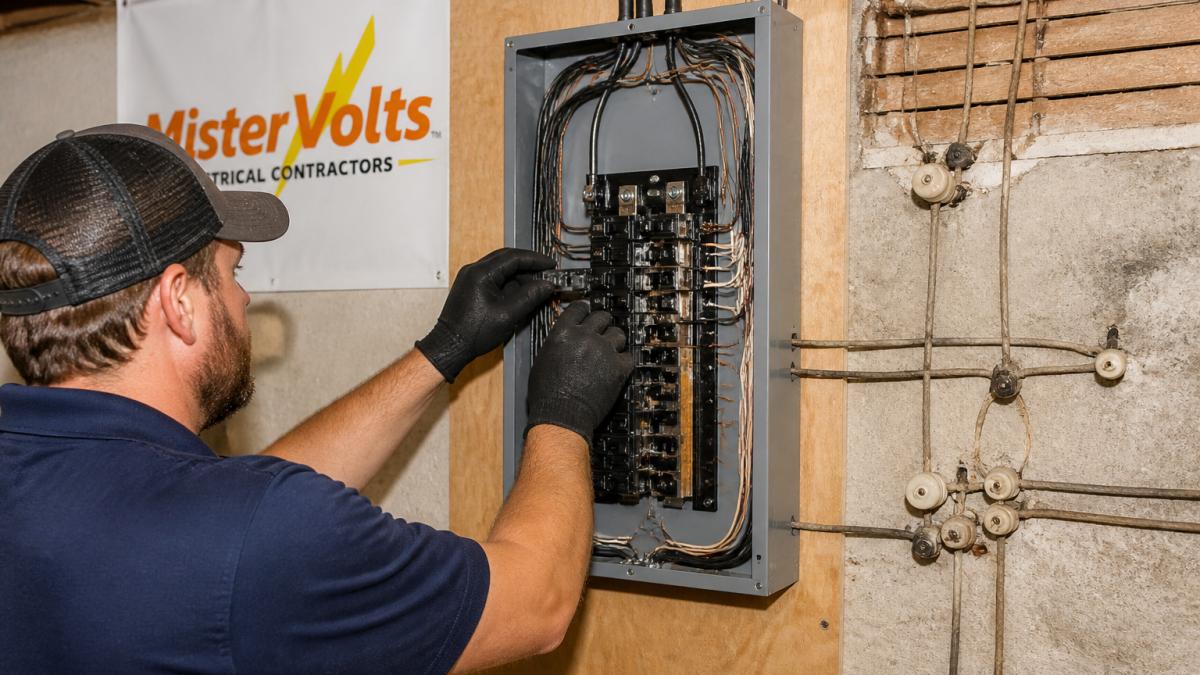
- Service panel and breakers: signs of heat, corrosion, loose connections, and correct breaker sizing
- Grounding and bonding: verification that fault current has a safe path
- GFCI and AFCI protection: confirmation that required locations are protected and devices trip correctly
- Wiring and connections: exposed conductors, damaged insulation, and improper splices
- Lighting and fixtures: secure mounting, correct wattage, and adequate clearance
- Receptacles and dedicated circuits: load testing and identification of overloaded circuits
- Emergency and exit lighting: function testing where required
The findings should come back as a written report with photos and prioritized recommendations, not a verbal summary.
How Often Retail Systems Should Be Inspected
Most retail electrical systems benefit from an inspection at least annually, with more frequent checks in high-traffic stores, food service operations, or buildings with older wiring (osha.gov). Any renovation, new equipment installation, or reported issue should trigger an additional inspection regardless of the calendar.
Commercial Electrical Maintenance Checklist for Retail Managers
A commercial electrical maintenance checklist turns electrical care from a reactive expense into a predictable routine. The goal is to catch small problems, warm breakers, flickering lights, damaged cords, before they escalate into outages or hazards.
Daily, Monthly, and Annual Tasks
| Frequency | Task | Why It Matters |
|---|---|---|
| Daily | Visual check of outlets, cords, and fixtures | Catches damage before it becomes a hazard |
| Daily | Confirm emergency and exit lights are lit | Required for safe evacuation |
| Monthly | Test GFCI receptacles | Confirms shock protection works |
| Monthly | Inspect panel for heat, noise, or odor | Early sign of overload or loose connection |
| Quarterly | Check POS and refrigeration circuits | Protects revenue-critical equipment |
| Annually | Full inspection by a licensed electrician | Verifies code compliance and system health |
| As needed | Load calculation before new equipment | Prevents overloading existing circuits |
Managers don't need to perform electrical work to run this checklist. The daily and monthly items are observation and testing tasks. Anything involving the panel interior, wiring, or repairs belongs to a licensed electrician.
Choosing an Electrical Partner for Safe and Reliable Retail Installations
The right electrical partner for a retail store is one who understands both code compliance and the operational cost of downtime. Reliability is not just about showing up; it is about scoping the work correctly, scheduling around store hours, and standing behind the finished installation.
When evaluating providers, ask directly:
- Are your electricians licensed, and can you provide references from similar retail work?
- How do you handle permits and inspections?
- What is your process for minimizing disruption during business hours?
- What warranty or guarantee covers the completed work?
The answers reveal whether a provider treats retail electrical work as a specialty or as a generic job. For store owners and facility managers, the difference shows up in fewer surprises, cleaner inspections, and systems that hold up under real retail demand.
Mister Volts provides licensed electricians for commercial and retail electrical work, from panel upgrades and breaker replacements to full building wiring, with a commitment to NEC-compliant installations and competitive quotes. You can review our services and request a quote through our website.
Frequently Asked Questions
What are the NEC requirements for retail electrical installations?
The National Electrical Code (NEC) sets minimum standards for wiring methods, grounding, overcurrent protection, receptacle placement, and lighting loads in retail spaces. Requirements vary by occupancy type and local amendments. A licensed electrician confirms which articles apply to your store and pulls the required permits before work begins. Inspectors then verify the installation matches the approved plans.
How often should retail electrical systems be inspected for safety?
Most retail environments benefit from an annual retail store electrical safety inspection, with more frequent checks in high-traffic stores, older buildings, or locations with heavy refrigeration and lighting loads. A qualified electrician can recommend a schedule based on your equipment, building age, and any prior issues. Documenting each inspection helps with insurance and compliance records.
What should be included in a commercial electrical maintenance checklist?
A practical commercial electrical maintenance checklist covers panel and breaker condition, GFCI testing, outlet and switch wear, lighting performance, emergency and exit lighting, grounding and bonding, and thermal scans of connections. It should also log any flickering, tripping, or warm outlets reported by staff. Review the list monthly and schedule repairs before small faults become outages.
How do reliable electrical installations impact retail operational costs?
Reliable installations reduce unplanned downtime, protect inventory like refrigerated goods, and lower energy waste from failing fixtures or loose connections. Fewer emergency repairs and extended equipment life also cut long-term maintenance spending. A properly sized panel and modern lighting controls let you add displays or equipment later without a full rewire.
Retail operations can't afford electrical surprises, and the difference between a safe system and a risky one usually comes down to planning and maintenance, not luck. Mister Volts brings licensed electricians, NEC-compliant installations, and a full range of commercial services, from minor repairs to complete building wiring, to every job. Get started with Mister Volts and keep your store powered safely through every peak hour.