
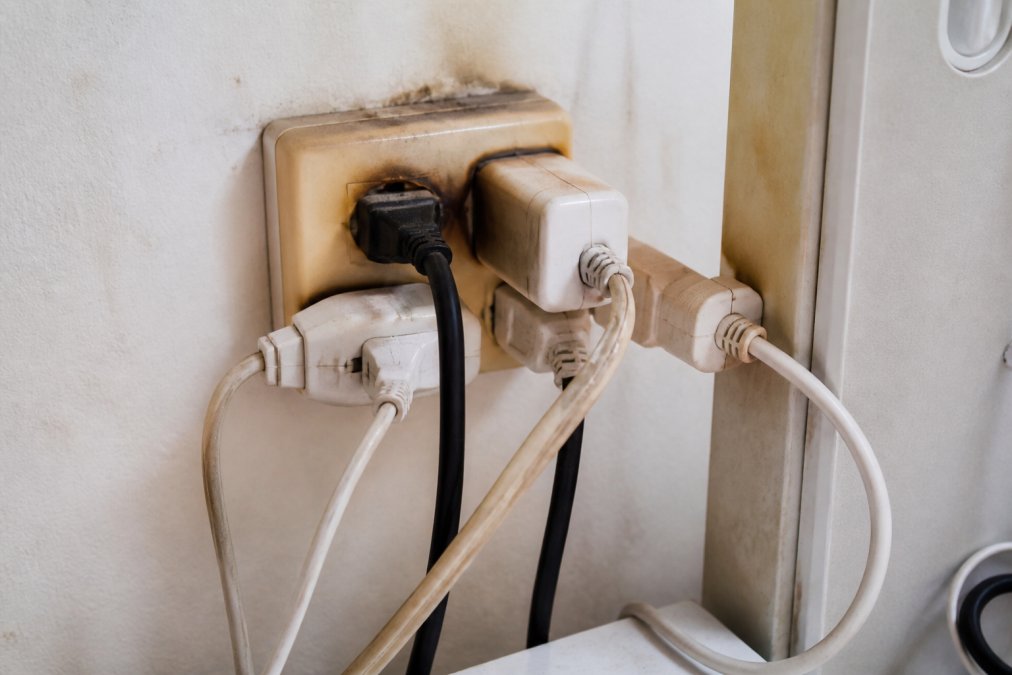
 ultimate-guide
Signs of Overloaded Circuits in Older Homes
Table of Contents
- 1. Frequently Tripped Circuit Breakers and Blown Fuses
- 2. Flickering or Dimming Lights
- 3. Warm, Discolored Wall Plates and Outlets
- 4. Burning or Plastic Smells and Buzzing Sounds
- 5. Signs of Outdated Electrical Wiring That Raise Overload Risk
- 6. How to Prevent Circuit Breaker Tripping
- 7. Electrical Panel Upgrade Cost and When You Need One
- Conclusion
- Frequently Asked Questions
Last Updated: September 24, 2026
1. Frequently Tripped Circuit Breakers and Blown Fuses
A circuit breaker that trips repeatedly is the clearest early warning that your home's wiring is straining under overloaded circuits. Each trip means the breaker did its job: it detected an overcurrent condition and cut power before thermal damage could start a fire.
Here's what most homeowners miss. A breaker that trips once during a heat wave is normal. A breaker that trips weekly, or trips the moment you run the microwave and the toaster together, is telling you the circuit is carrying more amperage than it was designed for. Older homes often have 60-amp or 100-amp service feeding circuits that were sized for a few lamps and a radio, not a modern kitchen.
Blown fuses tell the same story in older fuse-box systems. A fuse that blows, gets replaced, and blows again within days is a sign of a persistent overload rather than a one-off surge. Never upsize a fuse to stop it blowing. The fuse rating protects the wire, and a larger fuse lets the wire overheat inside the wall where you can't see it.
U.S. Fire Administration electrical fire safety guidance
2. Flickering or Dimming Lights
Lights that dim when the refrigerator kicks on point to a voltage drop, and voltage drop is a load problem. When a large appliance draws current, the voltage available to everything else on that circuit sags briefly. In a healthy system you barely notice. In an overloaded one, every light in the room dips.
Flickering is different from dimming. A flicker that pulses rhythmically often traces to a loose connection at the panel or a failing breaker, while random flickering across multiple rooms usually means the service itself is strained. One fixture flickering on its own is a fixture problem. Whole-house flickering is a system problem.
Pay attention to which rooms flicker and when. If the kitchen dims every time the air conditioner starts, those two loads are competing on shared capacity. That pattern is common in older homes where a single circuit was stretched across rooms that now carry far more appliance usage than the original wiring anticipated.
3. Warm, Discolored Wall Plates and Outlets
A wall plate that feels warm to the touch, or shows brown scorching around the slots, is a safety hazard that needs same-day attention. Heat at the outlet means resistance at the connection, and resistance generates the thermal damage you can see as discoloration.
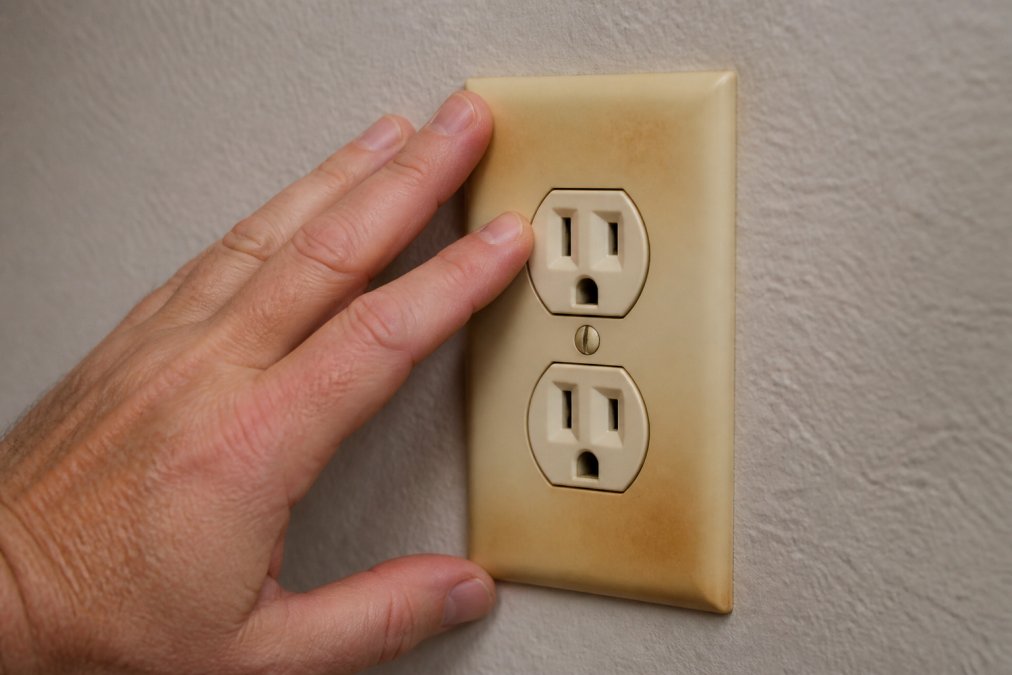
Discoloration ranges from faint yellowing to black charring, and the severity tracks how long the problem has been building. Outlets that feel warm, smell faintly of hot plastic, or show visible melting should be taken out of service immediately. Stop using that outlet, and don't plug a power strip or extension cord into it as a workaround.
The underlying cause is usually a loose wire termination, a worn outlet that no longer grips plugs tightly, or a circuit running at its limit. All three are fixable, but only before the heat damages the surrounding box and drywall.
4. Burning or Plastic Smells and Buzzing Sounds
A persistent burning smell with no visible source is a fire warning, not a nuisance. The smell of melting plastic near an outlet, switch, or panel means insulation is overheating somewhere in the circuit.
Buzzing, crackling, and humming sounds deserve the same seriousness. A faint hum from a dimmer switch can be normal. A crackle or buzz from a breaker, outlet, or panel is arcing, and arcing ignites surrounding material. If you hear crackling inside a wall, cut power at the panel and call a licensed electrician.
https://mistervoltsusa.com/contact →
Don't confuse these sounds with the quiet hum of a working appliance. The warning signs are sounds coming from the wiring itself: from the panel, from a switch plate, or from inside the wall. Those locations should be silent.
5. Signs of Outdated Electrical Wiring That Raise Overload Risk
Older wiring raises overload risk because the conductors, insulation, and terminations were engineered for a fraction of today's household demand. Two legacy systems cause most of the trouble, and each fails in a different way.
Knob-and-tube wiring runs individual hot and neutral conductors through ceramic knobs and tubes inside open framing, with no equipment ground.
- No ground path. There is no equipment ground, so a fault has nowhere safe to travel. That is why ungrounded outlets near water are a shock risk, not just an inconvenience.
- Brittle insulation. The cloth-and-rubber insulation dries out and cracks with age. Every time a conductor moves, during a renovation, a pest infestation, or a heavy load that heats the wire, the insulation can flake off and expose bare copper inside the wall.
- Oversized fusing relative to modern use. Knob-and-tube circuits were typically fused at 15 or 20 amps for lighting and small appliances. Plug a 1,500-watt space heater (about 12.5 amps at 120 volts) into one of those circuits and you are running it near its limit for hours at a time, which is exactly the duty cycle the original insulation was never asked to handle.
How to tell which system you have:
- Two-prong outlets with no ground slot, or three-prong outlets with no ground wire behind them
- A fuse box instead of a breaker panel
- Cloth-wrapped, rubber, or brittle insulation visible at connections
- Ceramic knobs or tubes in an attic, basement, or crawlspace
- Small-gauge aluminum conductors visible at a panel or outlet (silver-colored, often stamped "AL")
- No GFCI protection near water, and no AFCI protection on bedroom circuits
U.S. Consumer Product Safety Commission aluminum wiring repair guidance
6. How to Prevent Circuit Breaker Tripping
| Appliance | Typical wattage | Amps at 120V |
|---|---|---|
| Space heater | 1,500W | ~12.5A |
| Hair dryer | 1,500W | ~12.5A |
| Microwave | 1,000-1,500W | ~8-12.5A |
| Toaster | 800-1,500W | ~7-12.5A |
| Window AC (small) | 500-1,200W | ~4-10A |
| Refrigerator | 100-800W running | ~1-7A running |
| LED TV | 50-150W | ~0.4-1.3A |
| Phone charger | 5-20W | ~0.04-0.17A |
That last step matters most. Redistribution buys time, but it does not add capacity. If your panel is already full or your service is 60 or 100 amps feeding a house with modern appliances, no amount of rearranging fixes the underlying limit.
7. Electrical Panel Upgrade Cost and When You Need One
Electrical panel upgrade cost depends on the amperage, the condition of the existing service, and how much rewiring the new panel requires, so pricing is quoted per home rather than set from a flat rate. For an accurate figure, request a quote based on an on-site inspection.
| Situation | What It Signals | Typical Next Step |
|---|---|---|
| Breakers trip weekly despite redistribution | Service at capacity | Load calculation, then panel evaluation |
| Fuse box still in service | No modern overcurrent protection | Panel replacement |
| Adding an EV charger or heat pump | New high-draw load | Capacity check before install |
| Warm panel or scorch marks | Thermal damage at connections | Immediate inspection |
| No spare breaker slots | No room for new circuits | Panel upgrade |
Conclusion
The signs of overloaded circuits in older homes rarely appear alone. A tripping breaker, a warm wall plate, and a faint buzzing sound are usually three symptoms of one capacity problem, and the fix is a proper load evaluation rather than another workaround. At Mister Volts, our licensed electricians handle everything from a single outlet repair to full panel upgrades and complete building wiring, all NEC-compliant and backed by competitive quotes.
NFPA 70 National Electrical Code overview
Frequently Asked Questions
How to tell if an electrical circuit is overloaded?
The most reliable signs include a breaker that trips repeatedly, lights that flicker or dim when appliances cycle on, and wall plates that feel warm. In older homes, these symptoms often point to overloaded circuits struggling with modern appliance demand. If a breaker trips more than once a month, or you smell burning near an outlet, stop using that circuit and have a licensed electrician inspect it before something worse happens.
What are three warning signs of an overloaded electrical circuit?
Three clear warning signs are a circuit breaker that trips often, lights that flicker or dim when you turn on other devices, and outlets or wall plates that feel warm to the touch. A fourth sign many homeowners miss is a faint buzzing or crackling sound near a switch or outlet. Any of these signs of overloaded circuits in older homes deserve a professional look because they signal heat buildup inside the wiring.
Will an overloaded circuit fix itself?
No. An overloaded circuit will not resolve on its own. A tripped breaker or blown fuse is a safety response, not a cure. If you simply reset the breaker without reducing the load, the same condition returns. Over time, repeated overcurrent cycles cause thermal damage to wiring insulation and outlet contacts. The fix is either redistributing appliance usage across circuits or upgrading the electrical panel so it can handle the actual amperage your home draws.
Why are older homes more susceptible to electrical circuit overloads?
Older homes were wired for far fewer appliances than a typical household uses today. A 1950s home might have had one 15-amp circuit for an entire bedroom wing. Now that same circuit powers TVs, computers, phone chargers, and space heaters. Add outdated wiring materials like knob-and-tube or undersized aluminum, and the circuit reaches its wattage limit quickly. Signs of outdated electrical wiring, such as ungrounded outlets and cloth-insulated conductors, make overloads more dangerous because the system has less margin for error.