 Listicle
Signs Your Home Needs a Standby Generator: A Homeowner's Checklist
Last Updated: November 19, 2026
Quick Summary
Your home needs a standby generator if outages are frequent or long, or if a single loss of power would damage your home, food supply, or health. Score each outage from the past twelve months on frequency, duration, and household impact to see whether a standby generator is worth it.
- Score each outage from the past twelve months on frequency, duration, and household impact.
- Outages that happen more than a few times a year, or run for many hours, justify backup power.
- Medical equipment such as oxygen concentrators and home dialysis machines depends on steady electricity.
- Sump pumps need electricity, so the pump protecting your basement stops when the power fails.
- A standby generator runs on natural gas or propane and starts automatically within seconds of an outage.
Table of Contents
- How to Tell If Your Home Needs a Standby Generator
- 1. You're Seeing More Frequent or Longer Power Outages
- 2. Storm Season Leaves Your Household in the Dark
- 3. You've Lost Food or Comfort During an Extended Outage
- 4. Someone in Your Home Relies on Medical Equipment or Well Water
- 5. You Work From Home or Run a Business From the House
- 6. Your Sump Pump or Basement Is at Risk When the Power Fails
- Standby Generator vs. Portable Generator: Which Fits Your Home?
- Home Generator Installation: What the Process Involves
- The Bottom Line on Backup Power
- Frequently Asked Questions
How to Tell If Your Home Needs a Standby Generator
A standby generator is a permanently installed backup power system that starts automatically when utility power fails. Most signs your home needs a standby generator come down to one question: how often does your household lose power, and what does that outage actually cost you? Below, we cover eight situations that point toward backup power, plus the sizing, safety, and cost factors that shape the decision.
The short answer: if outages in your area are frequent or long, or if a single loss of power would damage your home, food supply, or health, a standby unit deserves serious consideration.
1. You're Seeing More Frequent or Longer Power Outages
Outages that arrive more often, or last longer, are the clearest early signal. Tree limbs, aging utility equipment, and severe weather can knock out power more regularly than in the past.
Most guides stop at "count your outages." A more useful approach is to score each outage on three dimensions: frequency, duration, and household impact. Frequency tells you how often the system fails. Duration tells you how long you must self-supply. Impact tells you what actually breaks when the power stops. A household with four two-hour outages a year may need nothing more than flashlights. A household with one five-day outage that spoils food, floods a basement, or interrupts medical care has a stronger case than the raw count suggests.
Use this simple scoring tool. For each outage in the past twelve months, assign points:
- Frequency: 1 point for each outage beyond two per year.
- Duration: 1 point for any outage longer than four hours; 2 points if any outage exceeded twenty-four hours.
- Impact: 2 points if food spoiled, 2 points if someone lost income or work time, 3 points if medical equipment or well water was affected, and 2 points if the basement flooded or the sump pump failed.
The scoring above is a rough way to weigh a single severe outage against a string of minor ones instead of treating every flicker as equal evidence.
Ask yourself three questions to sanity-check the score:
- How many outages have you had in the past twelve months?
- What was the longest one, in hours?
- Did any of them happen during extreme heat or cold, or while someone was home alone?
Outages that happen more than a few times a year, or that run for many hours, are the kind a standby generator is meant to cover. The scoring tool matters because it separates a nuisance from a pattern that costs you money, safety, or both.
The article suggests scoring each outage from the past twelve months on three dimensions.
| Dimension | Points | Trigger |
|---|---|---|
| Frequency | 1 | Each outage beyond two per year |
| Duration | 1 | Any outage longer than four hours |
| Duration | 2 | Any outage exceeded twenty-four hours |
| Impact | 2 | Food spoiled |
| Impact | 2 | Someone lost income or work time |
| Impact | 3 | Medical equipment or well water affected |
| Impact | 2 | Basement flooded or sump pump failed |
2. Storm Season Leaves Your Household in the Dark
Storm-driven outages are different from routine flickers. They arrive with high winds, downed lines, and utility crews stretched thin, so restoration can take days. If your neighborhood sits on a line that seems to go down first and come back last, you already know the pattern.
What most guides miss is that the risk isn't just the storm itself. The dangerous stretch is the cleanup period, when heat, spoiled food, and dark stairwells create their own hazards. A standby generator that restores power automatically removes that entire window of vulnerability.
3. You've Lost Food or Comfort During an Extended Outage
An extended outage turns your refrigerator and freezer into a countdown timer. Once food spoils, you're replacing a full week of groceries, and no one wants to guess whether the milk is still safe.
Comfort matters just as much. During a summer outage, a home without air conditioning can become genuinely unsafe for children, older adults, and anyone with health conditions. In winter, a heat pump without power leaves the house cold fast. If you've already thrown out a freezer's worth of food or spent a night in a sweltering house, that's your answer. You can book residential generator installation for your Middle Georgia home.
4. Someone in Your Home Relies on Medical Equipment or Well Water
This is the sign that moves backup power from convenience to necessity. Medical equipment such as oxygen concentrators, home dialysis machines, and certain monitors depends on steady electricity. A utility service interruption isn't an inconvenience in those households; it's a health risk.
Homes on a private well have a similar problem. The well pump needs power to deliver water, so an outage means no running water, no flushing, and no showers. If either situation applies, plan for backup power before the next storm season, not during it.
5. You Work From Home or Run a Business From the House
When your income depends on a router, a computer, and a reliable connection, every outage is lost work. A single afternoon offline can mean missed calls, delayed deadlines, and unhappy clients.
Home-based businesses raise the stakes further. Freezers full of inventory, point-of-sale systems, and security equipment all stop dead without power. If you've ever taken meetings from a parking lot to find a signal, a standby generator is worth pricing out. Our electrical system upgrade guide explains how to check whether your home's electrical capacity can support added backup equipment.
6. Your Sump Pump or Basement Is at Risk When the Power Fails
Here's the failure mode homeowners overlook most: sump pumps need electricity. The heaviest rain often arrives with the power already out, so the pump that protects your basement stops exactly when it's needed.
If your basement has flooded before, or if your sump pump runs regularly during storms, backup power protects more than your comfort. It protects your foundation, flooring, and stored belongings. If you're also noticing a panel that trips under load, read our guide to the warning signs your electrical panel needs attention before adding a generator to the system.
Standby Generator vs. Portable Generator: Which Fits Your Home?
The right choice depends on how much convenience and protection you want. A standby generator runs on natural gas or propane, sits outside on a concrete pad, and starts automatically within seconds of an outage. A portable generator costs less up front, but you have to wheel it out, fuel it, and connect it by cord, and it can't run unattended overnight.
In practice, the trade-off looks like this:
- Standby generator: automatic power restoration, whole-home or essential-circuit coverage, higher installation cost, requires professional installation and a transfer switch.
- Portable generator: lower upfront cost, manual setup, limited power output, needs fuel on hand and safe placement away from windows.
Consumer Reports frames the decision around outage frequency and duration, plus whether you value a generator that starts on its own, and notes that standby units are expensive (Consumer Reports generator comparison). For homeowners facing repeated multi-day outages, that expense often pays for itself in peace of mind. When you're ready to talk through options, you can start with a conversation about your home's needs.
Home Generator Installation: What the Process Involves
Professional installation follows a set sequence, and skipping steps creates real safety risks. A licensed electrician sizes the unit to your load, sets the pad, installs a transfer switch, and connects fuel and electrical lines to code.
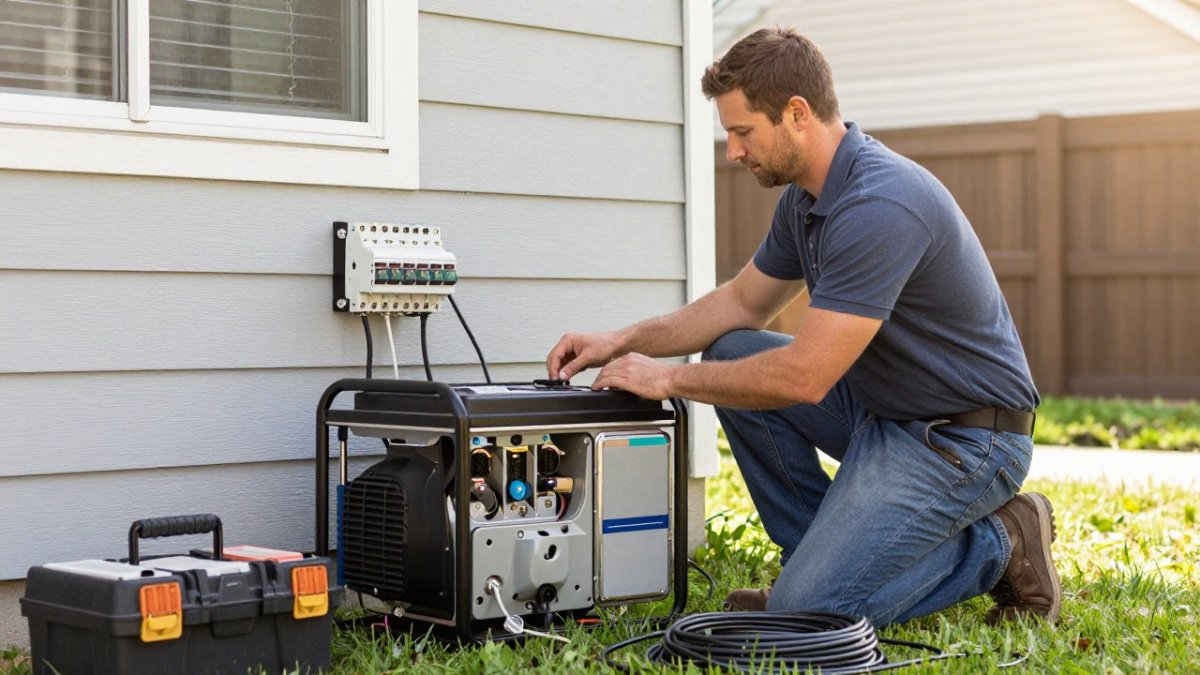
The first decision is whole-home versus essential-circuit backup, and it drives everything that follows. Whole-home backup sizes the generator to carry every load in the house at once, including central air conditioning, electric ranges, and electric water heating.
Build that load list before you shop. Walk through the house and note every appliance you would want during an outage, then separate must-run items from nice-to-have items. A well pump, sump pump, furnace, refrigerator, and medical device belong in the must-run column. A hot tub, electric dryer, and pool pump usually do not.
Sizing comes next. Most homes fall within a range that depends on which appliances you want to run; Champion Power Equipment suggests sizing by adding essential appliances' running watts plus the highest single load (Champion generator sizing guide).
Watch out: a generator connected without a proper transfer switch can backfeed power onto utility lines and endanger line workers. That connection is not a DIY job. The transfer switch also prevents utility and generator power from meeting at the panel, which can destroy equipment or start a fire.
Budget for total cost of ownership, not just the sticker price. The four components are the unit, installation, fuel, and maintenance. Installation includes the pad, transfer switch, electrical wiring, fuel connection, and permits, and it can rival the equipment cost in a complicated retrofit.
Finally, plan for upkeep from day one. Standby generator maintenance includes regular testing, oil changes, and an annual service check. A unit that sits untested for a year may not start when you need it, so schedule the exercise cycle and the annual service as part of the installation plan.
The Bottom Line on Backup Power
Start by counting your outages and listing what fails when the power goes: food, heat, water, work, or medical equipment. If more than one item on that list matters to your household, it's time to call a licensed electrician for an assessment. Mister Volts is a team of licensed electricians serving Middle Georgia with code-compliant electrical work and competitive quotes. We can help you assess your home's electrical needs and plan the work with care. Get started with Mister Volts and keep your home powered through the next outage.
Frequently Asked Questions
How do I know if my home needs a standby generator?
Start by tracking your outages. If you lose power several times a year or sit through outages lasting more than a few hours, a standby generator is worth considering. Other signs include a refrigerator full of spoiled food, medical equipment that depends on electricity, a sump pump that protects your basement, or a home office that can't go dark. A licensed electrician can review your panel and load to confirm whether a standby generator fits your home.
What is the difference between a standby generator and a portable generator?
A standby generator is permanently installed outside your home and wired to a transfer switch. It starts automatically when utility power fails and runs on natural gas or propane. A portable generator is moved into place, powered by gasoline, and connected manually with extension cords or a manual transfer switch. Standby units cost more but offer automatic power restoration and whole-home or essential-circuit coverage. Portable units suit shorter, less frequent outages and smaller loads.
Can a standby generator power an entire house?
Yes, but sizing matters. Sizing is based on the essential appliance running watts plus the highest single starting load. Whole-home power requires a larger generator and a service-rated transfer switch, while essential-circuit backup costs less and covers the furnace, refrigerator, well pump, and a few lights. An electrician can calculate your power requirements from the electrical panel.
How often should a standby generator be serviced?
Routine testing and periodic service help confirm automatic power restoration works. Maintenance covers oil and filter changes, spark plugs, battery condition, fuel system inspection, and a load test. Because a standby generator sits idle for months, wear and tear can hide until the next storm outage. Regular service can help catch unusual noise, vibration, exhaust smoke, or fluctuating voltage before they become failures.