 Listicle
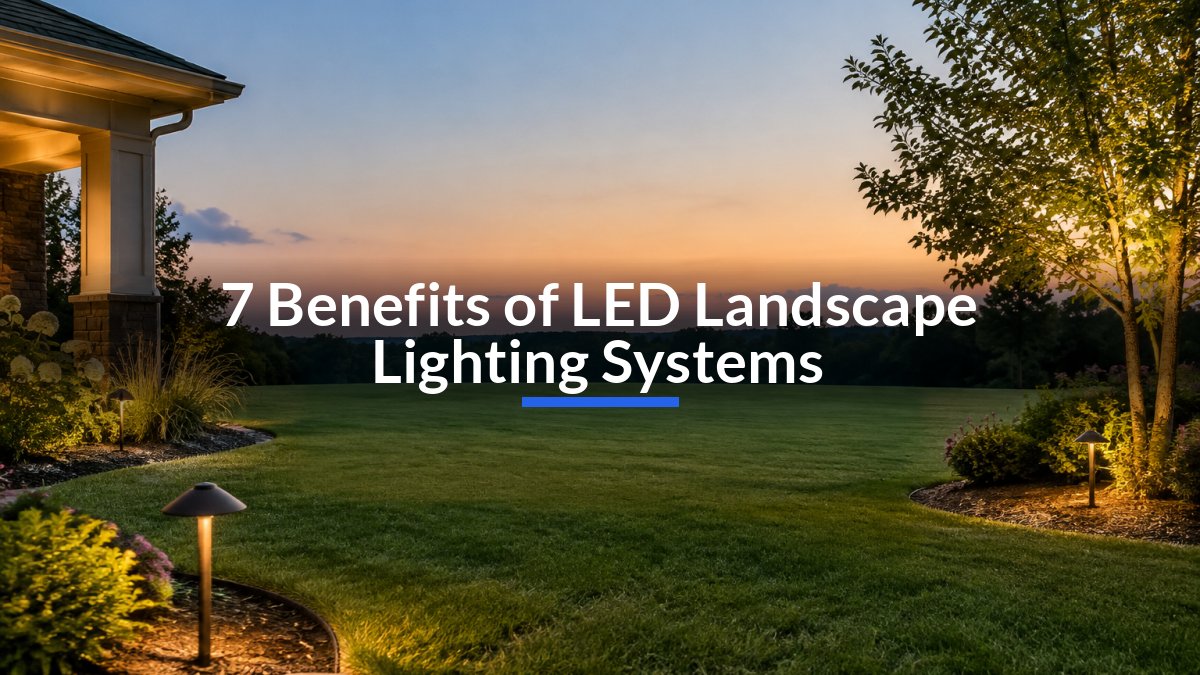
7 Benefits of LED Landscape Lighting Systems
Last Updated: November 6, 2026
Quick Summary
LED landscape lighting uses light-emitting diodes to illuminate yards, walkways, and building exteriors at a fraction of the energy older bulbs demand, converting most of its energy into light instead of heat. The benefits include lower power draw, longer life, and far less maintenance than halogen systems.
- A quality LED landscape fixture lasts up to 50,000 hours, versus about 2,000 hours for halogen.
- LEDs use about 80% less energy than older lighting for the same light output.
- Low-voltage landscape lighting runs on 12 volts through a transformer, making it safer around soil, stone, and water.
- Most residential landscape lighting sits between 2700K and 3000K for warm white light.
- Space path lights every 6 to 8 feet for a 12- to 18-inch fixture so the pools just touch.
Table of Contents
- Why LED Landscape Lighting Systems Are Worth the Switch
- LED vs Halogen Landscape Lighting: How the Two Compare
- How Long Do LED Landscape Lights Last?
- Energy Use and Operating Costs You Can Expect
- Low-Voltage Landscape Lighting and Why It Fits Most Yards
- Safety, Security, and Durability Benefits
- Landscape Lighting Design Ideas That Show Off Your Property
- Planning Your LED Lighting Upgrade with Mister Volts
- Frequently Asked Questions
Why LED Landscape Lighting Systems Are Worth the Switch
LED landscape lighting systems use light-emitting diodes to illuminate yards, walkways, and building exteriors at a fraction of the energy older bulbs demand. Industry forecasts put LED at 74.4% of the commercial landscape lighting market in 2026, according to Coherent Market Insights' commercial landscape lighting forecast, driven by energy efficiency and design flexibility. At Mister Volts, we install and service these systems across Middle Georgia, and the reasons homeowners switch rarely change: lower power draw, longer life, and far less maintenance.
The core benefit is simple. A LED landscape lighting system converts most of its energy into light instead of heat, so the same brightness costs less to run. You also stop climbing ladders to replace bulbs every season. Below, we break down seven reasons the switch pays off, from lifespan and operating costs to safety and curb appeal.
LED vs Halogen Landscape Lighting: How the Two Compare
Halogen bulbs burn hot and die young; LED runs cool and lasts for years. A published cost guide for homeowners compares LED lifespan at 50,000 hours against roughly 2,000 hours for older lighting, per Moda Outdoor Living's landscape lighting cost guide. That gap is the whole argument in one number.
| Feature | LED | Halogen |
|---|---|---|
| Typical lifespan | Up to 50,000 hours | About 2,000 hours |
| Heat output | Low | High |
| Energy use | Much lower | Higher |
| Bulb changes | Rare | Frequent |
| Upfront cost | Higher | Lower |
Be honest about the trade-off: LED carries a higher upfront purchase and installation cost than halogen, and some people find LED color slightly less warm than halogen, as Tru-Scapes' LED vs halogen comparison notes. In practice, the lower running and replacement costs close that gap over time.
How Long Do LED Landscape Lights Last?
A quality LED landscape fixture lasts up to 50,000 hours, which works out to well over a decade of normal evening use. Halogen bulbs in the same fixture often need replacing every year or two. That difference is the LED landscape lighting lifespan advantage in plain terms: fewer bulbs to buy, fewer fixtures to open, and less time on a ladder.
What shortens that life? Heat trapped in a poorly ventilated fixture, water intrusion at the connections, and cheap drivers. Proper sealing and a correctly sized transformer protect the investment.
Energy Use and Operating Costs You Can Expect
LED landscape lighting uses far less electricity than halogen for the same light output. The same cost guide cited above reports LEDs use about 80% less energy than older lighting, per Moda Outdoor Living. On a low-voltage system, that translates to a smaller transformer and a lighter load on your bill.
Operating cost also depends on runtime. Networked controls let you trim wasted hours and adjust output to conditions, an approach Action Services Group's outdoor lighting controls overview describes as a way to cut unnecessary operating time. A simple timer or photocell does the same job on a basic system. We can't quote an exact monthly figure without seeing your layout, so treat any promised dollar savings with suspicion until someone measures your actual load.
Low-Voltage Landscape Lighting and Why It Fits Most Yards
Low-voltage landscape lighting runs on 12 volts through a transformer that steps down household current, which makes it safer to install around soil, stone, and water. Most residential yards are a natural fit. The wiring is shallow, the fixtures are smaller, and you can add a path light or two without redoing the whole run.
Sizing the transformer correctly matters more than people expect. Add up the wattage of every fixture, leave headroom for future additions, and match the transformer to the total. Undersized transformers cause dim, flickering lights and premature driver failure. Our guide to outdoor landscape lighting installation walks through transformer sizing, NEC requirements, and wiring so you can see what the job involves.
Safety, Security, and Durability Benefits
Outdoor lighting earns its keep in two practical ways: it helps people see where they are walking, and it removes the dark pockets that make a property easier to target. The safety side is mostly about contrast and glare control. A path light that shines into someone's eyes is worse than no light at all, because the pupil constricts and the steps beyond it go black. The fix is shielding and aiming: use fixtures with cutoffs or louvers, keep the light on the walking surface, and space path lights so the pools overlap slightly rather than leaving gaps.
On the security side, the goal is not brightness but consistency. A porch light that snaps on only when something moves tells you something moved; a system that keeps entries, garage aprons, and side yards evenly lit makes the approach less attractive in the first place. Motion sensors still have a place, and our article on motion sensor lighting for industrial safety explains how sensors cut energy and support safety compliance. For residential systems, a photocell plus a timer is usually enough to keep lights on from dusk until a set hour, with a manual override for late arrivals.
Durability is where LED separates itself, but only if the fixture is built for outdoors. The LED itself is not the weak point; the driver and the connections are. A sealed housing with a gasketed lens keeps rain and irrigation spray off the driver. Potting or conformal coating on the driver board protects it from humidity and temperature swings. Connectors should be gel-filled or heat-shrink sealed, because the most common failure we see is corrosion at a wire nut that was twisted on and left exposed.
Watch out: a fixture rated for wet locations is not automatically rated for direct burial or for use in a fountain. Check the UL listing and the manufacturer's location rating before you put a fixture where water will stand.
Heat management matters too, even though LED runs cooler than halogen. A driver crammed into a small housing with no ventilation will run hot and fail early, which is why quality fixtures use metal housings as a heat sink and why cheap plastic fixtures often die in the first few summers. Fewer failures mean fewer service calls and a system that still looks right years after install.
Landscape Lighting Design Ideas That Show Off Your Property
The right layout turns a plain yard into a feature at night, and LED gives you more control over that layout than halogen ever did. The three dials that matter most are color temperature, beam spread, and fixture placement.
Color temperature is measured in kelvin. Most residential landscape lighting sits between 2700K and 3000K, which reads as warm white and flatters brick, stone, and wood. Going above 4000K starts to look clinical and can wash out foliage. The common mistake is mixing temperatures on the same facade, so pick one and stay with it across the whole system.
Beam spread is the angle of the cone of light. A narrow beam, roughly 10 to 15 degrees, throws a tight pool and is good for highlighting a trunk or a sculpture. A medium beam, around 25 to 35 degrees, suits most uplighting on trees and walls. A wide beam, 60 degrees or more, is for washing a facade or lighting a patio. The narrower the beam, the more fixtures you need to cover the same area, so spread and count are a trade-off.
Placement follows the same logic. Here are ideas we use often:
- Uplight a large oak or pine from 2 to 3 feet off the trunk so the canopy catches the light rather than the bark
- Line a stone walkway with path lights spaced so the pools just touch, usually every 6 to 8 feet for a 12- to 18-inch fixture
- Wash a brick or stone facade with downward light from the eaves to avoid glare at eye level
- Highlight a garden bed or water feature with a single accent fixture rather than a ring of them
- Keep color temperature consistent across the whole system
Aim for layers rather than a flood of light. A mix of path, accent, and wash lighting reads as intentional. For more inspiration on layered setups and color temperature, see our guide to custom lighting ideas for home offices, which covers the same principles indoors.
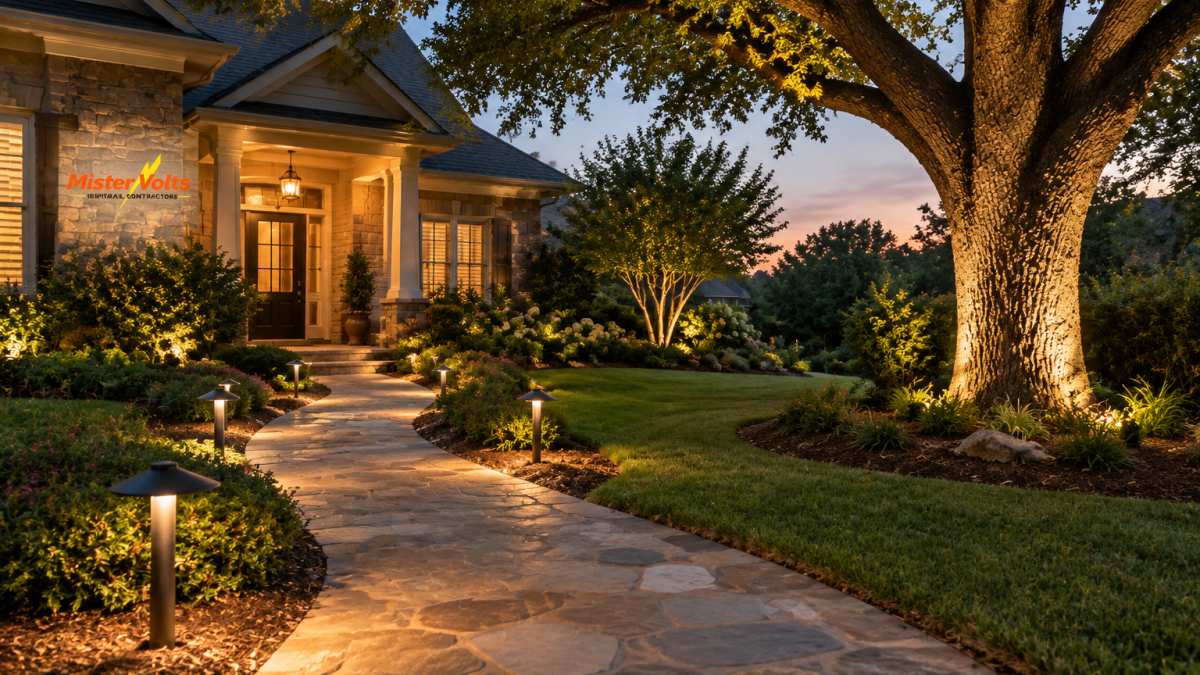
Watch out: a fixture aimed straight up a trunk from too close will produce a hot spot and leave the rest of the tree dark. Step back and angle slightly toward the canopy.
Planning Your LED Lighting Upgrade with Mister Volts
An LED upgrade starts with a plan: count your fixtures, size the transformer, choose a consistent color temperature, and decide where you want light. Most homeowners can handle the layout decisions. The wiring, transformer connections, and panel work are where a licensed electrician is needed.
Mister Volts is a licensed electrical team serving homeowners and businesses across Middle Georgia. We handle the electrical side of a lighting upgrade, from the transformer and circuit to the fixtures, with code-compliant installation. If the job calls for a dedicated outdoor circuit, we can also install or upgrade service panels and circuit breakers to support it. If you want to see the full scope of what we do around the home, our residential electrical services page covers repairs, panel upgrades, and fixture installation. When you're ready, start with a conversation about your project and get a clear quote.
Frequently Asked Questions
Do LED landscape lights use less electricity than traditional lights?
Yes. LED fixtures convert most of their power into light instead of heat, so they draw far less electricity than halogen bulbs for the same brightness. LEDs generally use substantially less energy than older lighting. Over a full season of nightly use, that gap shows up clearly on your utility bill, especially if you run several fixtures across a large yard. Pairing LEDs with a timer or photocell control cuts wasted runtime further.
How long do LED landscape lights last?
LED lifespan is commonly rated far longer than older halogen bulbs. At four hours of nightly use, that works out to decades of service from a single fixture. Real-world life depends on fixture quality, heat management, and moisture sealing, so choose weather-rated units and have connections installed correctly. Fewer bulb changes means less ladder work and lower long-term maintenance.
Are LED landscape lights worth the higher upfront cost?
The purchase and installation cost of LED systems usually runs higher than halogen, and some users find LED color quality less natural. The trade-off comes in lower energy use, a much longer lifespan, and less frequent replacement. For homeowners planning to stay in the property, those savings typically outweigh the initial gap. Ask for a quote that separates fixture cost from installation labor so you can compare fairly.
Can LED landscape lighting improve outdoor safety and security?
Well-placed lighting removes dark pockets around walkways, steps, driveways, and entry doors, which lowers trip risk after dark. Targeted fixtures also make a property less appealing to intruders by keeping entrances and side yards visible. Responsible outdoor lighting, with shielded fixtures aimed downward, can save energy and reduce light pollution. A licensed electrician can lay out coverage so light lands where it is useful.
A lighting upgrade is one of the few home projects that pays you back every month in lower power use and fewer bulb changes. If your yard is dark, your old fixtures keep failing, or you're planning a new install, Mister Volts can size the system, handle the wiring, and get it done right the first time. Our licensed electricians bring competitive quotes, precise workmanship, and NEC-compliant installs to every job. Get started with Mister Volts and light up your property with confidence.