 Listicle
Warning Signs Your Electrical Panel Is a Fire Hazard
Last Updated: November 5, 2026
Quick Summary
The signs your electrical panel is a fire hazard include a burning or fishy smell near the panel, breakers that trip repeatedly or feel hot, and crackling or sizzling sounds that signal arcing. Scorch marks, melted insulation, rust, or flickering lights across several rooms also point to danger. Shut off power and call a licensed electrician if you notice any of these.
- Electrical failures cause roughly 7% of all residential structure fires in the United States.
- A breaker that trips the instant you reset it means the fault is still live, so stop resetting it.
- Breakers should run cool; one noticeably hotter than its neighbors should be shut off.
- Never open the panel cover yourself, since main lugs stay energized even with the main breaker off.
- A proper inspection includes thermal scanning, torque checks, and grounding verification.
Table of Contents
- Why Electrical Panel Fire Hazards Deserve Your Attention
- Burning Smells and Odors Near the Panel
- Signs of a Faulty Circuit Breaker: Tripping, Heat, and Reset Failures
- Buzzing, Crackling, and Sizzling Sounds From the Panel
- Flickering Lights, Visible Damage, and Other Warning Signs
- NEC Electrical Code Requirements and What a Professional Inspection Involves
- Electrical Panel Replacement Cost and Repair Versus Replace Decisions
- Schedule a Panel Safety Inspection With Mister Volts
- Frequently Asked Questions
Why Electrical Panel Fire Hazards Deserve Your Attention
Electrical failures and malfunctions cause roughly 7% of all residential structure fires in the United States, according to 2026 electrical fire statistics. The Electrical Safety Foundation International estimates home electrical fires strike about 51,000 times a year, causing nearly 500 deaths and more than 1,400 injuries. At Mister Volts, we've walked into plenty of Macon and Perry homes where the panel was quietly building toward exactly that outcome.
The signs your electrical panel is a fire hazard are rarely dramatic at first. A faint smell. A breaker that trips more often than it used to. A buzz you hear for a second and then forget. Those small clues matter because the panel is the one component every circuit in your house passes through.
Below, we'll show you exactly what to look for, what to do the moment you spot it, and when it's time to call a licensed electrician. The warning signs we cover are the kinds of issues our electricians look for during a panel inspection.
Burning Smells and Odors Near the Panel
A burning smell near your electrical panel is the single most urgent warning sign on this list. It usually means heat is degrading plastic, insulation, or wire somewhere behind the cover. Stop using the circuits on that panel and call an electrician.
Watch for two distinct odors. A fishy, acrid smell often points to overheating plastic or the insulation around wiring. A sharper, metallic burning smell can indicate arcing inside the panel or at a loose connection. Neither smell improves on its own, and both get worse under load.
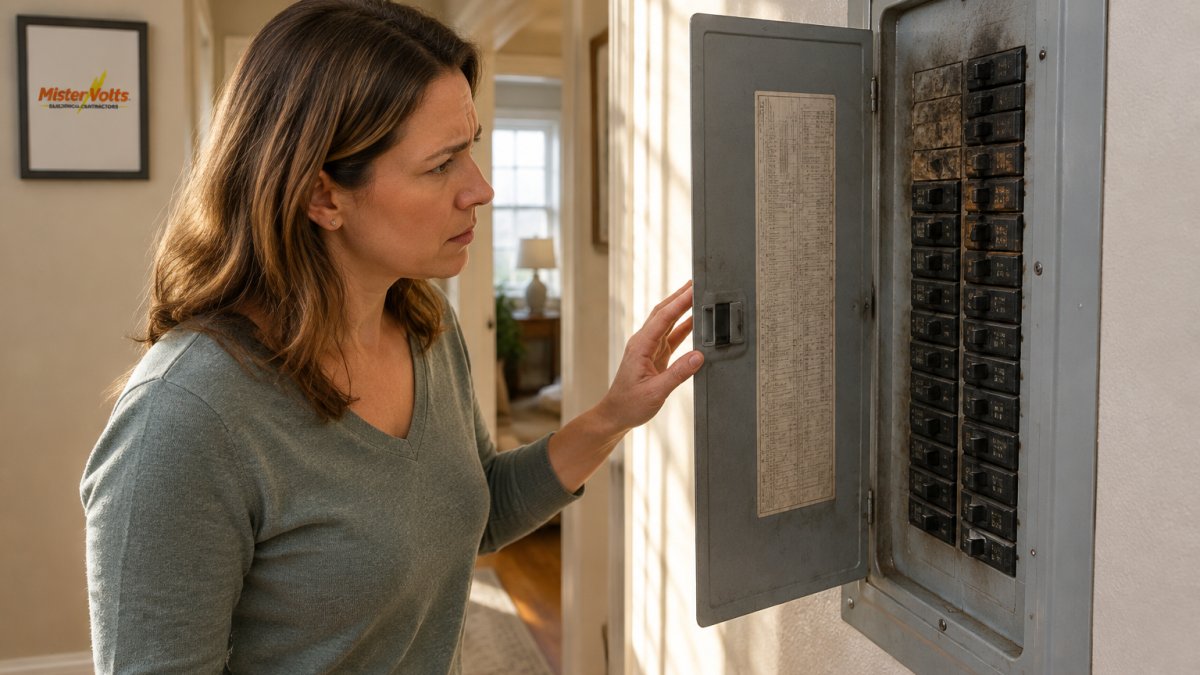
A common mistake is airing out the room and assuming the smell came from somewhere else. If the odor returns when you run the dryer, the oven, or the AC, the panel is telling you something. Treat burning plastic odor near a panel as a reason to shut off power at the main breaker and make a call.
Signs of a Faulty Circuit Breaker: Tripping, Heat, and Reset Failures
A breaker that trips once during a storm is normal. A breaker that trips weekly, feels warm to the touch, or refuses to stay reset is not.
The hard part is that the same symptoms can come from three very different places: the breaker, the circuit wiring, or whatever is plugged into it. A thorough diagnosis separates these causes, which is the difference between replacing a single breaker and missing a panel-level fire hazard.
| What you observe | Most likely cause | Where the hazard lives |
|---|---|---|
| One breaker trips only when a specific appliance runs | Appliance fault or an overloaded circuit | Circuit or appliance, not usually the panel |
| One breaker trips under the same load every time, even with nothing plugged in | Wiring fault on that circuit | Circuit wiring |
| Breaker trips immediately after reset | Short circuit or ground fault still present | Circuit or panel |
| Breaker face is noticeably hotter than its neighbors | Loose connection or failing breaker | Panel |
| Multiple breakers trip across unrelated circuits | Capacity problem or a loose service connection | Panel or service entrance |
| Breaker will not reset at all | Failed breaker or a shorted circuit | Breaker or circuit |
| Breaker trips and there is a burning smell or scorch mark | Arcing at a connection | Panel, treat as urgent |
Here is how to read that table without doing anything unsafe. Start with what changed. If the trips began after you added a space heater, a window AC, or a new appliance on that circuit, the load is the first suspect.
If the trips continue with nothing plugged in, the fault is in the wiring or the panel, and that is electrician territory. A breaker that trips the instant you reset it is telling you the fault is still live.
A warm breaker is worth taking seriously. Breakers should run cool. If one is noticeably hotter than its neighbors, shut that circuit off and leave it off until an electrician looks at it.
Watch out: do not open the panel cover to check torque or inspect the bus yourself.
If you're seeing these symptoms, our guide on when to replace an electrical panel walks through the warning signs that point to replacement rather than repair.
Buzzing, Crackling, and Sizzling Sounds From the Panel
Crackling or sizzling from inside a panel is the sound of electrical arcing, and it is a genuine fire risk. Buzzing and humming can be normal in small amounts, but a loud or new buzz is not.
Listen carefully to where the sound comes from. A steady hum you've heard for years is usually harmless transformer noise. A crackle, pop, or sizzle that comes and goes is different. That's current jumping across a gap it shouldn't cross, and it throws sparks and heat every time it happens.
Watch out: never open the panel cover to investigate a crackling sound yourself. The main lugs stay energized even with the main breaker off in many older panels, and the risk of electrocution is real. Shut off power at the meter if you can do so safely, then call a licensed electrician.
Flickering Lights, Visible Damage, and Other Warning Signs
Flickering or dimming lights across several rooms at once often trace back to a loose connection at the panel rather than a bad bulb. When lights pulse in time with an appliance kicking on, the panel is struggling to carry the load.
Visible damage is the easiest sign to confirm with your own eyes. Look for:
- Scorch marks on the panel cover or around breaker slots
- Melted wire insulation or discolored wiring at the breaker terminals
- Rust, corrosion, or moisture inside the panel
- Breakers that don't match the panel brand, a sign of mixed breaker brands installed by someone improvising
- A panel type you've been told is a recalled panel or known problem model
Rust and moisture damage deserve special attention. Water and electricity don't coexist quietly, and corrosion on the bus bars creates resistance, which creates heat. If your panel sits in a garage, basement, or utility closet with any history of dampness, have it inspected.
NEC Electrical Code Requirements and What a Professional Inspection Involves
The National Electrical Code sets the minimum safety standards for panel installation, breaker sizing, grounding, and clear working space. An inspection checks your panel against those standards and against how your home actually uses power today.
Here is what a proper panel inspection involves:
- Visual inspection of the panel interior, wiring, and breaker condition with the cover removed by a licensed electrician.
- Thermal scanning to find hot spots that don't show visually, especially at breaker terminals and lugs.
- Torque checks on breaker and lug connections, since loose connections are a leading cause of panel fires.
- Grounding and bonding verification to confirm fault current has a safe path.
- Load assessment to see whether your electrical capacity matches your appliances and any planned additions.
- Written findings with photos and a clear repair-or-replace recommendation.
A few things are worth knowing before the electrician arrives.
It also helps to understand the limits of the inspection. A visual and thermal inspection catches heat, damage, loose connections, and code violations that are present at the moment of the visit. It cannot see a connection that is tight today and will loosen next year, and it cannot certify a panel as safe forever.
Expect the findings to land in one of four buckets. The panel may be sound and simply need maintenance or labeling. It may need specific repairs, such as replacing a failed breaker, re-terminating a loose connection, or correcting a double-tapped breaker. It may need a capacity upgrade because the load has outgrown the service. Or it may be a known problem panel type where repair is a poor bet and replacement is the safer recommendation.
An annual electrical safety inspection catches these issues before they become emergencies. If you want to know what to expect and why it matters, our page on the annual electrical safety inspection covers what gets checked and the warning signs that justify one.
Electrical Panel Replacement Cost and Repair Versus Replace Decisions
Panel replacement pricing depends on the amperage, the condition of the wiring feeding it, permit requirements, and whether the meter or service entrance needs work too. Pricing depends on the specifics of each home, so contact Mister Volts at https://mistervoltsusa.com/contact for a quote.
The repair-versus-replace decision usually comes down to four factors:
| Situation | Recommended Path | Why |
|---|---|---|
| One failed breaker, panel otherwise sound | Replace the breaker | Cheapest fix, solves the immediate fault |
| Warm breakers, scorch marks, or corrosion | Replace the panel | Damage is in the bus or enclosure, not one part |
| Repeated tripping across multiple circuits | Load assessment, then likely upgrade | Capacity no longer matches the home |
| Outdated or recalled panel type | Replace the panel | Parts and safety history make repair a poor bet |
| Planning an addition or EV charger | Upgrade capacity first | New load needs headroom the old panel lacks |
For a full breakdown of the factors involved, see our electrical panel upgrade cost guide.
Schedule a Panel Safety Inspection With Mister Volts
If any sign sounds familiar, don't wait for it to get worse. Mister Volts provides licensed electricians for homes and businesses in Macon, Perry, Warner Robins, and surrounding Georgia communities to inspect panels, replace circuit breakers, and handle service-panel and electrical meter upgrades.
Before we arrive, clear the area around the panel and note which circuits trip and when. Our guide on how to prepare for an electrical safety inspection covers the rest. You can also review our full range of residential electrical services, from panel work to outlets, fixtures, and generator installation.
Frequently Asked Questions
How common are electrical panel fires?
Electrical failures and malfunctions are a recognized contributor to residential fires in the United States. Panels, wiring, and connected circuits all contribute to that total, which is why spotting an electrical panel fire hazard early matters.
What are the signs of a faulty circuit breaker I should never ignore?
Watch for breakers that trip repeatedly, breakers that will not reset, warm or hot breaker surfaces, buzzing or crackling sounds, and any burning plastic odor near the panel. Scorch marks or melted insulation on the breaker or bus bar are also serious red flags. If more than one of these signs appears, shut off power to the affected circuit and call a licensed electrician for an inspection.
Should a 50-year-old electrical panel be replaced?
Age alone does not decide it, but a 50-year-old panel deserves a professional evaluation. Older panels may lack modern safety features, use discontinued breaker types, or show corrosion and heat damage. An electrician can check capacity, breaker condition, and NEC electrical code requirements, then advise whether repair or replacement is the safer path for your home.
What is the 80% rule for electrical panels?
The 80% rule means a circuit should carry no more than 80% of its rated load continuously, so a 20-amp circuit should handle about 16 amps for sustained use. Overloading beyond that point generates heat at the breaker and wiring. If your panel feels warm or breakers trip during normal use, an electrician can measure actual load and recommend upgrades.
A flickering light or a warm breaker is easy to ignore until it isn't. If you've spotted any of these warning signs, the safest next step is a professional inspection, and Mister Volts is ready to help. Our licensed electricians provide code-compliant panel inspections, breaker replacements, and full service-panel upgrades with competitive quotes and precise workmanship. Get started with Mister Volts and get a clear answer on whether your panel is safe.