
 ultimate-guide
Warehouse Lighting Color Temperature: A Guide
Table of Contents
- Understanding Warehouse Lighting Color Temperature
- 4000K vs 5000K: Which Works Best for Your Warehouse
- OSHA Lighting Requirements for Warehouses
- Color Rendering Index (CRI) for Warehouses
- Benefits of 5000K Lighting in Warehouses
- Lighting by Warehouse Zone and Task Type
- Frequently Asked Questions
Last Updated: September 25, 2026
Understanding Warehouse Lighting Color Temperature
Warehouse lighting color temperature measured in Kelvin determines the visual character of your space and directly impacts how workers perceive their environment. Color temperature ranges from warm (2700K-3000K) through neutral (4000K) to cool (5000K-6500K), with higher numbers producing bluer, more energetic light and lower numbers producing warmer, more relaxed tones.
The choice between warm and cool warehouse lighting color temperature isn't merely aesthetic. It affects visibility, worker alertness, safety performance, and energy consumption across your facility. Most warehouses benefit from cooler temperatures in high-activity zones and moderate temperatures in administrative areas.
According to OSHA guidance on workplace lighting standards, adequate illumination is essential for safe warehouse operations. The specific color temperature you select shapes how well workers can distinguish details, read labels, and identify hazards. This guide from Mister Volts covers the technical and practical considerations that should drive your warehouse lighting color temperature decisions.
4000K vs 5000K: Which Works Best for Your Warehouse
The difference between 4000K and 5000K lighting represents the most common decision point for warehouse facilities. At 4000K, often called neutral white, you get a balanced spectrum that feels neither warm nor cool, comfortable for extended shifts while maintaining reasonable visibility. At 5000K, daylight-like illumination dominates, creating sharper contrast and enhanced visual acuity for detail work.
For most warehouse operations, 5000K delivers superior performance in picking, sorting, and quality inspection tasks. Workers can distinguish colors more accurately, spot small defects more readily, and maintain alertness through longer shifts. The higher color temperature aligns more closely with natural daylight, which our circadian rhythms recognize as daytime illumination.
That said, 4000K works well in administrative zones, break rooms, and offices within warehouse facilities. The slightly warmer cast feels less clinical while still providing excellent visibility. Some facilities use a hybrid approach: 5000K in active picking and storage areas, 4000K in loading docks and receiving zones where workers move between indoor and outdoor environments.
| Color Temperature | Best Use Cases | Worker Impact | Visibility |
|---|---|---|---|
| 4000K (Neutral White) | Offices, break areas, loading docks | Balanced, less fatiguing | Good |
| 5000K (Daylight) | Picking areas, inspection zones, storage aisles | Enhanced alertness, higher energy | Excellent |
OSHA Lighting Requirements for Warehouses
OSHA does not mandate specific color temperature values, but the agency's illumination standards create a framework where color temperature becomes a compliance lever. OSHA requires 30 foot-candles for general warehouse areas, 50 foot-candles for loading and unloading zones, and 100 foot-candles or more for detailed inspection and quality control work. These foot-candle minimums define quantity of light; color temperature and CRI define quality.
The Illuminating Engineering Society (IES) warehouse lighting guidelines provide the technical standard that bridges OSHA's quantitative requirements and color temperature selection. The IES recommends 5000K (daylight) or 4100K (cool white) for warehouse picking and storage areas, with CRI 80 minimum for general operations and CRI 90+ for inspection tasks. This guidance exists because a warehouse meeting OSHA's 30 foot-candle requirement with 2700K warm white lighting may still fail to deliver the visual acuity workers need to identify hazards, read small labels, or spot damaged goods, creating a compliance gap that foot-candles alone do not capture.
Color temperature interacts with foot-candles through a principle called "visual clarity." A 5000K light source at 30 foot-candles delivers measurably better contrast and color discrimination than a 3000K source at the same illumination level. This is why facilities that upgrade from warm-white to daylight-spectrum lighting often report fewer picking errors and safety incidents without increasing total lumen output, the spectral shift improves task visibility within the same energy budget.
For regulatory compliance, document your facility's color temperature and CRI specifications alongside foot-candle measurements. If an OSHA inspector or insurance auditor questions visibility in a particular zone, you can demonstrate that your lighting design meets both quantitative (foot-candles) and qualitative (color temperature, CRI) standards. Facilities using 5000K with CRI 85+ in active work zones have a stronger compliance posture than those relying on foot-candles alone.
The IES also publishes task-specific recommendations: 5000K for picking and sorting, 4100K for receiving and shipping, and 3500K-4100K for administrative areas. Aligning your warehouse lighting design to these IES categories, rather than applying a single color temperature throughout, demonstrates a standards-based approach that satisfies both OSHA's safety mandate and insurance requirements.
Color Rendering Index (CRI) for Warehouses
Color Rendering Index measures how accurately a light source reveals object colors compared to natural daylight, on a scale of 0-100. Most warehouse LED fixtures offer CRI ratings between 70 and 95. While CRI and color temperature are distinct properties, they work together to determine how well workers perceive their environment.
A 5000K light source with CRI 95 reveals colors almost as accurately as daylight itself. This matters significantly in warehouses where workers must distinguish between similar items, verify product condition, or identify color-coded inventory systems. A lower CRI rating at 5000K, say 70, still provides good visibility but may cause slight color distortion that compounds over an eight-hour shift.
For quality inspection, receiving, and picking operations, specify CRI 90 or higher. The additional cost of high-CRI LED fixtures returns value through faster, more accurate work and fewer picking errors. In storage aisles and less detail-intensive zones, CRI 80 provides acceptable performance at lower cost.
Benefits of 5000K Lighting in Warehouses
Cool white 5000K lighting delivers measurable advantages across warehouse operations, with the most significant gains in visibility, worker alertness, and circadian alignment, especially for facilities running extended or overnight shifts.
Visibility and Task Accuracy
https://mistervoltsusa.com/contact →
The daylight spectrum at 5000K enhances color discrimination and contrast, helping workers distinguish between similar items, identify color-coded inventory systems, and spot defects or damage. Workers under 5000K lighting complete picking tasks faster and with fewer errors compared to warmer alternatives. This accuracy improvement directly reduces customer returns, restocking labor, and operational waste. For warehouses where picking accuracy is tied to customer satisfaction metrics, the visibility gain justifies the lighting choice.
Circadian Rhythm Alignment and Shift-Worker Fatigue
A unique advantage of 5000K lighting that most guides overlook: the spectral distribution aligns with the human circadian system's response to daylight. The human eye contains intrinsically photosensitive retinal ganglion cells (ipRGCs) that respond most strongly to blue wavelengths in the 460-480 nanometer range, precisely the spectrum that 5000K light sources emit abundantly. This biological alignment signals the body that it is daytime, suppressing melatonin production and promoting alertness.
For warehouses operating early morning, evening, or overnight shifts, this circadian alignment is operationally critical. Workers exposed to 5000K lighting during night shifts report less fatigue, maintain faster reaction times, and experience fewer safety incidents compared to those working under warm-white or dim lighting. A facility running a 10 p.m.-6 a.m. shift under 3000K lighting is fighting against the worker's natural circadian drive to sleep; the same shift under 5000K lighting works with that biology.
This effect is not marginal. Research in occupational health shows that circadian-aligned lighting in industrial settings reduces fatigue-related errors by 10-15% and improves worker retention by reducing burnout in shift-work roles. For facilities with high turnover in night-shift positions, upgrading to 5000K lighting is a retention tool as much as a safety tool.
Energy Efficiency
Modern LED fixtures delivering 5000K light often achieve superior lumens-per-watt efficiency compared to warm-white alternatives. This efficiency advantage stems from LED phosphor technology: cool-white LEDs require less phosphor conversion loss than warm-white designs, delivering more usable light per watt of input power. Over a facility's lighting system lifespan (typically 50,000-100,000 hours for industrial LEDs), the combination of better visibility and higher efficiency reduces both operational costs and environmental impact.
Implementation Consideration
The benefits of 5000K are most pronounced when the entire active work zone is illuminated consistently. Mixing 5000K in picking aisles with 3000K in loading docks creates visual adaptation stress as workers move between zones. A cohesive approach, 5000K in all high-activity areas, 4000K in transitional zones like loading docks, maximizes both the circadian and visibility benefits.
Lighting by Warehouse Zone and Task Type
Different warehouse zones serve different functions, and each benefits from tailored color temperature selection. Loading docks and receiving areas experience frequent transitions between outdoor daylight and indoor illumination. A moderate 4000K temperature eases this transition, reducing eye strain when workers move between environments.
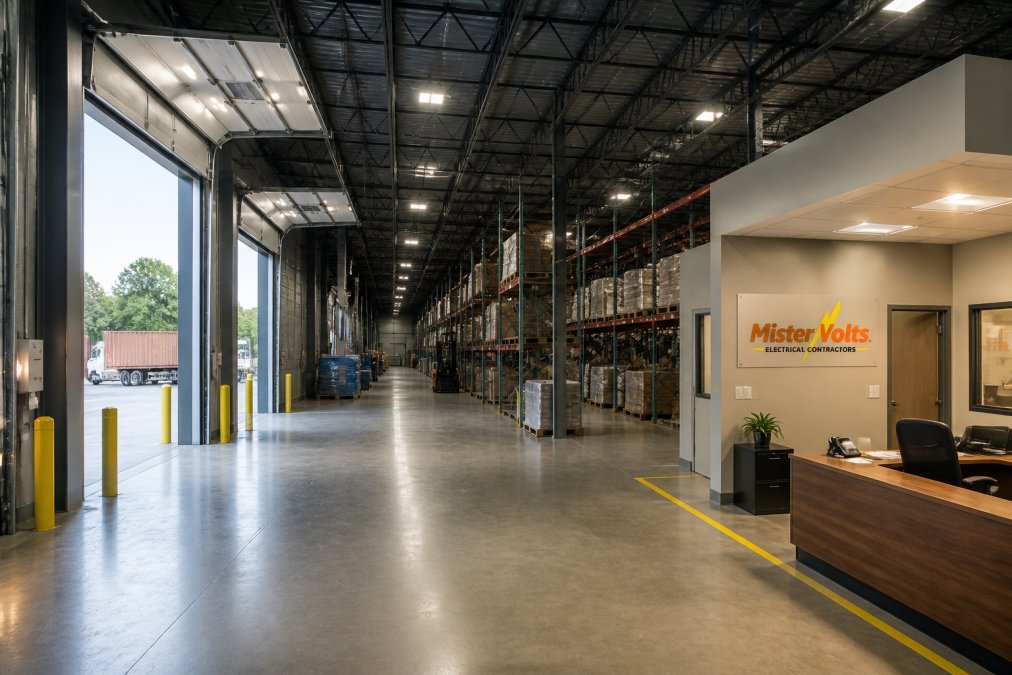
Active picking and storage aisles demand 5000K lighting. The superior visibility helps workers locate items quickly, read shelf labels accurately, and spot damaged goods before they're selected. High-bay fixtures mounted at 25-40 feet provide even distribution across the aisle floor, eliminating dark spots where picking errors occur.
Quality inspection stations require the highest light quality: 5000K with CRI 95 or better.
Frequently Asked Questions
What is the difference between 4000K and 5000K warehouse lighting?
4000K (neutral white) provides a balanced, comfortable light suitable for general warehouse tasks and reduces eye strain during long shifts. 5000K (cool white) offers higher visibility and alertness, making it ideal for precision work, safety-critical zones, and loading docks. The choice depends on your specific tasks: 4000K works well for storage aisles and administrative areas, while 5000K excels in high-activity zones where accuracy and safety are paramount.
Do OSHA standards require a specific color temperature for warehouse lighting?
OSHA does not mandate a specific color temperature. Instead, OSHA requires minimum illumination levels based on task type. The color temperature you choose should support these light levels while enabling workers to see clearly and safely. Cool white (4000K-5000K) is preferred in most warehouses because it delivers the visibility needed to meet OSHA standards without excessive energy use.
How does warehouse lighting color temperature affect worker productivity?
Cool white lighting (5000K) mimics daylight and promotes alertness, which can improve focus and reduce errors during repetitive tasks. Neutral white (4000K) provides comfort without overstimulation, reducing fatigue on longer shifts. Research indicates workers in cool-white environments show faster reaction times and better situational awareness. However, the psychological impact varies: some shift workers find 5000K lighting tiring over extended periods, so many warehouses use a hybrid approach, pairing cool white in high-activity zones with neutral white in rest areas.
What role does Color Rendering Index (CRI) play in warehouse lighting?
Color Rendering Index measures how accurately a light source reveals the true colors of objects, on a scale of 0-100. Warehouse lighting should have a CRI of at least 70, though 80+ is recommended for tasks requiring color accuracy (such as quality inspection or picking orders with color-coded labels). Higher CRI also improves visual comfort and reduces eye strain. When selecting LED fixtures for your warehouse, check both the color temperature and CRI rating to ensure workers can see clearly and safely.