 How-to
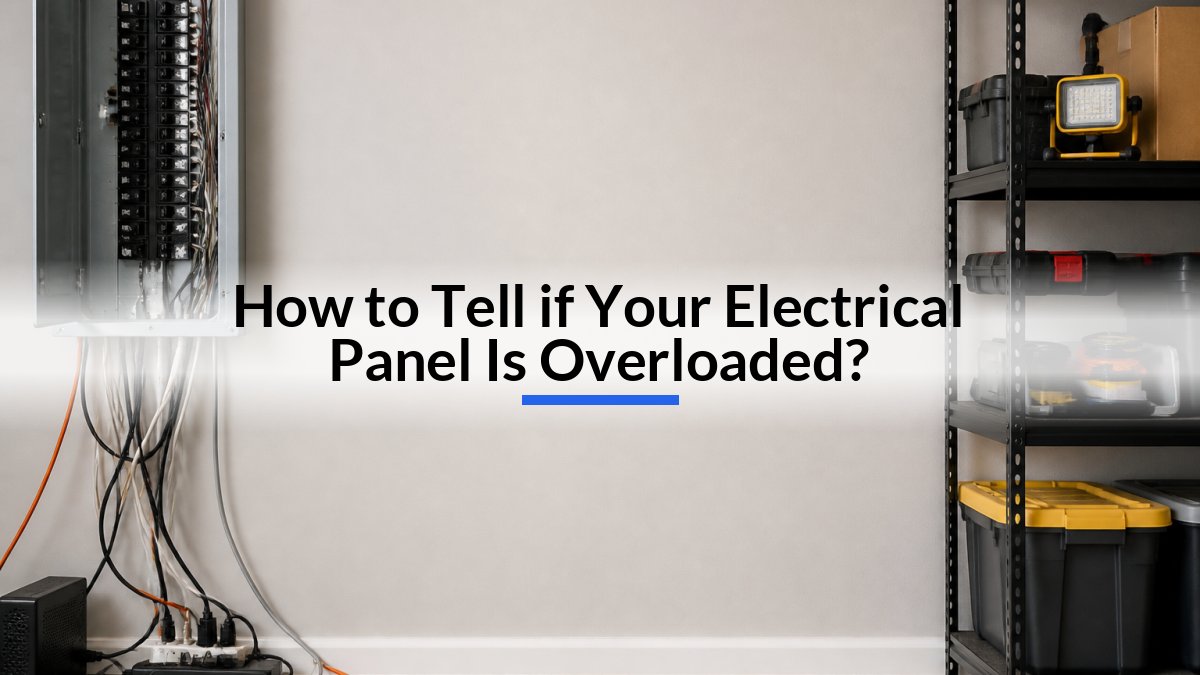
How to Tell if Your Electrical Panel Is Overloaded?
Last Updated: October 25, 2026
Quick Summary
An electrical panel overloaded occurs when your home demands more power than your service panel can safely supply. Warning signs include frequent breaker trips, flickering lights, and burning smells near the panel. If you're resetting breakers more than once or twice per month, have a licensed electrician inspect your panel immediately.
- Most homes built before the 1980s have 100-amp panels; modern homes typically have 200-amp panels.
- A breaker that trips repeatedly is doing its job, but multiple trips per week signal your panel is working beyond capacity.
- Never open your electrical panel yourself; the interior carries live current even when the main breaker is off.
- If your calculated electrical load exceeds roughly 80% of your service rating, your panel is overloaded in practice.
- Federal Pacific Electric Stab-Lok, Zinsco, and Pushmatic panels are known problem types that require professional replacement.
Table of Contents
- What an Overloaded Electrical Panel Means
- Overloaded Electrical Panel Symptoms to Watch For
- Why Your Circuit Breaker Keeps Tripping
- How to Check Your Electrical Panel Capacity
- Signs Your Electrical Panel Needs an Upgrade
- Your service is 100 amps or less and your home has grown
- Your panel is a known problem type
- You cannot add a circuit without a major change
- You are planning a renovation, addition, or electrification project
- How to compare written upgrade bids
- Questions to ask before you hire
- What you should receive at closeout
- Safety Risks of an Overloaded Panel
- When to Call a Licensed Electrician
- Schedule Your Electrical Panel Inspection
- Frequently Asked Questions
What an Overloaded Electrical Panel Means
An electrical panel overloaded situation occurs when your home demands more power than your service panel can safely supply.
Think of it like a water pipe: turn on every faucet at once and the main line gets overwhelmed.
Most homes built before the 1980s have 100-amp panels; modern homes typically have 200-amp panels.
Overloaded Electrical Panel Symptoms to Watch For
The warning signs are usually obvious: flickering lights, burning smells, and tripping breakers. Ignoring them puts your property at risk.
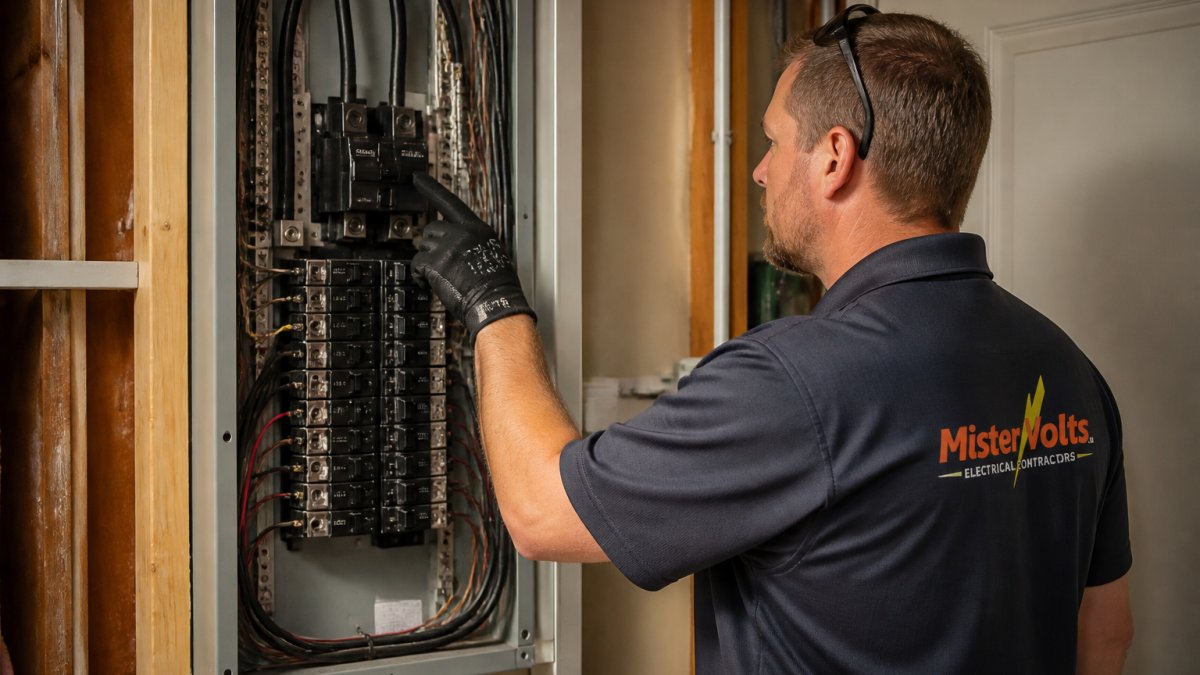
Frequent breaker trips and flickering lights
A breaker that trips repeatedly is doing its job, but repeated trips mean something's pushing your system too hard.
Jim & Sons Electric's guide on overloaded breaker panel warning signs identifies frequent breaker trips as one of the primary indicators that your panel capacity is insufficient.
Burning smells and warm panel surfaces
A burning smell near your panel is a red flag for overheating wires or components, which happens when circuits carry more current than they're designed to handle.
Carefully touch the outside of your panel without opening it.
Watch out: Never open your electrical panel yourself to investigate burning smells or heat. The interior carries live current even when the main breaker is off.
Why Your Circuit Breaker Keeps Tripping
Circuit breakers trip to protect your home. Understanding why helps you tell a simple overload from a deeper panel problem.
A breaker trips when current exceeds its rating, a 20-amp breaker trips above 20 amps, intentionally stopping dangerous overheating before it causes a fire.
If one breaker trips repeatedly when you use one appliance, that circuit is overloaded.
If multiple breakers trip, or if breakers trip even when you're not using many appliances, your main panel is overloaded. Explore overloaded circuits in older homes, which often relates to panel overload issues.
How to Check Your Electrical Panel Capacity
You can perform a basic assessment yourself without opening your panel. The goal isn't to become an electrician, it's to gather specific information for a productive conversation with one.
Step 1: Read your main service panel label
Your panel has a label on its door or just inside showing service capacity in amps, look for "100 amps," "150 amps," or "200 amps." That's the maximum power your utility supplies.
The main breaker matches your service capacity, a 100-amp main breaker means 100-amp service. If the label is faded or missing, photograph the panel interior for a licensed electrician; do not guess.
You can also call your power company, which will tell you your service capacity immediately. Keep that number handy.
Step 2: Build a panel schedule
A panel schedule lists every breaker, its amp rating, and what it controls. If your directory is blank, turn off one breaker at a time and note which outlets go dark, tedious but safe, since you're only operating the handle.
Your schedule should capture:
- The main breaker rating (100, 150, or 200 amps)
- Every branch breaker and its amp rating (15, 20, 30, 40, or 50 amps are common)
- What each circuit serves (kitchen small appliances, laundry, HVAC, water heater, etc.)
A complete schedule turns a vague "my panel feels overloaded" into a specific question: "My 100-amp panel has a 40-amp range breaker, a 30-amp dryer breaker, and a 30-amp AC breaker, can it handle an EV charger too?"
Step 3: Calculate your existing load
Adding up breaker ratings gives the theoretical maximum, but the National Electrical Code uses a service load calculation with demand factors, assuming not every appliance runs at full power at once.
A simplified version you can do yourself:
- General lighting and receptacles: Multiply your home's square footage by 3 volt-amperes (VA) per square foot. A 2,000-square-foot home starts at 6,000 VA.
- Small appliance and laundry circuits: Add 1,500 VA for each of the two required kitchen small-appliance circuits and 1,500 VA for the laundry circuit.
- Fixed appliances: Add the nameplate ratings for the water heater, range, dryer, dishwasher, disposal, and any other permanently connected equipment.
- Apply demand factors: The first 3,000 VA of general load counts at 100%; the remainder from 3,001 to 120,000 VA counts at 35%. Fixed appliances often have their own demand rules.
- Add your largest motor (usually the air conditioner or heat pump) at 25% above its nameplate rating.
- Divide the total VA by 240 volts to get amps.
If your calculated load lands above roughly 80% of your service rating, you are in the danger zone.
National Electrical Code requirements for service capacity sizing provides the technical method licensed electricians use.
Step 4: Compare your load to your lifestyle
The calculation tells you what your home was designed for; your lifestyle tells you what it's actually doing. If you've added a hot tub, EV charger, second refrigerator, or heat pump in the last decade, your real load has grown while your panel has not, that gap defines an overloaded panel.
Signs Your Electrical Panel Needs an Upgrade
Beyond immediate symptoms, certain situations make a panel upgrade necessary. The difference between merely old and genuinely inadequate comes down to specific, checkable conditions, not a gut feeling.
Your service is 100 amps or less and your home has grown
A 100-amp panel was standard before the 1980s, sized for a world without central air, EV chargers, or heat pumps.
A 200-amp service is the modern baseline for a single-family home. Learn what an electrical panel upgrade costs and what to expect from the process. Larger homes with electric heating, multiple HVAC zones, or an EV charger plus a heat pump may need a 320-amp or 400-amp service.
Your panel is a known problem type
Some panels are not just old, they are known to be unsafe or to have failure modes that make them poor candidates for continued service. A licensed electrician will recognize these immediately:
- Federal Pacific Electric (FPE) Stab-Lok panels, breakers that may fail to trip under overload
- Zinsco panels, aluminum bus bars prone to overheating and arcing
- Pushmatic panels, obsolete breakers with limited replacement availability
If your panel is on this list, an upgrade is not optional maintenance, it is a safety correction.
You cannot add a circuit without a major change
A practical test: ask an electrician to add a 240-volt circuit for an EV charger or a 50-amp circuit for a range. If the answer is "we would need to replace the panel first," your panel has reached its practical limit. Panels with no open breaker spaces, or with every space filled by a tandem breaker, are full.
You are planning a renovation, addition, or electrification project
New rooms, appliances, and fuel-switching projects (gas to electric range, furnace to heat pump, solar or battery storage) all increase demand. Solar, EV charger, and heat pump contractors typically require a panel evaluation before warranting their work. Assessing first prevents a mid-project surprise.
How to compare written upgrade bids
Ask for a written bid separating scope, materials, labor, permits, patching, cleanup, and change-order terms. A bid itemizing panel brand and model, conductor size, grounding and bonding, permit, utility disconnect and reconnect, and drywall patching is comparable; a lump sum is not. Compare line by line, the lowest bid often has the most exclusions.
Questions to ask before you hire
A short interview script separates qualified electricians from salespeople:
- Are you licensed in this state, and what is your license number?
- Do you carry general liability insurance and workers' compensation? Can you provide certificates?
- Will you pull the permit, and will the work be inspected?
- What load calculation method will you use, and will you share the result?
- What is included in the bid, and what is excluded?
- How will you handle patching and cleanup?
- What is your change-order process if the job uncovers surprises?
- What warranty do you provide on the panel and on your labor?
Red flags: vague estimates, no license number, reluctance to pull a permit, pressure to decide immediately, and no written contract. A qualified electrician will answer these questions without hesitation.
What you should receive at closeout
After the work is complete, ask for the inspection sign-off, the panel schedule with every circuit labeled, the manufacturer's warranty documentation, and the contractor's labor warranty in writing. These records protect your home's resale value and give the next electrician a clear starting point.
Certain conditions make a panel upgrade necessary, beyond immediate symptoms of overload.
| Condition | Applies If | Action Needed |
|---|---|---|
| Service is 100 amps or less | Home has added central AC, EV charger, heat pump, or similar | Upgrade to 200-amp service |
| Federal Pacific Electric Stab-Lok panel | Breakers may fail to trip under overload | Replace panel for safety |
| Zinsco panel | Aluminum bus bars prone to overheating and arcing | Replace panel for safety |
| Pushmatic panel | Obsolete breakers with limited replacement availability | Replace panel |
| No open breaker spaces available | Every space filled or requires tandem breakers | Panel is full and overloaded |
| Planning renovation, addition, or electrification | Adding rooms, appliances, or switching fuel sources | Assess panel before project |
| Cannot add 240-volt circuit without replacing panel | Electrician says panel replacement required first | Panel has reached practical limit |
Safety Risks of an Overloaded Panel
An overloaded electrical panel isn't just inconvenient, it creates real hazards.
Electrical fires start when wires overheat.
Unstable power damages appliances.
Reduced home value affects resale potential. Buyers and inspectors flag overloaded panels, and many lenders won't finance homes with inadequate service.
Shock and electrocution risk increases when panels are stressed. Overheated components can fail unexpectedly. Worn insulation creates shock hazards.
When to Call a Licensed Electrician
Several situations demand immediate attention from a qualified professional.
Call if you're planning any major electrical work, adding circuits, installing new appliances, or renovating.
Call if your home is older and you've never had the panel professionally inspected.
Call if you're considering solar installation, an electric vehicle charging station, or other high-demand additions.
A licensed electrician brings expertise, proper tools, and knowledge of electrical codes.
Schedule Your Electrical Panel Inspection
Addressing an overloaded electrical panel now prevents bigger problems later. A professional inspection takes a couple of hours and costs far less than electrical damage or a house fire.
Mister Volts provides comprehensive electrical panel inspections and upgrades for residential and commercial properties.
Contact Mister Volts today to schedule your electrical panel inspection. Our team will assess your current capacity, discuss your electrical needs, and provide a clear recommendation.
Frequently Asked Questions
What are the signs of an overloaded electrical panel?
Common signs include circuit breakers that trip frequently, lights that flicker or dim when appliances run, outlets that feel warm to the touch, and a burning smell near the panel. You may also notice that multiple outlets stop working at once. These symptoms indicate your electrical panel is struggling to handle the demand on your electrical system and needs professional evaluation by a licensed electrician.
Can an overloaded electrical panel cause a fire?
Yes. An overloaded panel creates excessive heat that can damage wiring insulation and ignite surrounding materials. This fire hazard is serious and requires immediate attention. If you notice a burning smell, warm panel surface, or frequent breaker trips, stop using high-demand appliances and contact a licensed electrician right away. Do not ignore these warning signs.
Why does my circuit breaker keep tripping?
Circuit breakers trip to protect your home when too much current flows through a circuit. This happens when your electrical panel is overloaded or when individual circuits are drawing more power than they're rated for. Tripping can also result from a short circuit or ground fault. If a breaker trips repeatedly, do not keep resetting it, call a licensed electrician to diagnose the underlying problem and prevent fire hazards.
How can I tell if my electrical panel needs an upgrade?
Your panel may need an upgrade if it's over 20 years old, frequently trips breakers, shows signs of corrosion, or can't handle new appliances or home additions. Older homes with outdated wiring systems or aluminum wiring are also candidates for panel upgrades. A licensed electrician can assess your service capacity and determine whether your current panel meets code compliance and your home's electrical demands.
An overloaded electrical panel puts your home and family at risk. Don't ignore the warning signs. Reach out to Mister Volts and let our licensed electricians ensure your electrical system is safe and adequate for your needs.