 Comparison
LED vs Fluorescent High Bay Lighting: A Comparison
Table of Contents
- LED Versus Fluorescent Lighting Overview
- Energy Consumption and LED High Bay Light Efficiency
- Operating Costs and Energy Savings
- Lifespan, Replacement Frequency, and High Bay Lighting Maintenance
- Light Output, Brightness, and Quality
- High-Bay and Low-Bay Applications With LED Lighting Controls for Warehouses
- Installation, Retrofit Compatibility, and Setup Considerations
- Comparison Table: LED and Fluorescent High Bay Fixtures
- Frequently Asked Questions
Last Updated: October 8, 2026
LED Versus Fluorescent Lighting Overview
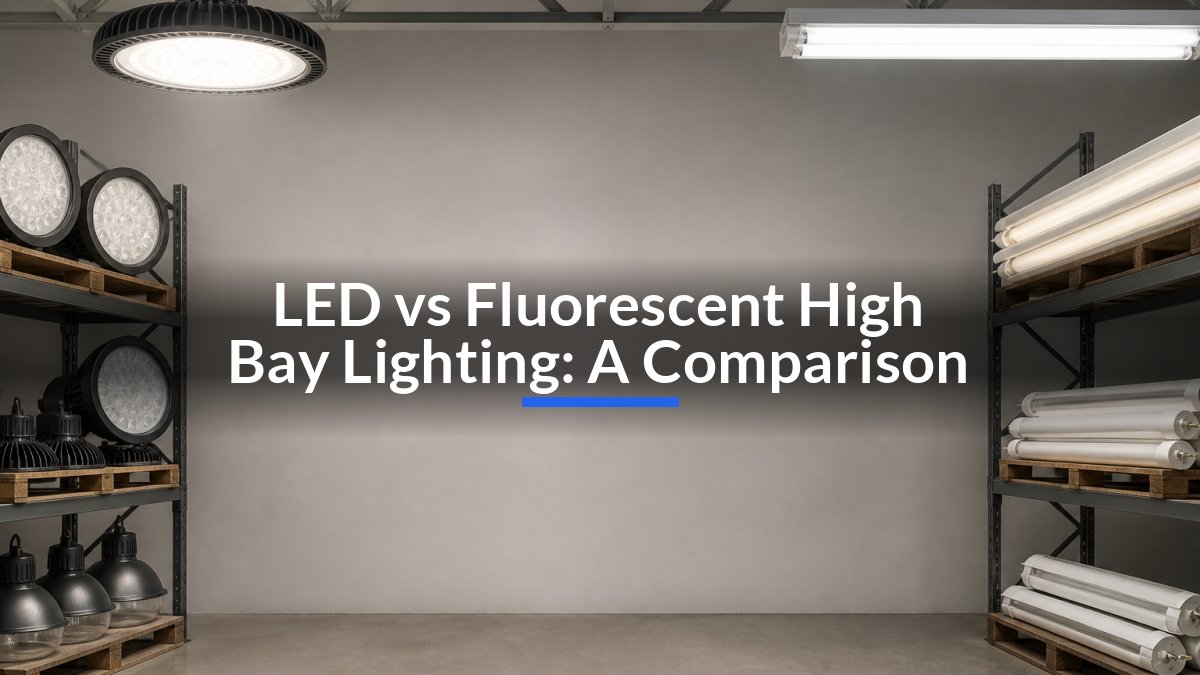
Comparing high bay LED fluorescent lighting means weighing two fundamentally different technologies. Fluorescent fixtures dominated warehouse and factory ceilings for decades, but LED high bay lighting has transformed the landscape.
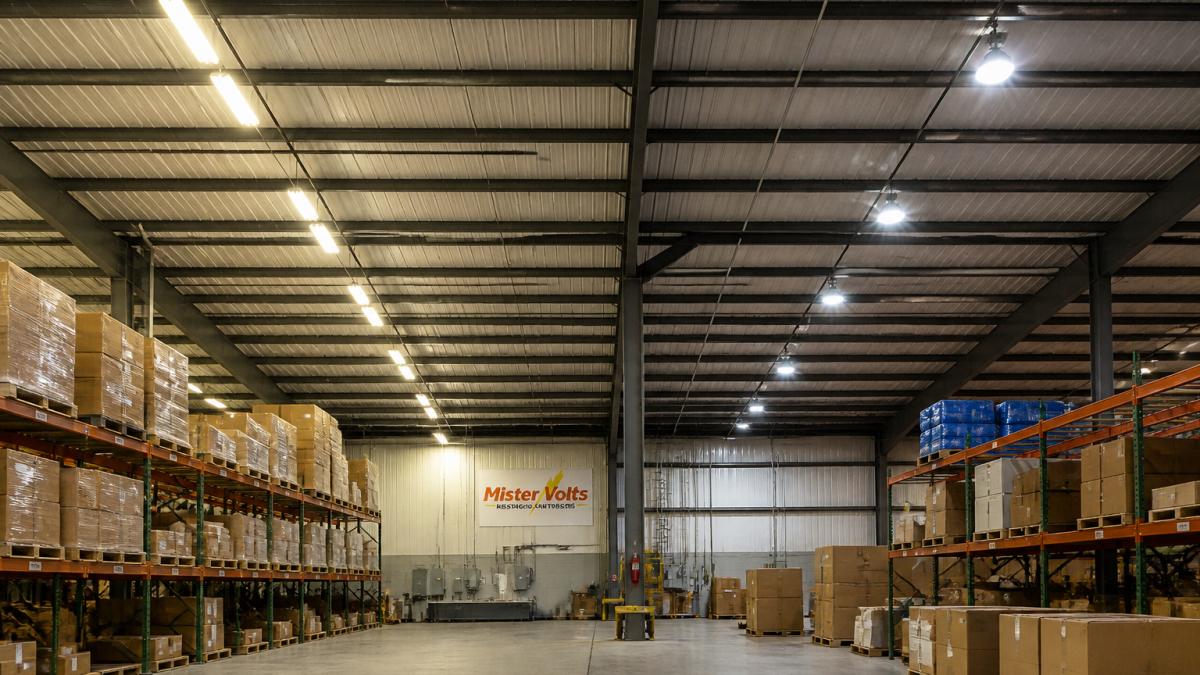
The core difference: fluorescent fixtures use gas-filled tubes and ballasts, while LED high bay lights use semiconductor diodes. That distinction ripples across energy use, lifespan, light quality, and total cost of ownership.
For facility managers and business owners, the choice has real financial and operational consequences. At Mister Volts, we help commercial clients evaluate lighting systems as part of comprehensive electrical upgrades and maintenance planning.
Energy Consumption and LED High Bay Light Efficiency
LED high bay lighting consumes significantly less energy than fluorescent systems for the same light output.
The efficiency advantage compounds over time: fluorescent fixtures lose efficiency as they age, while LEDs maintain consistent output until they near end-of-life.
Warehouse and industrial facilities with high ceilings benefit most. The larger the space and the longer the operating hours, the more dramatic the savings, a 50,000-square-foot warehouse switching from fluorescent to LED high bay lighting could see meaningful reductions in monthly electricity consumption.
Operating Costs and Energy Savings
Operating costs extend beyond electricity: maintenance labor, replacement parts, disposal, downtime, and the productivity cost of dark zones. Fluorescent fixtures require ballast replacements, tube swaps, and scheduled cleaning. LED high bay systems eliminate most of these recurring expenses, but the size of the advantage depends on your operating profile.
A Transparent Payback Framework
Rather than repeating broad claims about savings, build a simple model. Key inputs:
- Fixture count and current wattage, count every fluorescent high bay and note the fixture wattage (including ballast losses, which typically add 10-15% to the lamp rating).
- Operating hours per year, a single-shift warehouse runs roughly 2,000-2,500 hours; a two-shift operation runs 4,000-5,000; a 24/7 facility runs 8,760.
- Utility rate, commercial rates vary widely by region and tariff structure. Check your most recent bill for the blended $/kWh figure rather than assuming a national average.
In warehouse retrofits, the LED fixture typically draws roughly 40-60% of the fluorescent wattage for equivalent delivered light. At 4,000 hours per year, that reduction translates directly into kilowatt-hour savings: (wattage saved × hours × rate). Payback is the upfront cost difference divided by combined annual energy and maintenance savings.
Where the Maintenance Math Bites Hardest
Fluorescent tubes typically need replacement every 20,000-30,000 operating hours, roughly every two years at 16 hours daily. Replacing hundreds of tubes across a large warehouse demands significant labor and disruption, and in high-ceiling spaces that labor often requires scissor or boom lifts, adding rental cost and safety planning to every service call.
Fluorescent systems also carry hidden costs that don't appear on a maintenance log:
- Ballast failures, these occur unpredictably and can leave sections of the floor dark without warning, a safety and productivity issue in active work zones.
- Lumen depreciation, fluorescent output fades gradually, so the space is under-lit long before the tubes actually fail.
- Mercury disposal, spent tubes and ballasts are regulated waste and require proper handling, adding a compliance cost to every replacement cycle.
LED systems need minimal maintenance, primarily cleaning and occasional driver replacement. That reduction in service calls, lift rentals, and parts inventory compounds every year the facility operates.
Rebates and Utility Programs
Many utilities offer prescriptive rebates for qualifying LED high bay retrofits, often calculated per fixture or per watt reduced. These vary by territory, program year, and project type. Before committing to a design, check with your utility's commercial efficiency program and confirm which fixtures and controls qualify, a rebate can shorten payback meaningfully.
Downtime and Operational Cost
One cost that rarely appears in payback models is downtime. Every fixture replacement in a high-ceiling space means blocking off a work area, bringing in a lift, and pulling maintenance staff from other tasks. LED fixtures reduce those events, which is why facility managers often weight maintenance savings more heavily than energy savings after a few replacement cycles.
Lifespan, Replacement Frequency, and High Bay Lighting Maintenance
The lifespan difference between LED and fluorescent high bay fixtures is one of the most compelling reasons to switch.
Fluorescent fixtures in continuous-use industrial settings typically need complete replacement every 2-4 years, including disposal of mercury-containing ballasts and tubes.
Fluorescent ballasts also fail unpredictably, sometimes leaving sections dark without warning.
For facility managers, reduced replacement frequency means fewer service calls, less inventory management, and more predictable maintenance budgets.
Light Output, Brightness, and Quality
Light output in high bay applications is measured in lumens, but lumens alone tell you little about how a space will look and function. The metrics that matter are foot-candles (illuminance at the work surface), uniformity, glare, and beam angle.
Foot-Candles: The Number That Actually Matters
A foot-candle is one lumen per square foot, the unit designers and inspectors use for light reaching the floor. A fluorescent high bay fixture might produce 10,000-15,000 lumens, while an LED equivalent delivers similar or greater output at lower wattage.
Recommended illuminance varies by task. The Illuminating Engineering Society publishes practice guides many designers reference. General orientation:
- General warehouse storage aisles, modest illuminance is usually sufficient for safe navigation and picking.
- Active picking and packing areas, higher illuminance is needed for reading labels, scanning, and accuracy.
- Detailed assembly or inspection, the highest illuminance, often supplemented with task lighting at the bench.
A single fixture type rarely serves every zone in a large facility. Zoning the space and specifying fixtures per zone beats blanketing the ceiling with one SKU.
Uniformity and the Spacing Ratio
Uniformity is the ratio of minimum to average illuminance. A poorly designed layout can hit the target average while leaving dark pockets between fixtures, exactly where workers trip, misread labels, or miss defects.
The spacing-to-mounting-height ratio is the design lever. A narrower beam angle allows wider spacing at a given mounting height, but push the ratio too far and uniformity suffers.
Glare and Beam Angle
Glare is the most common complaint after a high bay retrofit. A bare, high-output LED fixture at 25 feet can be uncomfortable to look at directly, and reflected glare off floors or equipment can be worse. Two design responses help:
- Choose a fixture with a diffused or shielded optic rather than an exposed emitter.
- Match beam angle to mounting height, a narrow beam concentrates light but can create hot spots; a wide beam spreads light but may not reach the floor with enough intensity from very high ceilings.
Fluorescent fixtures typically produce softer, more diffuse light because the source is a long tube rather than a point emitter. That's a genuine advantage in some spaces, and one reason a like-for-like comparison should look at delivered light quality, not just wattage and lumens.
Color Temperature and CRI
Color temperature and color rendering index (CRI) affect how your facility looks and how workers perceive safety and clarity. Fluorescent fixtures typically run 4100K (cool white) or 5000K (daylight) with CRI around 75-85.
Consistency matters too. Fluorescent lamps in the same fixture can drift in color as they age, producing a patchy ceiling. LED fixtures hold their color point much more consistently.
Putting It Together: A Like-for-Like Comparison
The honest way to compare LED and fluorescent high bays is at equivalent delivered illuminance, mounting height, and coverage, not equivalent wattage:
- Define the target foot-candle level for each zone.
- Model the layout with photometric files for both fixture types.
- Compare the number of fixtures, total wattage, and resulting uniformity.
- Check glare and beam angle against the mounting height.
When you run that comparison, LED high bay systems often deliver the same or better lighting quality with fewer fixtures or lower wattage, but the size of that advantage depends on the fixture, ceiling height, and layout. Broad efficiency claims hide the details that determine whether a retrofit actually improves the space.
High-Bay and Low-Bay Applications With LED Lighting Controls for Warehouses
High-bay applications typically involve ceilings 20 feet or higher, common in warehouses, manufacturing plants, and large retail spaces; low-bay fixtures work under 20 feet.
LED high bay systems work well in true high-ceiling environments where efficiency and long lifespan provide maximum benefit.
LED lighting controls for warehouses offer an advantage unavailable with standard fluorescent systems.
Fluorescent fixtures work with some control systems, but compatibility issues and efficiency losses during dimming make them less ideal.
Installation, Retrofit Compatibility, and Setup Considerations
Installing new LED high bay fixtures in an existing facility requires evaluating your current infrastructure.
Retrofit compatibility depends on your fixture type and ceiling structure. Linear high-bay fixtures (long rectangular) mount differently than UFO-style high bays (round domes).
Electrical considerations matter during installation. LED fixtures require drivers (similar to ballasts) that regulate power.
Installation labor costs depend on ceiling height, fixture quantity, and whether existing wiring can be reused.
Comparison Table: LED and Fluorescent High Bay Fixtures
| Factor | LED High Bay | Fluorescent High Bay |
|---|---|---|
| Energy consumption | 100-150W per fixture | 250-400W per fixture |
| Lifespan | 50,000-100,000 hours | 20,000-30,000 hours |
| Maintenance frequency | Minimal, every 10+ years | Every 2-4 years |
| Light output | 10,000-20,000+ lumens | 10,000-15,000 lumens |
| Color temperature | 4100K-5000K available | 4100K-5000K standard |
| Dimming capability | Full range, efficient | Limited, efficiency loss |
| Mercury content | None | Yes, hazardous disposal |
| Upfront cost | Higher | Lower |
| Total cost of ownership | Lower over 10 years | Higher due to replacements |
| Control system compatibility | Excellent | Limited |
The choice between LED and fluorescent high bay lighting ultimately depends on your facility's operational needs, budget constraints, and timeline. LED systems offer superior long-term value through reduced energy consumption, minimal maintenance, and longer lifespan.
For commercial facilities planning electrical upgrades or maintenance contracts, evaluating your lighting system as part of a comprehensive electrical assessment makes sense. Mister Volts specializes in commercial electrical design and installation, helping facility managers in Georgia make informed decisions about upgrades that improve safety, efficiency, and operational reliability.
Frequently Asked Questions
Are LED high bay lights more efficient than fluorescent high bay lights?
Yes. LED high bay fixtures consume significantly less power to produce the same light output as fluorescent alternatives. LEDs convert more electrical energy into visible light rather than heat, resulting in wattage reductions of 40-60% for equivalent brightness. This efficiency difference compounds over years of operation, making LEDs the lower-energy choice for warehouses and industrial facilities running lights for extended hours daily.
How long do LED high bay lights last compared with fluorescent lights?
LED high bay lights typically last 50,000 to 100,000 hours, while fluorescent tubes generally reach 20,000 to 30,000 hours. In a warehouse operating lights 12 hours daily, an LED fixture may run 10-20 years before replacement, whereas fluorescent tubes require replacement every 2-4 years. This extended lifespan reduces labor and material costs associated with frequent maintenance and fixture changes.
What should you consider when choosing high bay lighting for a warehouse?
Evaluate ceiling height, required light output measured in foot-candles or lumens, your operational hours, and total cost of ownership over the fixture's lifespan. High-bay applications (typically 20+ feet) benefit from focused beam angles and high efficiency. Consider whether your facility qualifies for rebates on LED upgrades, the availability of controls like motion sensors or dimming, and whether retrofit compatibility with existing mounting hardware affects installation timelines and costs.
Can you replace fluorescent high bay fixtures with LED lights?
Yes, in most cases. LED high bay retrofits are designed to fit standard mounting hardware used for fluorescent fixtures. However, compatibility depends on your existing ballast type, electrical configuration, and fixture design. Some retrofits require ballast removal or wiring adjustments. A licensed electrician can assess your current setup, confirm compatibility, and handle any modifications needed to ensure safe, code-compliant installation.