 How-to
7 Steps to Build a Commercial Building Maintenance Budget
Last Updated: October 31, 2026
Quick Summary
To create a commercial building maintenance budget, review two to three years of invoices and work orders, inventory and rank your assets by criticality, then forecast costs using a baseline formula with age, history, and criticality adjustments. Add preventive maintenance, contingency reserves of 5-10%, and a separate capital renewal fund, then track variance monthly.
- Pull the last two to three years of invoices, work orders, and service contracts before forecasting.
- Rank assets into critical, important, and deferrable tiers to direct funds where failures hurt most.
- Every $1 in planned maintenance prevents $3 to $5 in emergency spending.
- Set contingency reserves at 5-10% of your annual maintenance budget, higher for older buildings.
- Reforecast quarterly using year-to-date actuals, updated asset condition, and work-order trends.
Table of Contents
- Step 1: Review Historical Spending and Work Orders
- Step 2: Inventory Assets and Rank Criticality
- Step 3: Use a Building Maintenance Cost Formula to Forecast
- Step 4: Build the Preventive Maintenance Budget
- Step 5: Account for Commercial Property Maintenance Costs Beyond Routine Work
- Step 6: Set Contingency Reserves and Separate Capital Renewal
- Step 7: Track Variance and Reforecast with a Facility Maintenance Budget Template
- Put Your Maintenance Budget to Work with Mister Volts
- Frequently Asked Questions
Step 1: Review Historical Spending and Work Orders
A commercial building maintenance budget starts with your own records, not a rule of thumb. Pull the last two to three years of invoices, work orders, and service contracts.
Skipping this step and jumping straight to a per-square-foot guess is a mistake. Your history shows what your building actually costs to run.
Look for patterns:
- Which systems failed more than once?
- Which months carried the heaviest repair load?
- Where did emergency work replace planned work?
For a deeper look at separating planned repairs from larger renovations, see our guide on commercial maintenance planning. Good spend analysis here makes every later step easier.
Step 2: Inventory Assets and Rank Criticality
An accurate budget needs a real asset inventory. List every major building system, then rank each one by how badly a failure would hurt operations.
Start with the big-ticket items:
- Service panels and switchgear
- Electrical meters and distribution equipment
- HVAC units
- Roofing and envelope
- Lighting systems
- Life-safety devices, including smoke and carbon detectors
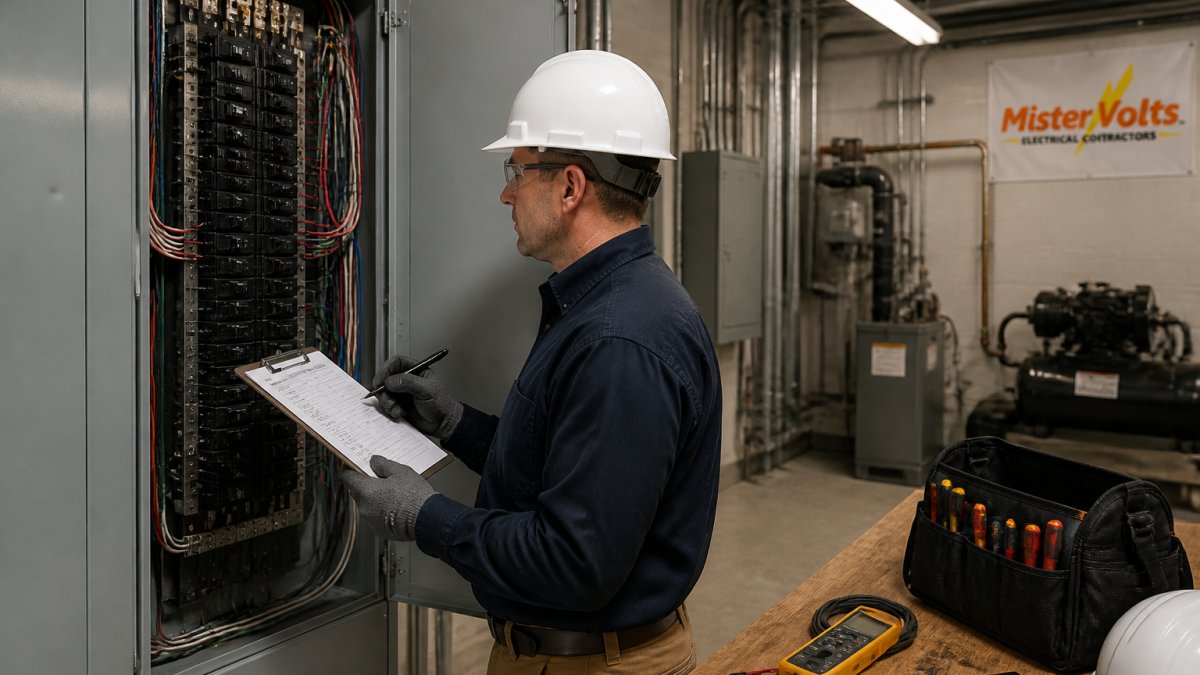
For each asset, record its age, condition, maintenance history, and failure risk. Eptura's budgeting guidance stresses that planning requires visibility into asset condition, maintenance history, and work-order trends (Eptura maintenance budgeting guidance).
Then sort assets into three tiers:
| Tier | Description | Budget Priority |
|---|---|---|
| Critical | Failure halts operations or creates safety hazards | Fund fully, inspect often |
| Important | Failure disrupts work but has backups | Scheduled maintenance |
| Deferrable | Cosmetic or low-impact systems | Monitor and plan |
This ranking drives where your money goes first.
Step 3: Use a Building Maintenance Cost Formula to Forecast
A building maintenance cost formula gives you a starting number, not a final one. The goal is a defensible forecast you can explain to ownership and finance, not a single per-square-foot guess.
Start with a baseline, then layer adjustments on top. Here is a repeatable forecasting method you can apply building by building:
- Baseline: square footage × benchmark rate per square foot
- Age adjustment: add 10-25% for systems past their expected service life
- History adjustment: compare to your Step 1 actuals and reconcile the difference
- Criticality weighting: shift funds toward Tier 1 assets from Step 2
- Planned work add-on: add known projects, compliance testing, and seasonal campaigns
- Contingency: apply a 5-10% reserve (covered in Step 6)
GAF cites a roofing-budget estimate averaging $0.05 to $0.08 per square foot (GAF commercial maintenance budget tips). Treat that as one input, not the whole budget. A roofing line is not an HVAC line, and a benchmark that blends everything hides the assets that actually drive your spend.
Worked example: a 50,000-square-foot building
Assume a 50,000-square-foot commercial building with mixed office and light industrial use, built in the early 2000s, with two HVAC rooftop units past their expected life and a service panel that has had two emergency repairs in the last 18 months. Here is how the forecast comes together:
| Line | Assumption | Annual forecast |
|---|---|---|
| Baseline (all systems) | 50,000 sq ft × $1.20/sq ft blended rate | $60,000 |
| Age adjustment | +15% on aging HVAC and electrical | +$9,000 |
| History reconciliation | Prior-year actuals ran 8% above baseline | +$4,800 |
| Criticality weighting | Shift $6,000 from deferrable to critical | $0 net |
| Planned work add-on | Compliance testing, seasonal changeovers | +$7,500 |
| Contingency | 8% of subtotal | +$6,504 |
| Total forecast | $87,804 |
The blended rate above is an illustrative planning assumption, not a published benchmark. Replace it with your own historical cost per square foot from Step 1, or with a rate your contractor or property manager can defend. The mechanics matter more than the number.
Why the formula alone is not enough
Oxmaint argues that a single per-square-foot figure is not enough. Its guidance recommends starting with a zero-based inventory of assets, each with its own schedule and cost (Oxmaint property maintenance budget guide). We agree. Use the formula as a sanity check, then build from the asset list.
A useful approach is to run the formula first, compare it to history, and investigate any large gap.
Finally, separate operating maintenance from capital renewal in the forecast itself. A roof replacement or service panel upgrade belongs in the capital plan, not the operating maintenance line. Keeping them separate makes the true cost of aging equipment easier to see. Step 6 covers how to keep the two funds distinct.
Step 4: Build the Preventive Maintenance Budget
A preventive maintenance budget funds scheduled work before it becomes an emergency. This is where you assign a maintenance schedule and cost to every asset from Step 2.
Build it in four parts:
- Labor: in-house hours plus contractor rates
- Materials and spare parts: filters, breakers, lamps, belts
- Service contracts: inspections, testing, and scheduled servicing
- MRO inventory: stock you keep on hand for common failures
Oxmaint reports that every $1 in planned maintenance prevents $3 to $5 in emergency spending (Oxmaint on rising commercial maintenance costs). That ratio is the strongest argument for funding prevention first.
Protect this line item when budgets get cut, since preventive work is typically far less costly than emergency repair.
Step 5: Account for Commercial Property Maintenance Costs Beyond Routine Work
Commercial property maintenance costs include more than scheduled service. Budget separately for emergency repairs, seasonal work, and compliance-driven maintenance.
Emergency repairs are unpredictable in timing but predictable in existence. Set a reserve based on your breakdown history.
Seasonal maintenance varies by climate and building use.
Compliance work covers inspections and testing of life-safety systems, including smoke and carbon detectors. Skipping it can create safety hazards.
For properties in the hospitality sector, electrical maintenance carries extra requirements. Our hospitality electrical maintenance guide covers the specifics.
Step 6: Set Contingency Reserves and Separate Capital Renewal
A contingency reserve covers what you cannot forecast. Capital renewal covers what you already know is coming.
Keep them apart. Mixing them hides the true cost of aging equipment.
Contingency reserve: typically 5-10% of your annual maintenance budget. Adjust upward for older buildings or harsh conditions.
Capital renewal: a separate fund for equipment replacement and major system overhauls. Track lifecycle costs for each asset and fund replacements before failure.
Energy upgrades often belong here. Our LED warehouse lighting ROI guide covers the payback math.
Step 7: Track Variance and Reforecast with a Facility Maintenance Budget Template
A facility maintenance budget template turns your plan into a living document. Build one that tracks budgeted versus actual spend by category, asset, and month. The template is not the deliverable, the monthly review habit is.
What the template should contain
At minimum, build these columns and tabs:
- Budget by category: labor, materials and parts, service contracts, MRO inventory, emergency repairs, seasonal work, compliance testing, contingency
- Budget by asset: one row per Tier 1 and Tier 2 asset from Step 2
- Monthly actuals: invoices and work orders coded to the same categories
- Variance column: budget minus actual, in dollars and percent
- Variance reason: a short note on every line that exceeds threshold
- Reforecast tab: year-to-date actuals plus remaining planned work plus updated contingency
Set variance thresholds before the year starts
One approach is to flag any category running well over plan, and any single work order above a set dollar threshold regardless of category. Investigate before it compounds. A 10% overrun in month two is a conversation; a 10% overrun in month eleven is a funding request.
Use three tiers of response:
| Variance | Response |
|---|---|
| Under 5% | Note it, no action |
| 5-10% | Review at monthly meeting, adjust coding or schedule |
| Over 10% | Written explanation, reforecast the category, escalate to budget owner |
Reforecast quarterly with three inputs
Reforecast quarterly using three inputs:
- Year-to-date actuals
- Updated asset condition
- Work-order trends
A reforecast is not a new budget. It is the same plan with better information. Keep the original approved budget visible next to the reforecast so ownership can see what changed and why.
Name an owner and an approval path
Budget ownership matters. Name one person accountable for the number, and set a clear approval path for overspend. A budget nobody owns is a budget nobody follows.
CIM notes that commercial facility maintenance backlogs across the market run into the hundreds of billions of dollars (CIM building maintenance software guide). Deferred work does not disappear. It moves to next year's budget at a higher price.
Communicate the budget to stakeholders
A budget that only the facility team understands will not survive a finance review. Prepare a one-page summary for ownership and finance: total budget, top five cost drivers, contingency level, capital renewal items separated out, and the variance thresholds you will use. Update it quarterly with the reforecast. This summary helps keep your next budget conversation focused.
Put Your Maintenance Budget to Work with Mister Volts
A solid plan only pays off when the work gets done right. At Mister Volts, our licensed electricians handle commercial electrical maintenance, service panel upgrades, and electrical work for facilities in the service area.
We can support your plan with:
- Electrical maintenance contracts for ongoing system care
- Code-compliant inspections and repairs
- Electrical design for renovations and upgrades
See our commercial electrical services to learn how we support facility teams. Ready to talk through your plan? Start with a conversation about your building's electrical needs.
Frequently Asked Questions
What should a commercial building maintenance budget include?
A complete maintenance budget covers routine and preventive maintenance, labor and contractor costs, materials and spare parts, emergency repairs, and a contingency reserve. It should also separate capital renewal from operating maintenance so equipment replacement does not drain the annual budget. Start with an asset inventory, assign each asset a schedule and cost, then layer in seasonal work and a reserve for unexpected failures. Reviewing work orders and historical spending keeps the figures grounded in real building data.
What is the formula for calculating maintenance costs?
A workable building maintenance cost formula is: forecast cost = (asset count x average service cost x service frequency) + historical emergency spend + contingency reserve. For example, if you service 40 assets twice a year at an average of $150 each, that is $12,000 before emergency and reserve figures. Adjust the assumptions each year using actual work-order data, and treat any broad per-square-foot benchmark as a starting reference rather than a finished number.
How much should a commercial property reserve for unexpected repairs?
There is no single figure that fits every building. A common approach is to base the contingency reserve on historical emergency spending and the failure risk of critical assets, then adjust for building age and condition. Eptura's budgeting guidance emphasizes balancing cost with risk and performance, so prioritize critical systems like service panels and circuit breakers. Review the reserve quarterly and increase it when work-order trends show rising breakdowns.
How can a preventive maintenance budget help control building costs?
A preventive maintenance budget shifts spending from reactive repairs to scheduled service. Planned maintenance can prevent more costly emergency spending. Scheduling inspections for electrical panels, meters, and safety devices catches problems before they cause downtime. Track completed preventive work orders against emergency calls each year to see whether the budget is doing its job.
Building a maintenance budget takes real work, and finding an electrical partner you can rely on takes the same care. Mister Volts brings licensed electricians, competitive quotes, and NEC-compliant work to every commercial job. Get started with Mister Volts and put your maintenance plan into action with electrical work you can trust.