 Ultimate guide
How to Tell If Knob and Tube Wiring Affects Your Home Appraisal
Quick Summary
Yes, knob and tube wiring can lower a home's appraised value and slow a sale. Buyers often discount properties with visible safety concerns, and some insurers may refuse coverage while the system remains in place. Loan type also matters, since FHA and VA appraisers may require repairs before closing.
- Appraisers note knob and tube wiring in their report, and that note can influence the price buyers offer.
- Some insurance providers deny coverage for homes with active knob and tube wiring, which can kill a deal.
- FHA appraisers may require electrician evaluation under FHA Minimum Property Requirements before closing.
- Dead knob and tube is not automatically harmless, and some carriers still decline or surcharge if old wiring remains visible.
- Never add insulation over active knob and tube wiring, because heat cannot dissipate and the fire risk is serious.
Table of Contents
- What Knob and Tube Wiring Is and Why Appraisers Notice It
- How Knob and Tube Wiring Affects Appraisal Value
- Insuring a Home with Knob and Tube Wiring
- How FHA and VA Loan Underwriting Treats Older Wiring
- Knob and Tube Wiring Replacement Cost and What Drives It
- NEC Electrical Safety Standards for Older Homes
- Booking a Wiring Assessment Before You List or Buy
- Frequently Asked Questions
How to Tell If Knob and Tube Wiring Affects Your Home Appraisal
Last Updated: November 4, 2026
What Knob and Tube Wiring Is and Why Appraisers Notice It
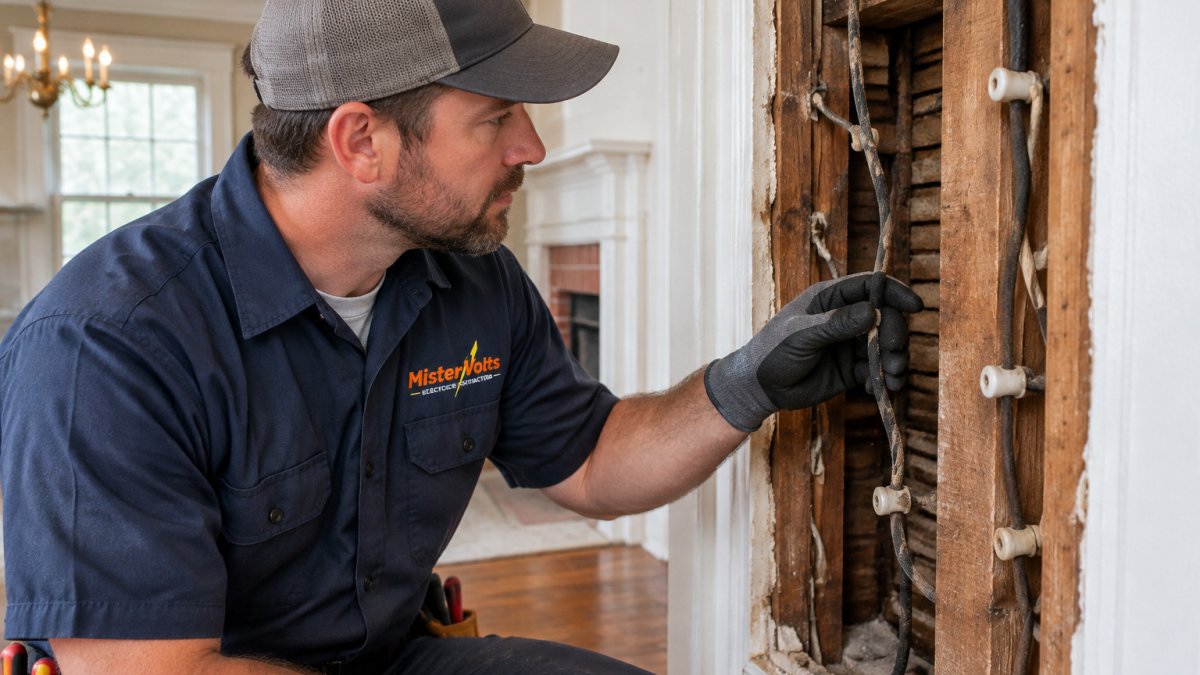
Knob and tube wiring is an early electrical system that carried current through individual copper conductors run along wooden framing, insulated with cloth or rubber and supported by porcelain knobs and tubes. Many American homes built before the 1940s still have some of it, and appraisers are trained to notice it. It often comes up during a home sale.
The system was designed for lighting and light loads, not the air conditioners, space heaters and kitchen appliances most homes run today. Our safety guide on using old wiring with modern appliances covers what current loads mean for these systems. That mismatch is the main reason buyers and lenders take it seriously. Appraisers look at wiring as part of overall condition and safety, and an older system can lower what a home is considered worth.
How Knob and Tube Wiring Affects Appraisal Value
Knob and tube wiring can lower a home's market value, and buyers often discount properties with visible safety concerns. The effect is not automatic, but it is common enough that sellers should expect questions about it. Appraisers note the system in their report, and that note can influence the price a buyer is willing to pay.
Time on the market matters too. Homes with knob and tube wiring can stay on the market longer, which means carrying costs for the seller grow while the home sits. Some buyers also ask for price reductions to cover remediation, so treat such requests as a sign of negotiating pressure rather than a fixed rule.
Why the 10 to 15 Percent Estimate Varies by Property
The range exists because no two houses carry the same risk. A partial system in an attic or a single run feeding a basement light affects value far less than wiring that runs through the whole house and into the panel. Location, the strength of the local buyer pool, and whether the rest of the home has been updated all shift the result. A recently remodeled kitchen with newer circuits may soften the impact, while an otherwise original home usually takes a deeper discount.
Insuring a Home with Knob and Tube Wiring
Insurance is often where a sale stalls. Some insurance providers deny coverage for homes with active knob and tube wiring. A buyer who cannot get a policy cannot close, so this issue can kill a deal even when the appraisal comes in fine.
Before listing, ask an agent to confirm which carriers in your area will write a policy with the wiring in place. Some carriers may reconsider once the system has been partly or fully replaced and documented by a licensed electrician. Keep permits and inspection reports on file, since they give an underwriter something concrete to review.
How FHA and VA Loan Underwriting Treats Older Wiring
Loan type changes the picture more than most sellers expect, because government-backed programs do not just care whether the wiring works, they care whether the property meets the program's minimum property standards. That is a different question from market value, and it is where deals most often stall.
For FHA-insured loans, the appraiser completes the appraisal on a form that includes the FHA Minimum Property Requirements. Those requirements focus on safety, soundness, and security, and visible knob and tube wiring is a common trigger for the appraiser to require further inspection by a licensed electrician. The appraiser is not the electrician and does not certify the system; instead, the report typically conditions the appraisal on a professional evaluation or repair. If the electrician finds exposed splices, missing grounding, or insulation in contact with active conductors, the lender may require remediation before closing.
VA loans work differently. The U.S. Department of Veterans Affairs does not prohibit knob and tube wiring outright, and VA guidance allows the system when it is in safe working condition. The VA appraiser issues a Notice of Value, and that document can include repair requirements the veteran and seller must satisfy before the loan is guaranteed. In practice, VA appraisers tend to focus on whether the system is functioning and safe rather than whether it is modern. That said, individual lenders can layer on stricter overlays, and a lender's underwriter may still require documentation from a licensed electrician.
Conventional loans are not exempt. Fannie Mae and Freddie Mac appraisal forms include a section on physical deficiencies, and an appraiser who notes knob and tube wiring can prompt the underwriter to require a repair or an inspection. The practical takeaway is the same across programs: get the electrical assessment in writing before the appraisal is ordered, so the appraiser and underwriter are working from documented facts rather than a visual guess.
Watch out: do not assume a VA or FHA appraisal that comes in at value means the wiring issue is resolved, the Notice of Value or appraisal condition can still require repairs after the value is set.
Loan type changes the picture more than most sellers expect. Here is how the main programs handle knob and tube wiring.
| Loan type | How it treats older wiring | What to do |
|---|---|---|
| FHA | Appraiser may require electrician evaluation under FHA Minimum Property Requirements | Get electrical assessment in writing before appraisal |
| VA | Allowed when in safe working condition; Notice of Value can require repairs | Ask lender early about overlays on older wiring |
| Conventional (Fannie Mae / Freddie Mac) | Physical deficiencies section can prompt repair or inspection | Document findings before appraisal is ordered |
Knob and Tube Wiring Replacement Cost and What Drives It
Most guides either skip the number or quote a single national average that does not survive contact with a real house. The honest answer is that replacement cost is driven by a handful of physical variables, and the biggest one is how much of the system is actually still live.
The cost of a rewire depends on square footage, the number of circuits, and how much finished wall and ceiling must be opened. A partial rewire, replacing only the circuits that are still active, is generally less involved than a full rewire, which is why it is the option many sellers ask about first. The catch is that a partial rewire does not always satisfy insurers or appraisers, because the remaining dead wiring can still be flagged on an inspection report. That is the partial-rewire myth worth naming: dead knob and tube is not automatically harmless, and some carriers will still decline or surcharge a policy if any of the old system remains visible.
The cost drivers, in rough order of impact, are:
- Access and wall openings. Wiring fished through finished plaster or drywall requires patching and painting, and those trades add cost beyond the electrical work itself.
- Insulation in the cavities. Blown-in insulation must be moved or replaced to reach the conductors, and insulation in contact with active knob and tube is a fire concern that must be corrected.
- Panel and service capacity. Older homes often need a panel upgrade and a new service drop to support modern circuits, and that work is priced separately from the rewire.
- Number of circuits and devices. More outlets, dedicated kitchen and laundry circuits, and GFCI protection all add labor and material.
- Permits and inspection. Most jurisdictions require an electrical permit and inspection for a rewire, and the permit and inspection fees are part of the project budget.
Request a written, itemized estimate that separates the electrical labor, the patching and painting, the panel work, and the permit fees, so you can compare scope rather than just the bottom-line number. A quote that does not itemize is hard to compare against a second bid.
Watch out: a very low rewire quote often assumes the wiring is accessible from an attic or basement and excludes patching, so confirm in writing what the price does and does not include before you compare bids.
NEC Electrical Safety Standards for Older Homes
The National Electrical Code (NEC), published by the National Fire Protection Association, sets the safety standards that modern electrical work must meet (NFPA 70, National Electrical Code (NEC)). Knob and tube wiring predates current grounding and circuit requirements, which is why it is flagged during inspections. Existing knob and tube is generally not illegal to keep in service, but it cannot be extended or spliced into modern circuits without meeting current code, and insurers and lenders weigh that gap heavily. Modern circuit breakers and a properly sized service panel are part of what brings an older home back in line with current code. Our list of signs your home needs electrical rewiring helps you recognize when the wiring has become a hazard.
Watch out: never add insulation over active knob and tube wiring. Heat cannot dissipate properly, and that is a fire risk that inspectors and insurers both flag immediately.
Booking a Wiring Assessment Before You List or Buy
A professional assessment is the fastest way to learn how much knob and tube wiring affects your specific home. A licensed electrician can map which circuits are still original, test the panel, and tell you whether partial replacement or a full rewire makes more sense. You can start by reviewing our trusted electricians for your home for residential service in the Macon area.
Once you have the findings in writing, you can share them with your agent, your insurance carrier and your lender before you list. Get the assessment early so you negotiate from facts, not from the buyer's inspection report.
For a deeper look at insurability, our knob and tube wiring insurance requirements guide explains what carriers typically ask for. When you are ready to plan the work, our knob and tube wiring replacement cost guide breaks down the main drivers. Mister Volts can walk you through the options and provide a written quote.
Frequently Asked Questions
Does knob and tube wiring automatically lower a home's appraisal value?
Not automatically. An appraiser weighs the wiring alongside the home's age, condition, and local comparable sales. Industry sources suggest that knob and tube wiring can reduce a home's value, but that effect reflects buyer and market perception rather than a fixed appraisal rule. Appraisers may note the wiring as a condition issue, and lenders may then ask for documentation of a safety assessment or repairs before approving the loan.
Why do insurance companies dislike knob and tube wiring?
Insurers view the wiring as a fire risk because it has no grounding conductor, its cloth or rubber insulation can degrade over decades, and it often runs through insulation that traps heat. Some insurance providers deny coverage for homes with active knob and tube wiring. Homeowners who cannot get coverage may be unable to close, so confirming insurability early in a sale or purchase is important.
Can I get a mortgage on a house with knob and tube wiring?
Often yes. VA loans may allow financing when the system is in safe working condition, though individual underwriting guidelines vary. FHA and conventional lenders may require an electrician's report or proof of partial or full rewiring. Asking your lender for its specific requirements before you make an offer can prevent delays at closing.
Is knob and tube wiring considered a safety hazard under NEC standards?
The National Electrical Code does not require existing knob and tube wiring to be removed, but it sets requirements for new construction and modifications that older systems do not meet, including grounding and modern circuit protection. Knob and tube is generally not banned outright where it already exists. Because the wiring can deteriorate and older systems often lack grounding, a licensed electrician should evaluate it. Mister Volts provides electrical assessments for homes in Macon, Perry, and surrounding Georgia communities, and pricing depends on the scope of the work, so request a quote through https://mistervoltsusa.com/contact.