 Ultimate guide
Why Office Building Electrical Code Compliance Matters
Table of Contents
- Why Electrical Code Compliance Matters for Office Buildings
- The Safety Risks of Noncompliance
- Commercial Electrical Safety Inspections: What They Reveal
- Commercial Electrical Inspection Checklist for Facility Managers
- Common Electrical Code Violations in Office Spaces
- Electrical Maintenance for Commercial Buildings: Staying Current
- Who's Responsible for Compliance
- The Business Case for Compliance
- Frequently Asked Questions
Last Updated: October 10, 2026
Why Electrical Code Compliance Matters for Office Buildings
Electrical code compliance isn't optional, it's the foundation that keeps your office safe, operational, and legally protected. When building owners, facility managers, and business operators ignore electrical code requirements, they expose their properties to fire hazards, electrical shocks, equipment damage, and costly downtime. Understanding why office building electrical code compliance matters helps you make informed decisions about maintenance, inspections, and upgrades.
The National Electrical Code (NEC) sets the minimum standards for electrical installation and safety across the United States (Learn More About NFPA 70, National Electrical Code (NEC)). These standards evolve every three years to reflect new technology, research on hazards, and lessons learned from real-world failures. Your local jurisdiction may adopt the current NEC or an earlier version, and many states and municipalities layer additional requirements on top. Staying current with electrical code compliance protects your business operations, reduces liability, and ensures your facility meets legal obligations.
At Mister Volts, we help commercial property owners understand their compliance responsibilities and execute the inspections and upgrades needed to meet them. Our licensed electricians work with facility managers to identify code violations, recommend corrective actions, and implement safe, reliable electrical systems that keep your office running smoothly.
The Safety Risks of Noncompliance
Ignoring electrical code requirements creates immediate and ongoing hazards. Noncompliance isn't a minor administrative issue, it directly increases the risk of fires, electrical shock, equipment damage, and business disruption. Understanding these risks clarifies why compliance matters beyond just "following the rules."
Electrical fires and shock hazards
Electrical fires start when wiring, connections, or equipment fail to meet safety standards. Overloaded circuits, outdated wiring, improper grounding, and faulty connections all create conditions where heat builds up, insulation breaks down, and fire ignites. In an office setting, a fire can spread rapidly through walls, ceilings, and equipment, destroying property and threatening lives.
Electrical shock hazards arise when exposed conductors, damaged insulation, or improper grounding create paths for current to flow through a person's body. Workers touching equipment, water, or metal surfaces in a noncompliant electrical system can suffer injury or death. Shock hazards are particularly dangerous in break rooms, restrooms, and areas near water sources where moisture increases conductivity.
Outdated wiring and overloaded circuits
Many office buildings still rely on wiring installed decades ago. Older wiring was designed for lower electrical loads, the building's original occupants used fewer devices, smaller motors, and less-intensive equipment. Today's offices demand far more power: multiple computers per workstation, high-capacity printers, HVAC systems, LED lighting, and increasingly, EV charging stations.
Overloaded circuits force current through wires and connections that weren't designed to handle it. The wires heat up, insulation degrades, connections loosen, and failure becomes inevitable. Overloaded circuits also trigger breakers to trip, causing power outages that disrupt work, damage unsaved data, and frustrate employees. In severe cases, overloaded circuits create fire hazards before the breaker ever trips.
Commercial Electrical Safety Inspections: What They Reveal
A professional electrical inspection identifies code violations, safety hazards, and system deficiencies before they cause fires, shocks, or outages. Inspections are the primary tool for understanding your facility's electrical compliance status and planning corrective actions.
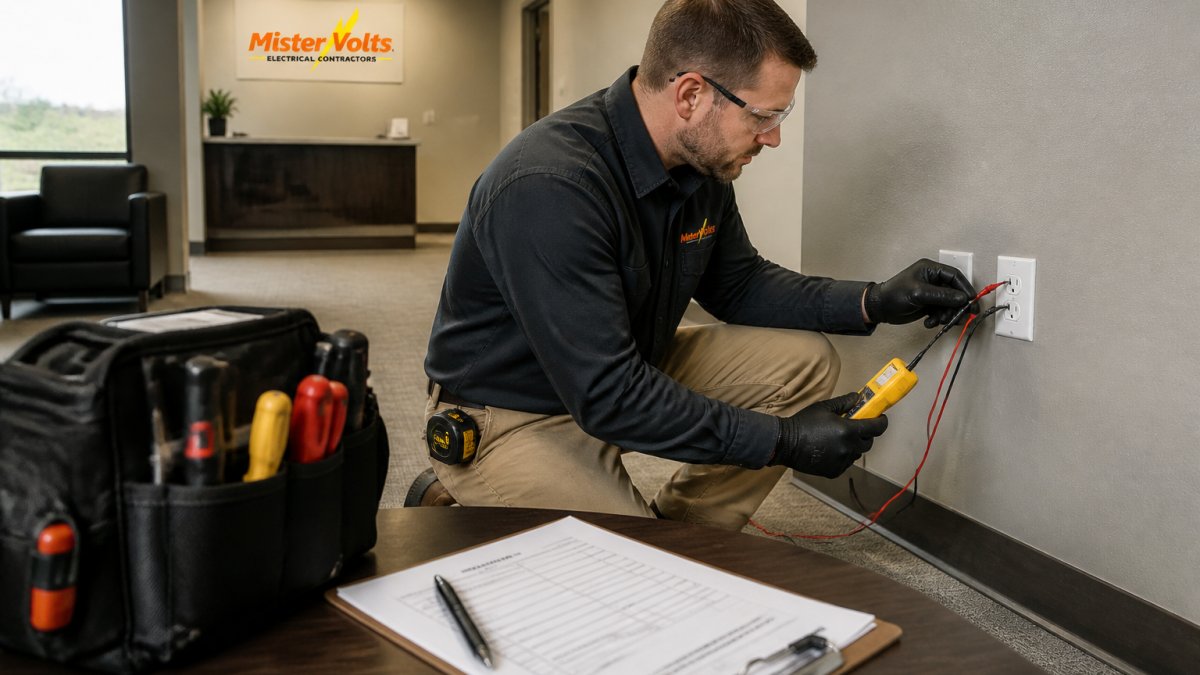
Commercial electrical safety inspections examine the entire electrical system: service panels, circuit breakers, wiring, outlets, switches, grounding systems, bonding connections, emergency systems, and life-safety equipment like smoke detectors and fire alarms. Inspectors test for proper voltage, verify that breakers trip at rated current, check for loose connections, confirm that outlets are properly grounded, and assess whether the system meets current NEC standards and local codes.
A thorough inspection reveals deferred maintenance issues that create hazards. Corroded connections increase resistance and heat generation. Loose breaker connections cause intermittent power loss and fire risk. Improperly installed outlets lack proper grounding or polarity. Missing or damaged insulation exposes live conductors. Undersized wiring creates overload conditions. These defects don't announce themselves, they only become visible during a professional inspection.
Commercial Electrical Inspection Checklist for Facility Managers
Use this checklist to prepare for an inspection and track your facility's compliance status. This checklist covers the key elements inspectors examine and helps you understand what questions to ask your electrician.
| Inspection Item | What to Check | Why It Matters |
|---|---|---|
| Service entrance and main panel | Proper sizing, labeling, accessible clearance, no corrosion | Ensures safe disconnect and circuit protection |
| Circuit breakers | Correct amperage, proper trips, no double-tapping, secure connections | Prevents overloads and fire hazards |
| Wiring and cables | Proper gauge, insulation intact, supported correctly, no damage | Ensures current flows safely without overheating |
| Outlets and switches | Proper grounding, correct polarity, GFCI protection where required, secure installation | Reduces shock hazards and electrical fires |
| Grounding and bonding | Continuous paths, proper connections, low resistance | Protects equipment and personnel from faults |
| Emergency systems | Backup power functional, exit lighting operational, fire alarms connected | Ensures occupant safety during outages |
| Overcurrent protection | Breakers and fuses correctly rated, no bypasses, proper coordination | Prevents fires and equipment damage |
| Conduit and cable trays | Properly supported, no sharp bends, secured to structure, corrosion-free | Protects wiring and maintains system integrity |
Before your inspection, document any known issues: outlets that don't work, breakers that trip frequently, buzzing sounds from outlets or panels, flickering lights, or areas where you've added equipment. Share this list with your inspector, it helps them prioritize and investigate specific concerns.
Common Electrical Code Violations in Office Spaces
The same violations appear repeatedly in office buildings across different industries and regions. Recognizing these common issues helps you spot problems in your own facility and understand why your electrician recommends specific upgrades.
Inadequate outlet spacing: The NEC requires outlets spaced no more than 6 feet apart along walls in office spaces.
Missing GFCI protection: Ground-fault circuit interrupter (GFCI) outlets are required in break rooms, restrooms, and any area within 6 feet of a water source. GFCI outlets detect ground faults and cut power in milliseconds, preventing electrocution.
Improper grounding: Older wiring systems may lack proper grounding conductors or have corroded grounding connections. Ungrounded outlets and equipment increase shock hazard and prevent proper operation of surge protection and safety devices.
Overloaded circuits: When too many devices connect to a single circuit, the circuit breaker trips repeatedly or fails to trip when it should. Overloaded circuits create fire hazards and cause chronic power outages.
Outdated or missing emergency systems: Life-safety systems, exit lighting, emergency generators, backup power, must meet current NEC standards. Many buildings have outdated equipment that no longer functions reliably.
Electrical Maintenance for Commercial Buildings: Staying Current
Preventive maintenance keeps your electrical system safe, reliable, and compliant. Rather than waiting for failures or violations to surface during an inspection, proactive maintenance addresses issues before they become hazards.
Establish an electrical maintenance schedule that includes annual inspections of critical equipment, quarterly checks of outlets and switches for damage or corrosion, and immediate attention to any signs of trouble: buzzing, burning smells, flickering lights, warm outlets, or frequent breaker trips. Document all maintenance work and keep records for your facility file.
Electrical maintenance for commercial buildings also means staying current with code changes. The NEC updates every three years, and local jurisdictions may adopt new standards. When your local code adopts new requirements, for example, new standards for EV charging stations or updated emergency system specifications, you have a compliance deadline. Working with a qualified electrician helps you understand which upgrades apply to your facility and when they're required.
Many facility managers find that establishing an electrical maintenance contract with a qualified electrician provides peace of mind and ensures consistent attention to system health. Regular maintenance reduces the risk of unexpected failures, extends equipment life, and helps you stay ahead of code compliance requirements.
Who's Responsible for Compliance
Electrical code compliance is a shared responsibility that depends on your role and your facility's structure. Understanding who bears responsibility helps clarify your obligations and ensures the right people take action.
Building owners bear ultimate legal responsibility for electrical code compliance. Owners must ensure their facilities meet code requirements and remain safe for occupants.
Facility managers typically manage day-to-day operations and coordinate maintenance. Facility managers should know their facility's compliance status, schedule inspections, and work with qualified electricians to address violations.
Tenants in leased office spaces have limited responsibility for code compliance but should report electrical hazards to their landlord immediately. Tenants should not attempt to fix electrical problems themselves or authorize electrical work without the landlord's involvement.
Electrical contractors and licensed electricians must follow the NEC and local codes when performing installation and maintenance work. They're responsible for ensuring their work meets code requirements and for informing owners and managers of violations they discover.
When responsibility is unclear, particularly in multi-tenant buildings or complex leasing arrangements, the solution is clear communication. Establish written agreements that specify who is responsible for inspections, maintenance, and corrective actions. This prevents misunderstandings and ensures compliance work gets completed.
The Business Case for Compliance
From a purely financial perspective, electrical code compliance reduces costs and protects revenue. The upfront investment in inspections, upgrades, and maintenance is far smaller than the cost of electrical fires, equipment damage, business interruption, and legal liability.
Electrical fires destroy property, disrupt operations, and create liability exposure. A fire in an office building can force evacuation, shut down operations for days or weeks, damage equipment and data, and result in injury claims.
Power outages from overloaded circuits, failed equipment, or system failures cost businesses money directly: lost productivity, damaged equipment, lost data, and customer service interruptions. Businesses that depend on continuous power, data centers, financial institutions, healthcare facilities, face particularly severe costs from outages.
Legal liability and fines represent another cost category. Building code inspectors, insurance companies, and regulatory agencies can impose fines for violations.
The investment in electrical code compliance typically pays for itself through reduced insurance premiums, avoided fines, prevented outages, and reduced liability exposure. Mister Volts helps facility managers and business owners understand these costs and make informed decisions about inspections and upgrades.
Electrical code compliance is not a one-time checkbox, it's an ongoing commitment to safety, reliability, and legal protection. Mister Volts provides comprehensive electrical inspections, identifies code violations, and recommends corrective actions tailored to your specific facility. Our licensed electricians work with you to plan and execute upgrades that keep your office safe, compliant, and fully operational. Contact Mister Volts today to schedule an inspection and discuss your facility's electrical compliance needs.
Frequently Asked Questions
Why is electrical code compliance important in an office building?
Electrical code compliance protects occupant safety, prevents fires and electrical hazards, and ensures your building meets National Electrical Code (NEC) standards. Noncompliance creates liability for building owners, increases insurance risk, and can lead to fines or forced shutdowns. Compliance also maintains operational continuity, outdated or unsafe wiring causes power outages and equipment damage that disrupt business.
What are common electrical code violations in office buildings?
Common violations include outdated wiring that can't handle modern electrical loads, overloaded circuits lacking proper breaker protection, missing or inadequate grounding, improperly installed outlets near water sources, and emergency systems that don't meet life-safety requirements. Many offices also fail to maintain inspection records or delay corrective actions after inspections identify hazards.
How often should an office building's electrical system be inspected?
Most commercial buildings should have electrical inspections every 3-5 years, though older buildings or those with heavy equipment loads may need annual inspections. After any major renovation, system upgrade, or code change, a fresh inspection is essential. Facility managers should also schedule inspections if equipment damage, power outages, or safety concerns arise.
Who is responsible for electrical code compliance in a commercial building?
Building owners hold primary responsibility for compliance, but facility managers, landlords, and tenants all play a role. Owners must ensure systems meet NEC standards and arrange inspections; facility managers oversee maintenance and document compliance; tenants must report hazards. Qualified electricians and contractors execute upgrades and repairs to code specifications.